Underrepresented and overaffected: Newcomers and the referendum
The Social Impact Collective and School of Public Health's DIAG held a discussion about the impacts of the referendum questions focused on immigration.

 Leah Hennig
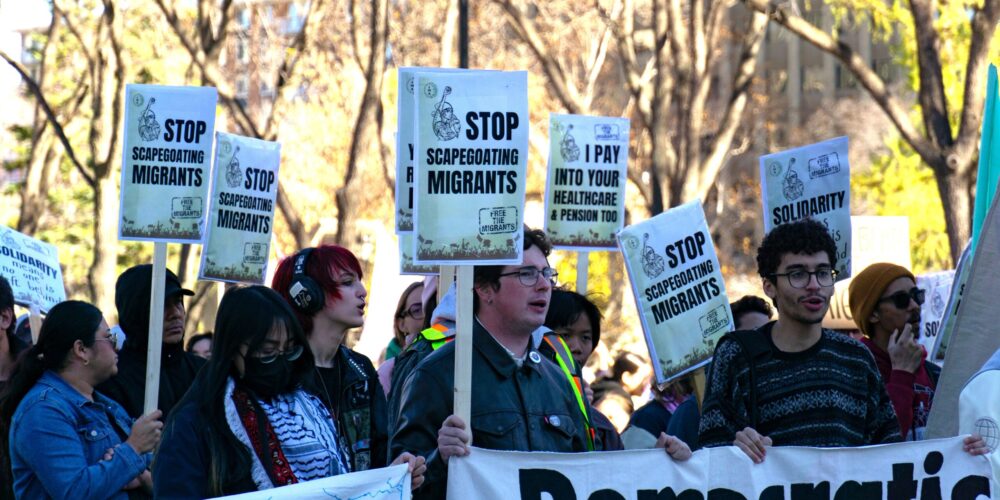
On October 16, ahead of the referendum, there was an online discussion on how the first five questions impact newcomers and racialized Albertans. The event was organized by the University of Alberta’s School of Public Health Diversity and Inclusion Action Group (DIAG) and Social Impact Collective.
The questions asked whether Albertans supported restricting temporary residents’ access to public services, including health care and education. The two other questions asked about support for the Government of Alberta restricting immigration to the province and requiring proof of citizenship when voting.
Unofficial results show the majority of Albertans voted in support of the immigration questions.
The discussion was led by Ashima Sumaru-Jurf, Ayan Sanchez, and Roxanne Felix-Mah. They focused on facilitating discussion rather than telling people how to vote, and looking at how the questions will affect people beyond the referendum.
Policies restricting newcomers’ rights aren’t new, Sumaru-Jurf says
Sumera-Jurf, a graduate of the U of A’s Master of Education Policy program, said the rhetoric behind questions posed by the Government of Alberta focused on newcomers is not a new feature in Canada or Alberta.
“It’s actually situated in a history of social policy in Canada where it’s often been accepted at a policy level for newcomers to be underserved and overaffected,” she said.
Policies have often allowed for migrants to provide labour but limited their pay, movement, right to vote, and agency of migrants. Sumera-Jurf noted the head tax on Chinese migrants who built the Canadian Pacific Railway. That was later followed by an explicit ban on Chinese immigrants.
“When you think that these questions in the referendum again are about this idea about the exploitation of labour, it’s actually a pattern we can recognize across so many newcomer communities all the way through our history.”
Felix-Mah said that the referendum is giving the illusion of civic engagement and democracy. But at the same time, the Alberta government has been pushing the idea that immigrants have caused a crisis in health care, education, and other public services.
That framing also puts people into camps. “Either you believe in solving problems or you believe in humanitarianism,” Felix-Mah said. “It’s not that simple.”
She added that “true civic engagement, dialogue, debate is about bringing as diverse ideas as possible to answer complex issues, and complex issues are not often solved by yes or no simple things.”
“What I’ve seen is the real danger of trying to simplify the answers to these complex problems, but the answers are limiting other people,” Felix-Mur said. “It really has implications on the kind of future that we’re having in Alberta.”
“We also want to think about how this type of framing closes off possibilities for decolonial or reconciliation grounded alternatives,” Sumera-Jurf said.
Polarization and misinformation
Sanchez, who is Indigenous to the Philippines and is a PhD candidate in the School of Public Health, said that when debates about public health shift from facts to identity, policy disagreements become tribal.
“The other side isn’t just wrong, but a threat, and group members on the other side feel pressured to adopt the whole package to prove their loyalty.”
In her conversations with community members, she’s heard echoes of redlining, which draws lines that mark some people as secondary or disposable.
She noted that non-permanent residents only make up about five per cent of Alberta’s population. Yet they make significant contributions.
“International students like myself pay tuition four to five times higher than domestic students,” she said. “And thinking about health more holistically, migrants are part of the fabric that keeps Albertans well. The labour migrants give sustains the food, retail, service, education, and health sectors.”
She added that temporary residents still contribute to taxes, Canadian Pension Plan, and employment insurance. Oftentimes, they don’t end up drawing on those funds.