Film Review: ‘You Can See Everything’
What does it mean to see everything? The title of Nathan Fielder and Lance Oppenheim’s documentary about Elizabeth Holmes sounds less like a promise and more like a threat.

 Supplied
Three hours is a long time to spend watching someone, especially someone who’s already spent years being watched. Surely, given the film is a documentary, a record of reality, the truth must eventually reveal itself. I went into You Can See Everything expecting to catch Elizabeth Holmes doing something. Maybe a revelation that would explain the deep voice and unblinking eyes. So I watched her closely — I wanted to know what she was up to.
Holmes, the founder of failed biomedical company Theranos, invites Nathan Fielder into her home in the weeks before she begins her prison sentence of more than 10 years. Best known for The Rehearsal and Nathan for You, Fielder has built a career out of making the uncomfortable entertaining. Here, co-directing with Lance Oppenheim, he faces a more difficult problem: how do you document someone whose public identity is already inseparable from performance and deception?
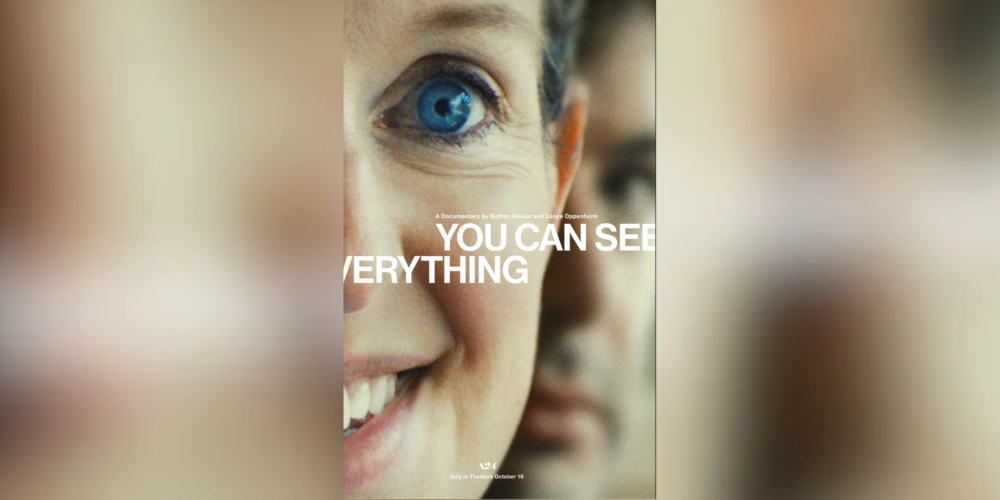
Initially, the film resembles an unusually intimate domestic documentary. Fielder and his crew enter the lives of Holmes, her partner Billy Evans, and their children. The cramped frame holds faces in uncomfortable proximity, and close-ups invite us to scrutinize expressions (and pore size) that might otherwise go unnoticed. Information arrives out of order — ordinary interactions acquire new significance as the film progresses. The pacing is deliberately slow, making even an uncomfortable pause feel consequential. We are encouraged to examine Holmes as if the truth might be somewhere on her face.
Then the film changes. Without revealing where exactly it goes, its later movements complicate the apparent purpose of everything that came before. Who is directing whom? What has been captured, omitted, or manufactured through editing? The experiment begins to happen to Fielder as much as to his subject.
Elizabeth Holmes may be a convicted fraudster, but that does not make every expression of sadness a performance, nor does every glimpse of vulnerability undo the consequences of her actions. The film refuses to leave Fielder outside the frame of suspicion as well. A documentary is not reality untouched. Someone decides where to point the camera, what to cut, and how long to make us sit with a moment.
Often, ambiguity can be an excuse for a film to avoid making a point. Withholding answers is not, by itself, a profound artistic achievement. Yet this film made me question the pleasure I took in fitting someone into a preconceived category. Editing can turn an ordinary pause into something suspicious. Context makes something either sympathetic or sinister. Is it Elizabeth Holmes who had me fooled, or that darned editor? Maybe the documentarian himself? Maybe it was the first guy who invented the camera, and his Frankensteinian audacity to capture human life. We see the footage, then mistake our interpretation of it for the truth.
Can a documentary promise that you will be able to see everything, or is that the beginning of its failure? Perhaps the film’s original sin is promising that we can see everything. Holmes remains difficult to read, but so does the filmmaker observing her, and so does the audience watching them both. The uncertainty is frustrating precisely because we want it resolved. We want to identify the villain, uncover the lie, and leave knowing what really happened. Yet You Can See Everything suggests that our eagerness to judge may be part of the problem. After two viewings, I still don’t know what to make of Elizabeth Holmes. I’m no longer sure what I expected to find.
In conclusion, go see You Can See Everything. Just don’t expect to.