Alumni awards honour Dr. Louis Hugo Francescutti’s life’s work
Dr. Francescutti has spent his life working towards preventing injuries and helping reshape care for unhoused individuals.

 Supplied
On Thursday, October 22, the University of Alberta hosted the 2026 Alumni Awards to recognize the impact alumni had through their “professional achievements, community service, and innovation.”
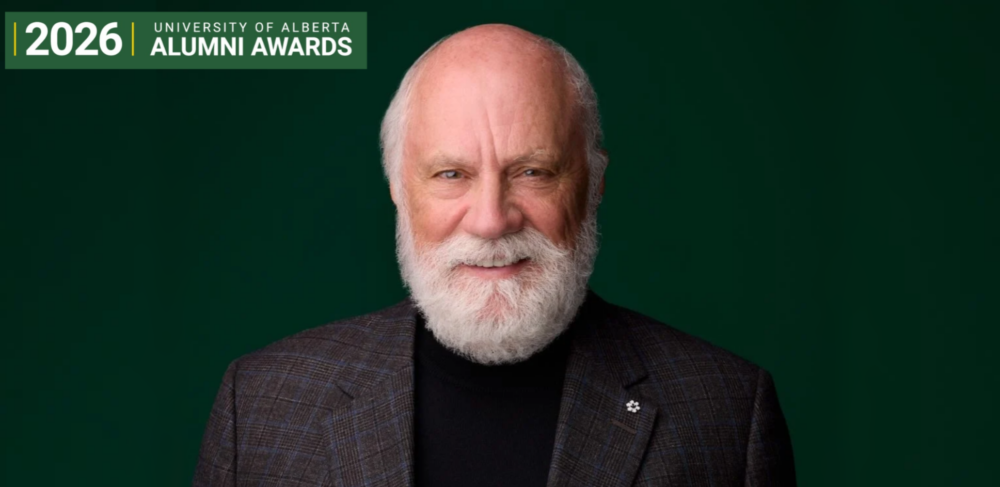
Dr. Louis Hugo Francescutti, an emergency department physician, public health advocate, and professor at the U of A, received the Distinguished Alumni Award, the Alumni Association’s highest honour.
After working within the medical sphere right out of high school, Dr. Francescutti decided to pursue a Bachelor of Science degree from Concordia University in Montreal. From there, the progression of his career in academia served as a means of navigation towards the medical field.
With an initial interest in being a trauma surgeon, Dr. Francescutti’s experiences during his neurosurgery rotations soon focused his attention toward injury control. “I realized that the majority, if not all, of injuries were totally preventable events,” he explained. “They weren’t accidents.”
This focus was heightened after he was able to observe a program that was being run in the United States for young teenagers by Dr. Clark Watts. Inspired, Dr. Francescutti came back to Alberta and created his own HEROES program.
“[It] was a true quadraphonic, 18 flight projector, 120 foot screen presentation that we took into high schools throughout Alberta and Canada,” he described. “That’s when I started realizing that we could prevent injuries rather than treat them.”
After eventually getting a Master’s degree in public health from Johns Hopkins, and doing residency in preventative medicine, Dr. Francescutti then returned to Alberta as an assistant professor. Among other initiatives, he’s since set up the Alberta Centre for Injury Control and Research and created the Bridge Healing program.
“I do prevention, then I go to work in emergency and I see my failures, and it motivates me to do more prevention at the university,” he said. When asked what inspires his ideas for these programs, he reiterated, “The answer’s quite simple: I like identifying what [the] problems are, and I don’t like talking about them. I like moving towards solutions.”
Bridging health and housing for patients
Bridge Healing, for example, is geared towards patients experiencing homelessness, who have no safe place to recover after leaving emergency departments. As the first of its kind in Canada, the program provides a place for patients in need, referred to as a “healing house,” that subsequently also helps them “[regain] a sense of purpose in their lives.”
“We’re now in the process of trying to [scale up] so that we have one of [those] healing houses in every distinct neighbourhood in Edmonton, at which there are 375,” Dr. Francescutti explained.
Currently, Bridge Healing has 72 beds to offer patients, but he estimates that there are around 4,000 Edmontonians that need housing support. With plans to expand into every neighbourhood, each healing house fitting 12 suites, they will be able to house 4,500 permanent residents in need.
“If we’re able to do that,” Dr. Francescutti said, “then we [will eliminate] homelessness as we know it in Edmonton.”
Expansion, however, comes with its own challenges. For example, bringing aboard more partners by spreading the word of attained success. An award for the work that’s already been done will hopefully help.
“I greatly appreciate it,” Dr. Francescutti said about being given the award, but also made sure to mention that the success so far achieved has been a combined effort with the people he’s worked with. “[The success] is built on the shoulders of many people that have, you know, worked with me over the years, and so this is shared with all of them.”
In the future, Dr. Francescutti hopes to tackle injury prevention related to motor vehicle collisions. Not helped by, or perhaps even a consequence of, the government increasing speed limits on the highways and getting rid of photo radar, Alberta has recently seen an increase in the number of casualties caused by these collisions. Currently, the province seems to be on track to having the highest number of traffic fatalities since 2015.
“[A]t a time when our health-care system can barely take care of who’s coming through the door, the low-hanging fruit, in terms of prevention, is preventable injuries.”