Mark Boyce and Lise Gotell win the 2026 University Cup
Both scholars have made lasting differences with their research and influenced national legislation.

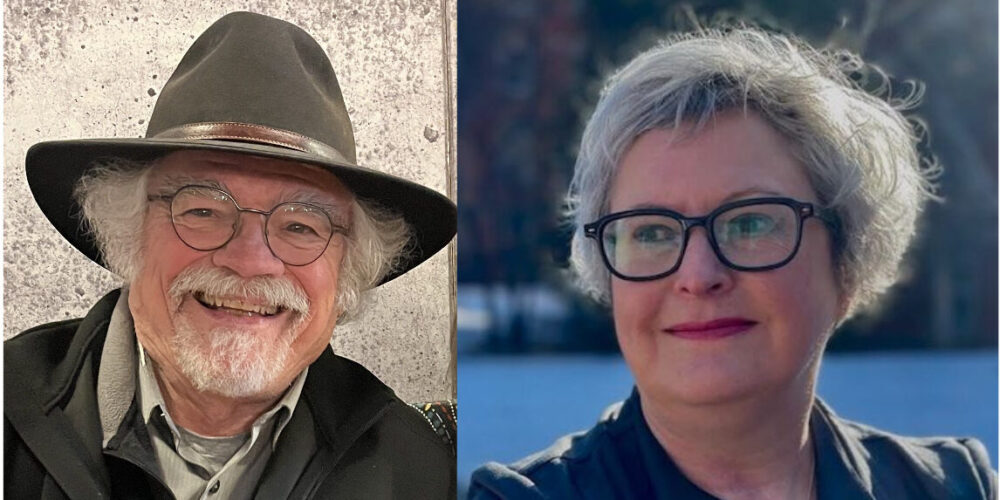 Supplied
Every year, the University of Alberta grants the University Cup award to faculty who have “achieved sustained commitment in areas of research, teaching, and service to the university and the community at large,” according to the selection procedure.
Mark Boyce, a professor of ecology, and Lise Gotell, a professor in women and gender studies, are this year’s recipients.
Mark Boyce: protecting sage-grouse on a federal level
Boyce has been a practicing ecologist for many years. Today, he is the Alberta Conservation and Association Chair in Fisheries and Wildlife, and also runs the Boyce Lab. However, it wasn’t until 1999 that he joined the U of A as a professor.
“I’ve known that I wanted to go into some kind of wildlife field since I was 14,” Boyce reflected. He started with studying fish and wildlife biology at Iowa State University in his home state.
After going to Yale University to earn a PhD in ecological theory, he worked for various American universities before joining the U of A.
“We have high quality students and colleagues at the University of Alberta and it’s just the right mix for me,” said Boyce.
He pointed to the time he helped sue the federal government as a significant moment his research made a real-world difference.
Sage grouse, the largest grouse species in North America, has long been endangered in both Canada and Alberta. Even though Boyce had published a 2007 study outlining critical habitat for endangered sage grouse, the federal government failed to consult it during their 2008 recovery plan.
Ecojustice, an organization protecting endangered species, asked Boyce if he would give a deposition in support against the federal government. In other words, give a sworn testimony that is used as court evidence.
At first, Boyce hesitated. The U of A gets a lot of money from the federal government, he explained. He worried “things might not go very well.” But ultimately, he gave the deposition to stand up for what he believed in.
The federal government was subsequently sued, and Ecojustice won the case. The government then hired 75 people in the Canadian Wildlife Service to conduct ecological modelling work.
Boyce’s current projects at the U of A are on bighorn sheep and on pheasants. Specifically, looking at how to protect wild bighorn sheep from diseases.
He also has graduate students working in large mammals such as cougars and grizzly bears, where they conduct fieldwork. “I can’t imagine a better job. I just do what I like to do,” he said.
This winter, he will be teaching a population ecology course (BIOL 431) — a course he’s been teaching for about 50 years, and one he wishes was available to him as a student.
“If I were to give advice to an aspiring wildlife person, they need to have the skills in statistics and mathematics,” said Boyce. “That’s where the demand is and what people need.”
Lise Gotell: influencing the Supreme Court to improve consent laws
Lise Gotell, a professor emerita in women’s and gender studies, is also the previous national board chair of the Women’s Legal Education and Action Fund (LEAF).
Similarly to Boyce, Gotell was at several institutions before joining the U of Ain 1997.
She went to York University to get her masters and PhD in political science, while focusing in areas of Canadian law. Constitutional politics gave Gotell comfort working on legal issues. Today, she researches how rough sex is used as a defense for violence in courts.
Gotell intentionally wanted to influence the Supreme Court after a ruling in 2012 stated that one does not need to specifically consent to condom use. “A colleague and I thought that was completely wrong,” she said. “We started to look at the implications of that decision and how it was playing out in the lower courts.”
Her research looked at the problem of sexual fraud: consent that is only given on the basis of deception (such as falsely claiming to be using contraception.) Gotell specifically examined the narrow circumstances in which sexual fraud undermines or invalidates consent.
She published this work with the goal of the Criminal Code being ammended to include condom use under sexual fraud.
Gotell was successful. With the help of the Barbara Scheilfer Commemorative Clinic, the Supreme Court acknowledged that consent to sex with a condom does not mean consent to sex without one.
Additionally, Gotell influenced governments of other countries like New Zealand and Scotland throughout her career. Unlike Canada, these countries had not enforced specific affirmative consent laws. In other words, laws which define consent as explicit and voluntary. These countries looked to Gotell’s research for inspiration.
“That’s how I started to think that my work is not just being read by academics but it is having an outside impact. I was being consulted on law reforms in other countries.”
While Gotell has taught a numerous amount of courses over the years, one she particularly enjoys teaching is a second-year course on consent (WGS 230).
“There’s a really strong need for students to defend what we have and to push further.”