Campus Saint-Jean faces scrutiny over changes to its campus
Francophone community members didn't expect renovations to mean losing some of CSJ’s heritage symbols.

 Leah Hennig
 In the summer of 2022, some francophone community members felt a shift at Campus Saint-Jean. The first sign was the removal of Garry Berteig’s artwork. The University of Alberta celebrated the artist’s work in an unveiling on May 20 of that same year.
The removal of the art came only two months later, and a few days into the term of a new dean at CSJ, Jason Carey. Since then, students, alumni, former professors, and francophone community members have been raising the alarm that French heritage is under threat.
Carol Léonard was a long-time professor at CSJ. About two years ago, as he saw the changes unfolding at the francophone campus, he felt there was a need to document what was happening. With that, he started the Collectif.
Another member, Paul Dubé, retired from teaching at CSJ about 10 years ago. He has played a huge role in the francophone community. Dubé was part of a case that set a legal precedent for access to French-language education in Canada and francophone representation on school boards.
Denis Noël is a U of A alumnus and has been a key figure in the local francophone community for many years. He joined the Collectif this summer.
The Collectif organized a public meeting in June. About 200 community members attended and discussed the changes happening at CSJ.
The June meeting was the first time they had invited community members to see their work of documenting the changes to CSJ.
“The Collectif never saw itself as one that would lead the political movement to perhaps reverse some things or whatever it was to do. It was to investigate what has happened here, document, and to inform people of what’s happening,” Noël said.
One of the first questions Noël asked was where the mandate to remove certain objects came from. “The dean [Carey] almost within … five days [of his term] started giving directions as to removing certain things,” Noël said. “I’d sure love to see that mandate … [or] if he made that decision by himself, how did he arrive at that so quickly?”
The Collectif found it strange how quickly CSJ removed the Garry Berteig paintings once Carey began his term.
U of A media relations told The Gateway that Indigenous community members raised concerns about the artist being non-Indigenous.
“While we acknowledge that Indigenous collaborators may have contributed to the work and that the style incorporates Indigenous elements, we are committed to upholding authentic representation and fostering an inclusive community,” media relations said.
They noted that the artwork had also not been acquired in accordance with the U of A’s established policies.
Renovations to modernize campus impact heritage symbols and spaces
Other changes came as the campus underwent an $8.1 million renovation. The project received funding from both the provincial and federal government.
The renovations are an effort to modernize the campus, as it aims to increase its enrolment. But some community members didn’t think modernization meant losing some of CSJ’s heritage symbols.
The historical room, Onésime Dorval Room, was removed during the renovations. It displayed panels on the history of CSJ, altars, photographs of graduates, and other artifacts.
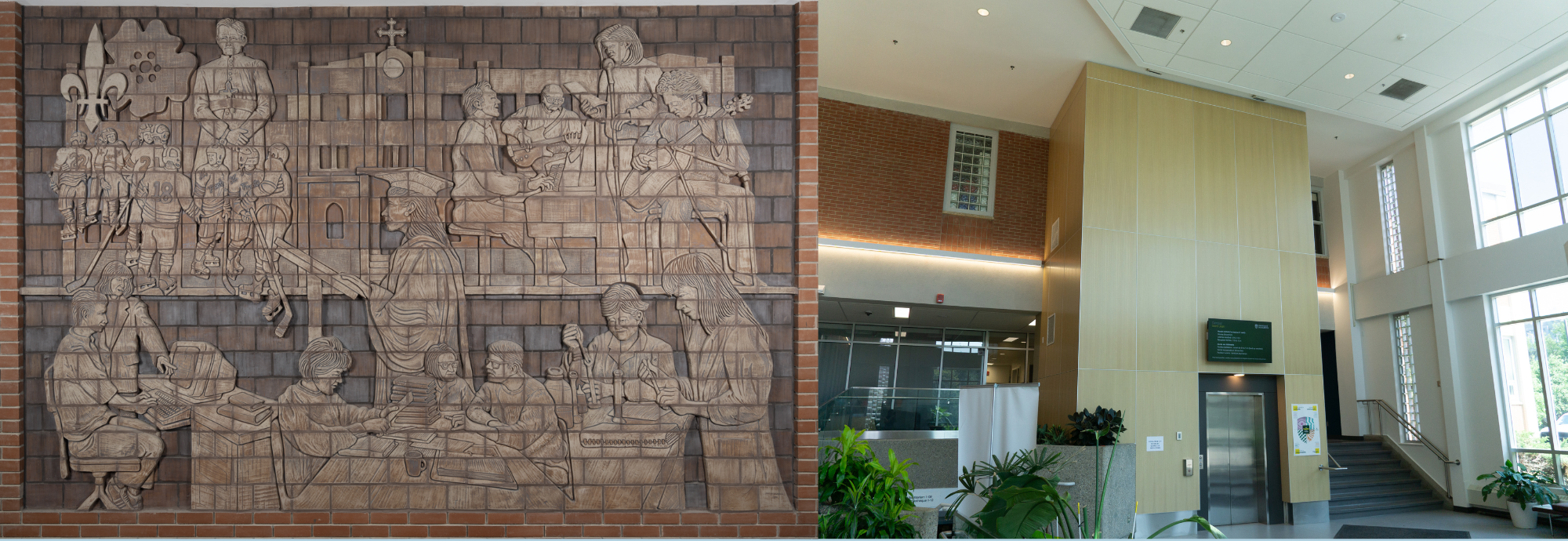
Additionally, a brick mural by James. A Marshall, first installed in the 1990s, looked over the entrance of Pavillon McMahon until it was covered.
Léonard said that when they learned the historical room would be dismantled, they weren’t allowed to enter the room or look at it from the outside.
As for the mural, the Collectif has trouble understanding why CSJ decided it needed to be covered.
“When you look at it, you say what was wrong with that mural? The cross on the top? Or the students in front of the computers at that time?” Léonard asked. “Is it the Fleur de lis and the rose?”
“I don’t think that in all of the things so far you have a clear explanation from the administration of what was objectionable about this mural,” Noël said.
A U of A webpage states that “upon analysis, it became apparent that certain visual elements of the mural did not represent the history of Saint-Jean in an adequate or pedagogically rigorous manner.”
A statement from Carey released on September 22 said that the decsion was made in consultation with the design team, the U of A Naming Advisory Committee, community representatives, and Marshall himself.
The removal of the historical room also caught the attention of the ACFA.
The president of ACFA, Nathalie Lachance’s first job when she moved to Alberta was with CSJ. She worked as a development officer in the late 1990s to the early 2000s, largely dealing with fundraising.
“I’ve described Campus Saint-Jean in the past as the alma mater that was never mine,” she said. It was also through her role at CSJ that she was introduced to Alberta’s francophone community.
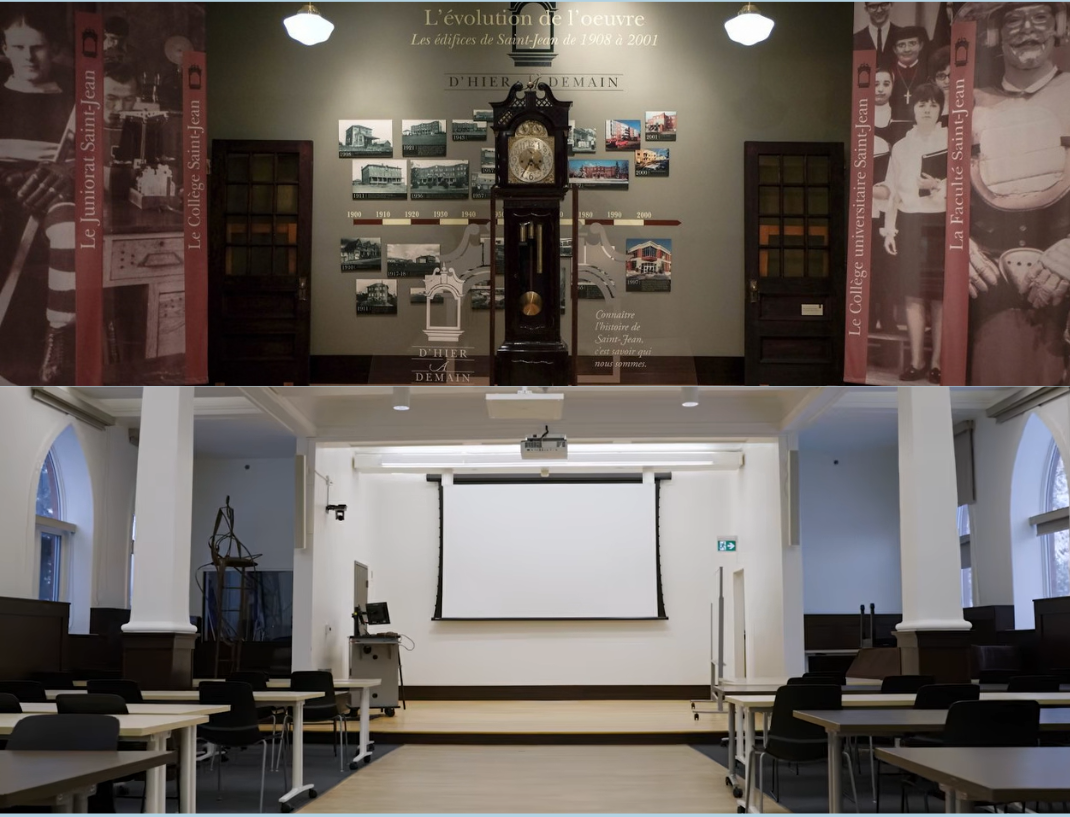
Her concerns around CSJ started when the ACFA was informed of changes being made without consultation. The first change was the closure of the historical room. Then, the Ceremonie de la Lumeire, a graduation ceremony that signified passing the torch to the next generation, was cancelled in 2023.
“Then we started asking questions,” she said. “At some point, I had a tour of the campus with the dean and I noticed that the graduation pictures had been removed. I was really floored by that.”
Those graduation photos felt personal to her. “I spent a lot of time in that hallway, looking at the picture of the grads because they were the people who were donating to the campus,” she explained. “I would have some of the professors coming to talk with me about those students who were sometimes fellow students of them, sometimes they were fellow students of their parents.”
The U of A states on its website that removing the photos of graduates was part of modernization efforts. It also says that the physical display of the photos did not always comply with Freedom of Information and Privacy or Protection of Privacy legislation.
Photographs of the Chorale Saint-Jean are still on display at CSJ. Additionally, the U of A still displays photographs of graduates in other faculties on its North Campus.
“The renovation work in this hall provided the Campus Saint-Jean administration with an opportunity to reflect on how the objects were displayed,” the U of A’s website said. “Many of the objects and display panels were linked to the history of the Oblates of Mary Immaculate and their presence in Alberta, but were presented without any educational or explanatory framework to enable the public to situate them within a broader historical and socio-cultural context.”
It also noted that the university transferred the altars to a cultural organization. Other items have been part of a display at the Royal Alberta Museum. Photographs of graduates are in the process of being digitized.
The page said that no items have gone missing or been destroyed.
The history of Campus Saint-Jean
The Oblates of Mary Immaculate started CSJ, then known as Saint Jean, in Pincher Creek in 1908. Two years later, Saint Jean moved to Edmonton. The Oblates ran the school as a place to train men for religious life until 1977, when it became a faculty of the U of A.
The Oblates also ran about 40 per cent of Canada’s residential schools. Some who held leadership or teaching roles at Saint Jean also served as teachers, principals, or missionaries at residential schools.
“Historical research and survivors’ testimonies shed light on allegations of abuse involving individuals whose paths crossed with that of Saint-Jean,” a U of A website states.
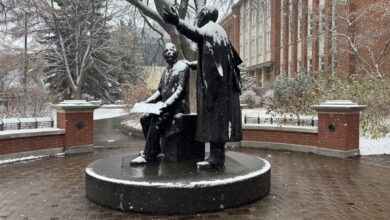
CSJ’s roots in the Oblates were visible — and still are — across the campus. A statue of Oblate Brother Anthony Kowalczyk sits behind the main buildings. A grotto to Mary, Notre-Dame de Lourdes, erected by Kowalczyk, stands behind Résidence Saint-Jean.
The U of A says there are no plans to remove the grotto.
When the Oblates transferred ownership of CSJ to the U of A, they remained involved through an agreement between the U of A, the provincial government, and the Oblates to protect the francophone character of the school. In 2019, the Oblates transferred their responsibilities to the ACFA.
The Collectif recognized the role the Oblates played in residential schools, but also noted that they played a significant role in protecting French culture and language before bilingualism was an official policy in Canada.
“The Oblates priests made and put in their disposition to be secretary general to try to defend French culture, to promote that,” Noël explained.
“Campus Saint-Jean for the French community was very much a focal point, especially at a time when francophones did face some discrimination,” Noël said. “It was part of that focal road of defense of the francophone community and preservation of its culture, language. And yes, in those days for the francophone community, language, culture was also associated with religion.”
He explained that it’s difficult to separate the history of fighting for the preservation of French language and culture from the Catholic church.
Work towards reconciliation
The U of A’s website says that a calumet ceremony on June 13, 2023 marked the official start of the campus’s journey towards reconciliation and decolonization. However, the Collectif noted that reconciliation efforts began in about 2017.
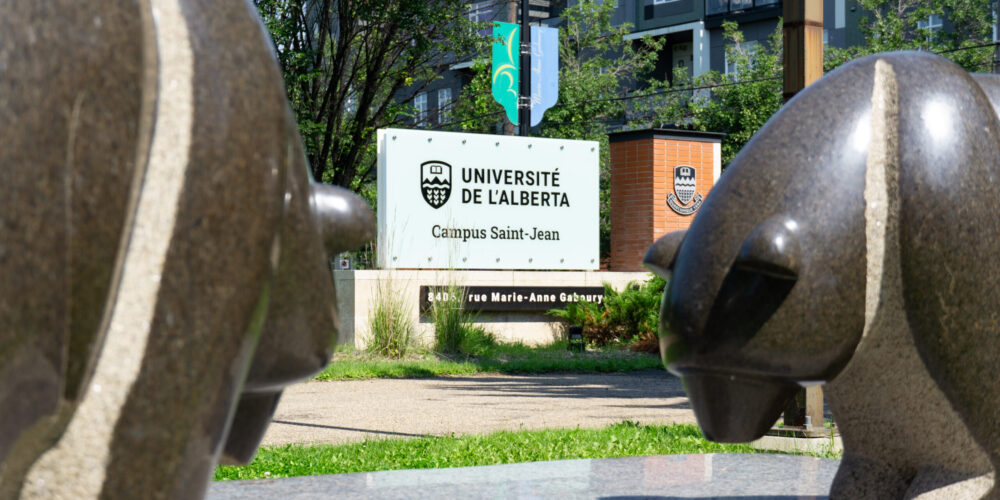
CSJ welcomed the installation of a statue called “Mother Bears Pray For Earth Healing” in 2017. The statues by Stewart Steinhauer feature two bears carved out of granite with their heads down. Not far from that statue is another, “L’Espirit Ours” which predates “Mother Bears Pray For Earth Healing.”
Steinhauer is also the artist behind the “Sweetgrass Bear” on North Campus.
Angelina Yellowbird started in her role as First Nations, Métis, and Inuit (FNMI) liaison in September 2023. She completed her Bachelor of Criminology at North Campus and is now doing a Master’s of Sociology at the U of A.
As a member of the Alexander First Nation, the work towards reconciliation and decolonization is close to her heart.
“Decolonization looks like not just inclusion in these institutional spaces, but acknowledging that every Indigenous student who might be francophone who comes into a space, they all have distinct backgrounds,” Yellowbird said.
Part of her work has been recruiting Indigenous students to CSJ, but also making sure they have a successful education.
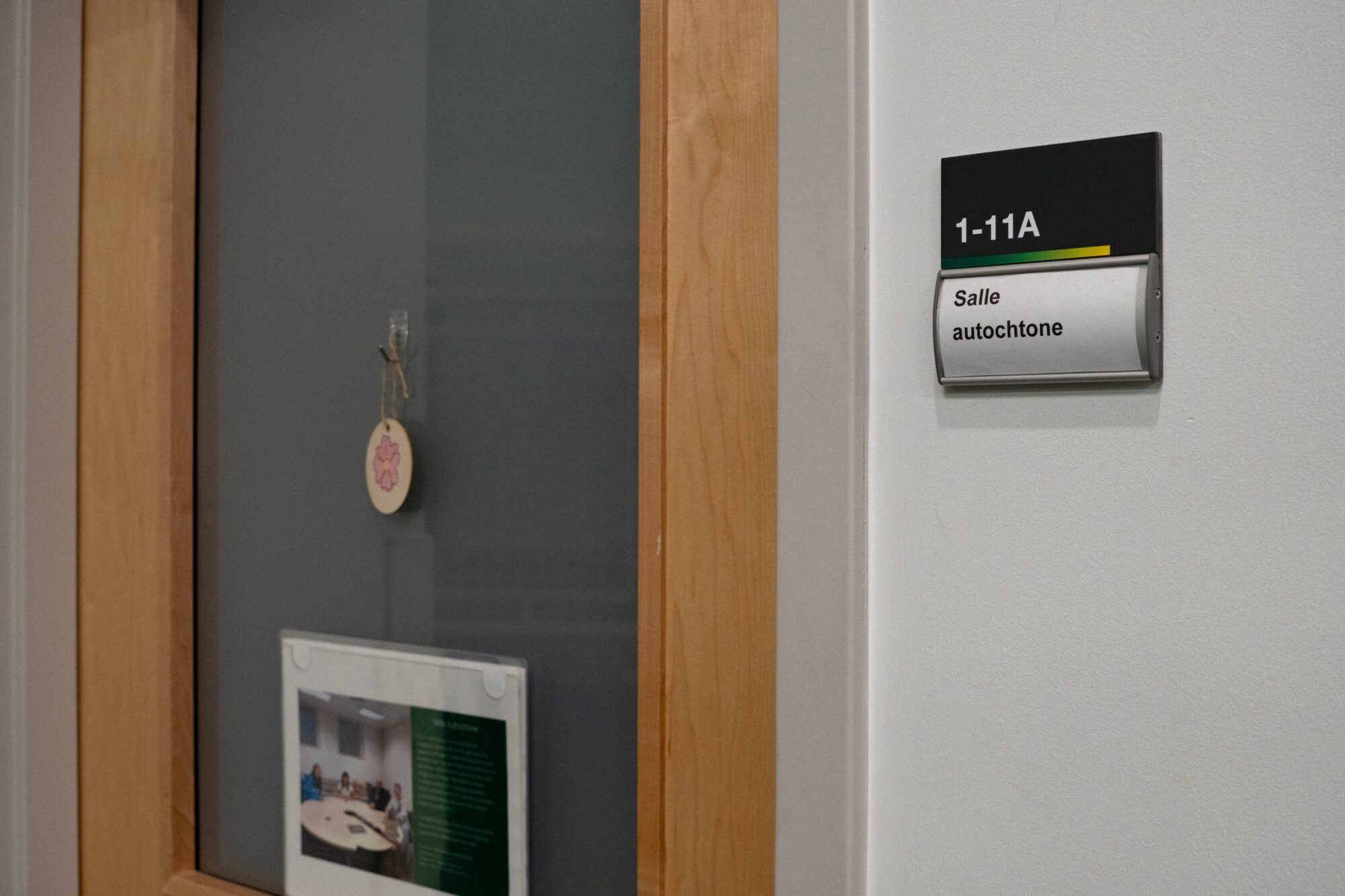
Another piece of recent work to decolonize CSJ was opening a space for Indigenous students and staff. The Indigenous Room opened on September 24, 2026.
Yellowbird noted that it was a project in the works before she started her role as FNMI liaison. But working with Cindy Gaudet and Keith Franklin to develop a comfortable space for Indigenous students.
The space is used for events, gatherings, and also for research.
“Historically, academic spaces and institutions at the university were not welcoming spaces for Indigenous people,” Yellowbird explained. “It’s a very unique identity being a French-speaking person and also being Indigenous.”
“Reconciliation and decolonization is putting the needs of our people, not first above everyone else, but first in the sense where we acknowledge that they have a space here,” she said.
Frustration in attempts to find answers
Finding answers to the Collectif’s and ACFA’s questions has been difficult. Noël described the responses from the U of A as the typical defensive response from an institution being questioned.
The U of A made a webpage to address concerns from community members. “In the face of rumours or misinformation, we firmly believe that open dialogue is the best course of action,” it states. “The University of Alberta and the Campus administration have absolutely nothing to hide.”
“Academic excellence and the maturity of a community are measured by its ability to analyze its history with courage and honesty in order to guide its future actions along the path of truth and reconciliation,” the webpage said.
Over the summer, the ACFA has written multiple open letters to the U of A about their concerns. Lachance stressed that they had tried to have conversations with the dean and had written to the president of the U of A several times.
They didn’t receive a satisfactory answer, according to Lachance. Even after they published their open letters, Lachance says they are still seeking answers to how the decisions were made and why.
She also noted that consultation with the community has been non-existent. When the ACFA inquired about who had been consulted before the Marshall mural was covered, they were told that the U of A had consulted student associations, a nomination committee, and an Indigenous organization.
The ACFA asked who those organizations were but did not receive a specific answer.
The U of A’s webpage states that “the Campus dean meets regularly, both formally and informally, with leaders of community organizations within Alberta’s diverse Francophone community. In particular, the administration consulted several of these leaders as part of the launch of the Campus’s decolonization process.”
In their research, the Collectif said they haven’t found evidence of a rigorous examination of the changes, including removing the historical room and covering of the brick mural.
Both the Collectif and Lachance said the decision to cover the Marshall mural was much different than the decision to cover the Alberta History mural in the Rutherford Library.
The Alberta History mural depicted a scene of settlers and priests with Indigenous Peoples. It was criticized for being racist and harmful to Indigenous Peoples. The U of A took multiple years to make its final decision to cover the mural and add a panel to explain why it was covered and how to access it digitally.
But Carey’s tenure brought a different approach, the Collectif said.
“In some ways, he erased what had been done [on reconciliation] before, and now he was offering us something different,” Dubé said.
“In a sense for some of my colleagues when they saw this, they said ‘okay, he’s erasing all the efforts that we did to pretend that he started the … new way to reconciliation,’” Léonard said.
Noël said he expected reconciliation to take place as a discussion and exchange of views between communities to find a path forward. The Collectif says that in 2016, that was taking place. However, in the Collectif’s research, they’ve found little evidence that that happened in Carey’s term.
He also stressed that he would not necessarily oppose the changes that have been made if the administration had followed the proper process. From the Collectif’s point of view, it seems the administration simply announced the decisions and implemented them.
Carey’s September 22 statement said that CSJ is currently completing a “comprehensive and transparent historical review.” The findings will be published “without omission.”
Rethinking how to present CSJ’s story
Lachance said that the ACFA firmly believes in continuing the work of reconciliation, but also believes the history of francophones in Alberta needs to be preserved while providing context.
“There’s no doubt that the Oblates fathers created Saint Jean in 1908 and played a key role in the organization until 1976,” she explained. “And we know that the Oblates fathers were involved in residential schools.”
“It shouldn’t be a decision to simply remove every sign and symbol that talks about the past. I think you have to put it in context.”
“To me, to be able to see generations of Franco-Albertans has always meant a lot to me,” Lachance said. “It allows me to understand the work that the francophone community has done to have their rights recognized and still be able to speak French in Alberta in 2026.”
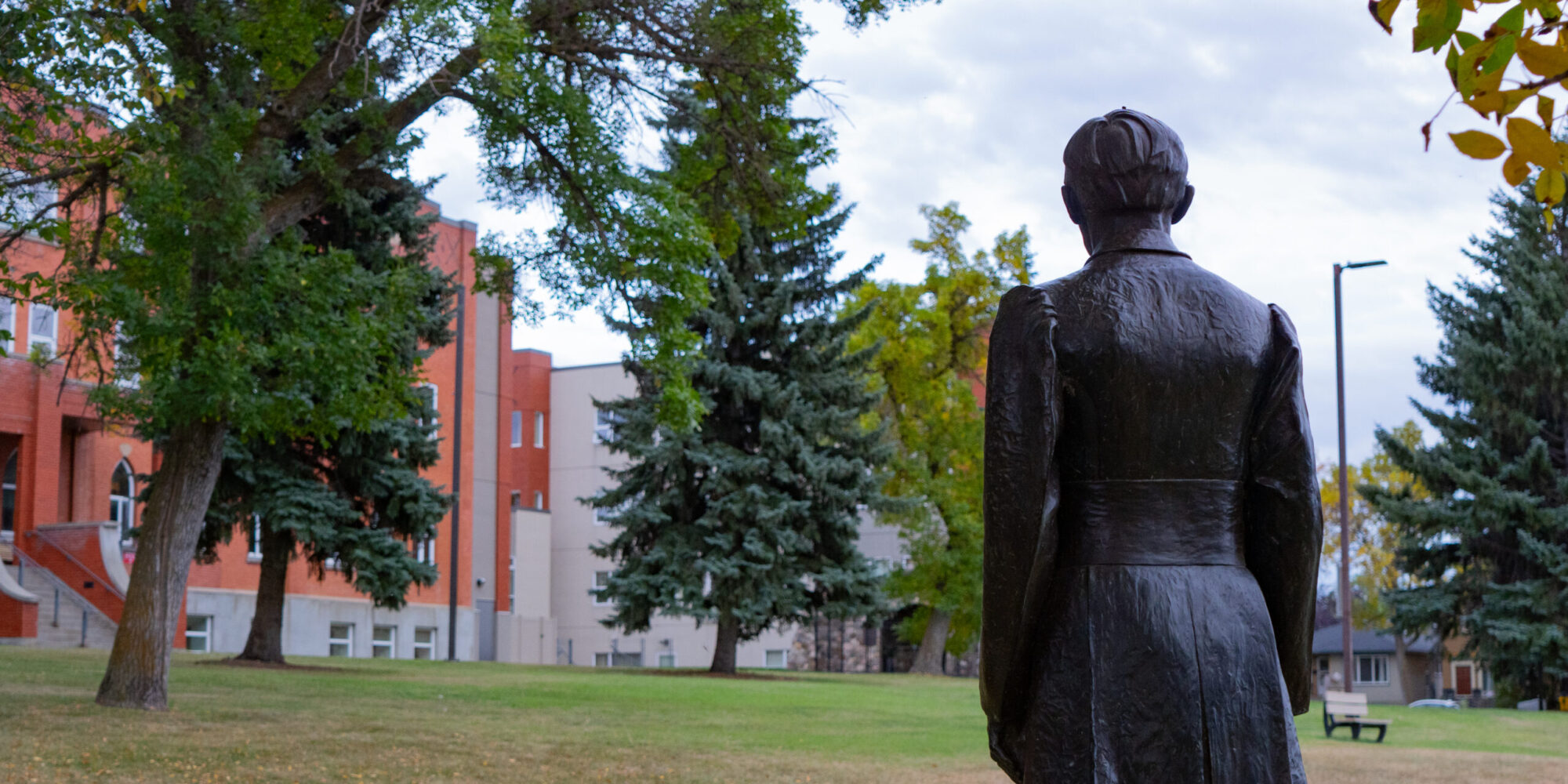
That history and the stories attached to it plays a big role in making an inclusive community where people can understand the past and where individuals fit into the present and future, she said.
“There’s a lot of history that is disappearing for us,” Lachance said. “That ability to see ourselves, as a community, and as we see ourselves really writ large.”
“Campus Saint-Jean does not seek to erase the past, but rather to evolve the Franco-Alberta heritage so that it remains vibrant, inclusive, and rooted in the 21st century,” the webpage says.
The U of A says that it is preparing to highlight CSJ’s history in upcoming plans to showcase its history among the modernized spaces.
That project has been another piece of Yellowbird’s work. She said the goal is to tell CSJ’s story, from the beginning to now.
“It was collaborating with various communities, Indigenous communities, French-speaking communities, professors,” she explained. “The francophone community is quite diverse and there’s a lot of perspectives to include within that storytelling.”
Yellowbird said there is a heavy history, but the goal isn’t to condemn anyone.
“Renconciliation was never about condemning people. It’s about working together towards a better future, towards a better present,” Yellowbird said.
She said she keeps the seven generation principle, thinking of how decisions will impact future generations, in mind in her work.
“For me, I take a very collaborative approach. We can acknowledge wrongdoings, but then we also have to have specific strategies and things in place to ensure that we work towards a more inclusive, more accepting community for all French-speaking people that want to come and study at Campus Saint-Jean.”
In the face of some of the pushback to changes at CSJ, Yellowbird says she tries to listen to the different perspectives and hear what people are saying.
U of A media relations told The Gateway that CSJ plans to unveil a tribute to alumni and their contributions next year for CSJ’s 50th annivesary.
The Gateway requested an interview with the Association des Universitaires de la Faculté Saint-Jean (AUFSJ), which represents CSJ students.
The AUFSJ declined to do an interview or provide comment, saying in an email that “At this time, as an organization, we have decided not to grant interviews on this subject, as it ultimately does not advance or benefit our student group to do so.”
The Gateway also requested an interview with Jason Carey but did not receive a response.