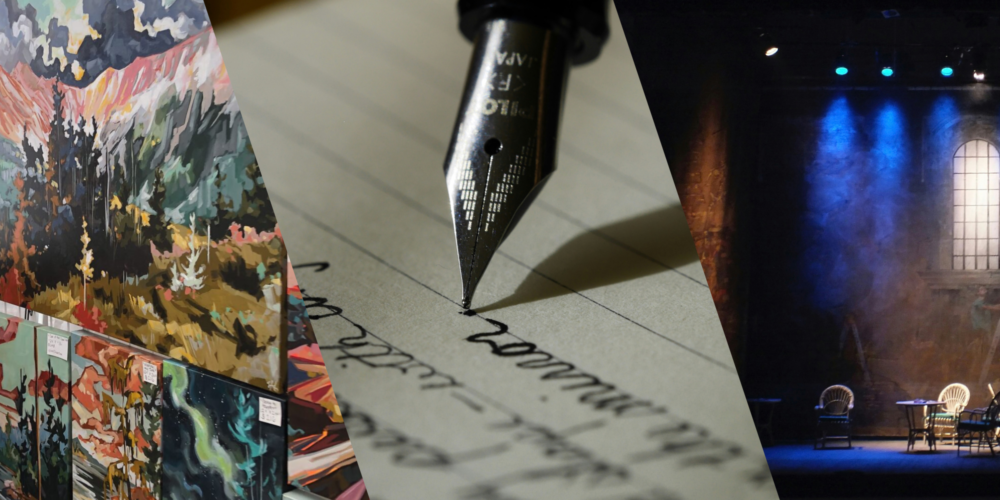
Ink, stage, and story: Creative expression’s evolution at the U of A
Artistic expression at the U of A has taken on many different forms over the years and continues to evolve in the age of ever-changing technology.


 Leah Hennig
On any given afternoon at the University of Alberta, a student might be drafting a poem between classes, rehearsing a scene under stage lights at the Timms Centre, sketching storyboards in HUB mall, or editing a short film on a laptop in Cameron Library. Creative expression has long been part of campus life — but what it looks like, who it includes, and how it circulates have shifted dramatically over the past century.
Founded in 1908, the U of A grew alongside Edmonton, and its creative culture evolved with it. In its early decades, artistic life on campus centred on the Literary Society of 1908, debating clubs, and theatre productions. These were the primary extracurricular spaces where students experimented with performance and prose.
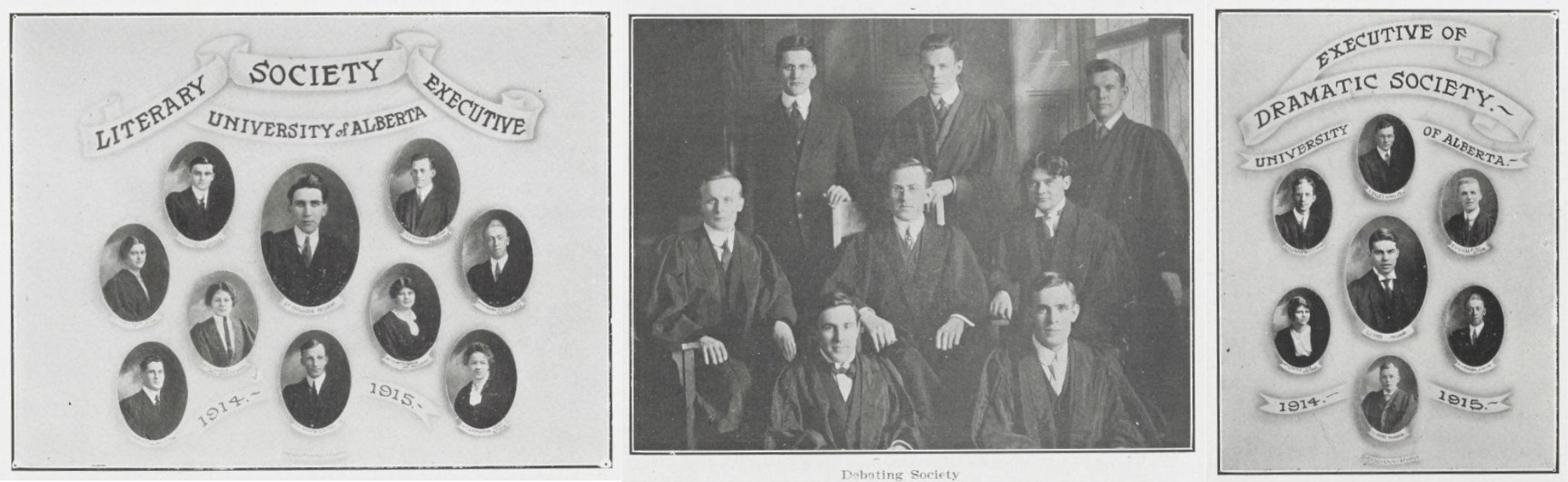
The Literary Society was particularly influential, serving as a social and intellectual anchor for the small student body. It wasn’t just a club; it was a forum where the provinces’s future leaders sharpened their wits. The prairie context significantly influenced early poetry, with writers often grappling with the vast, isolated landscape and the harshness of the climate, creating a unique regional aesthetic in their prose. Students in the 1920s often met in drafty lecture halls to recite verses that echoed the loneliness of the surrounding fields, yet also the optimism of a burgeoning society.
By the mid-20th century, creativity began to find a more defined home in the curriculum. Today, the department of English and film studies offers a structured creative writing stream known as WRITE, where students take workshops in fiction, poetry, creative non-fiction, and hybrid forms. The program emphasizes peer critique and revision — a marked contrast to the solitary image of the writer that once dominated popular imagination.
That collaborative ethos now extends beyond the classroom. The Creative Writing Club, a student group, hosts weekly meetings, open mics, and anthology projects, creating informal spaces for experimentation. The English and Film Studies Undergraduate Network (EFSUN) also runs writing workshops, poetry readings, used book sales, academic representation, and research opportunities.
The U of A Art Club and the various dance clubs on campus frequently collaborate on pieces and performances. The Gateway Student Journalism Society itself has a history of hosting photography and art shows, and covering student performances and publications.
These clubs reflect a broader shift: creative expression is no longer confined to a single discipline or building. It spills into residence lounges, student newspapers, online forums and performance venues across campus.
Pushing the boundaries of art, for better or for worse
Few outlets have captured that evolution as vividly as The Gateway itself, the university’s student newspaper since 1910. It has been a crucible for advocacy and experimentation. In the 1970s, the paper became a hub for radical student movements, with writers using creative essays to protest tuition hikes and social inequity. This was an era where the boundary between journalism and creative manifesto blurred.
The Gateway provided a canvas for experimental typography and gonzo-style reporting that challenged the university administration.
In the late 1980s and 1990s, it became home to Space Moose, a comic strip by Adam Thrasher. The strip, often provocative and surreal, sparked controversy and debate about censorship and student voice.
Thrasher, now a professor at the University of Houston, recalled the start of Space Moose. He said he had been drawing comics since middle school, but the character of Space Moose specifically came from some nefarious activity.
“My best friend was doing a book report in front of the class, and I was trying to disrupt his book report so I drew the funniest picture I could on a sheet of paper and held it up,” Thrasher said. “It cracked him up and made him lose his spot, so it was successful.”
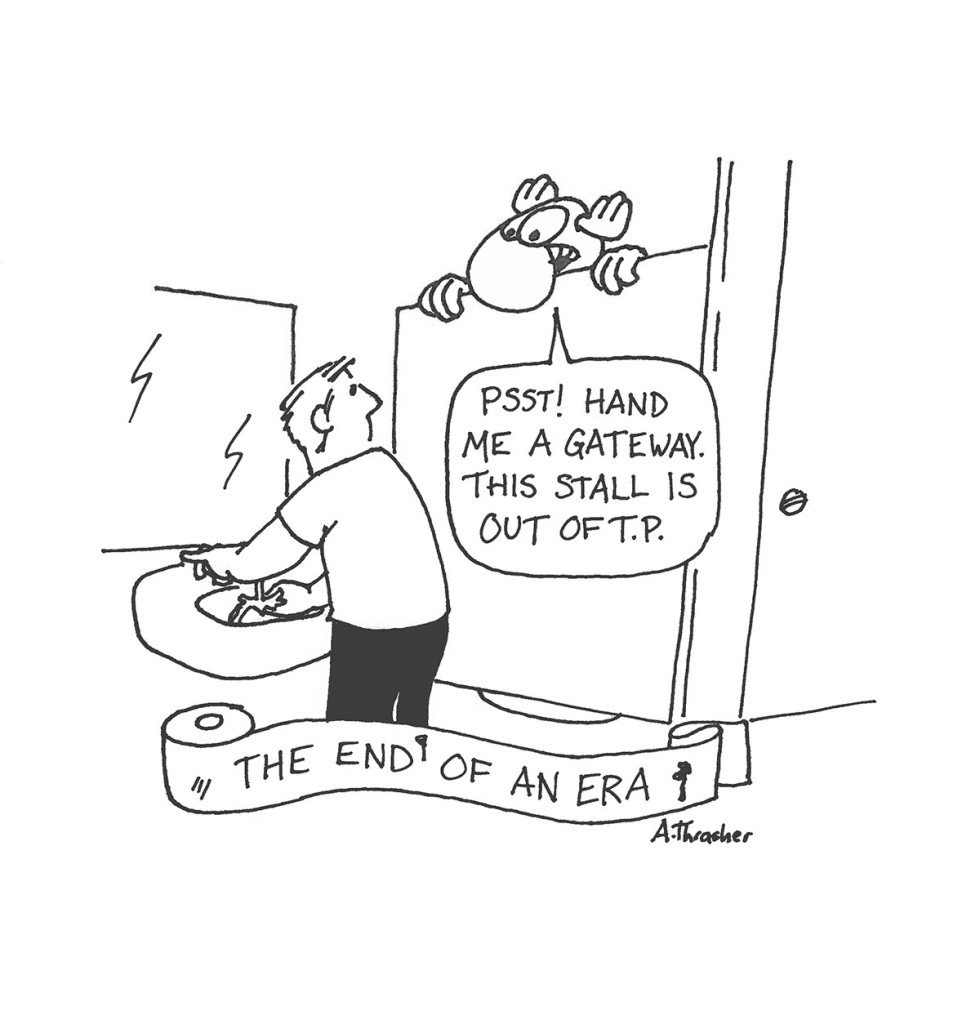
What Thrasher drew that day was the first version of Space Moose: A cartoon moose with lopsided, big googly eyes, a huge nose, and buck teeth.
He’s grown up reading comics, ranging from Marvel to Peanuts or whatever was in the newspaper. “Those kinds of comics drove me nuts because they were really edgeless,” he added.
So, when given the chance to publish his own comic strip in The Gateway, Thrasher went for edge.
Space Moose often satirized university life, particularly progressive circles at the U of A. It echoes the offensive humour of South Park. The intent wasn’t to be controversial, but to be funny.
Space Moose eventually landed in the early days of the internet and it started to reach audiences far beyond just U of A students. That also meant that when the controversy hit, it caught the attention of a lot of people.
At first, Thrasher really liked being controversial, but the pushback mounted with “Clobberin’ Time.” The Space Moose strip depicted Space Moose and his sidekick, Billy the Bionic Badger, sneaking up on a Take Back the Night March and then shooting the women. Then, a caricature of a (bulletproof) butch lesbian locks Space Moose and his friend up.
Thrasher published the strip online in October 1997, and The Gateway published a continuation of Space Moose and Billy’s rehabilitation the following week.
The reaction to the strip was immense. The Gateway printed letters to the editor railing against the comic in the same issues in which Space Moose strips were published. The public reaction ranged from a full page letter to Thrasher about the harm of “Clobberin’ Time,” to far shorter letters asking people to “give it a rest, already.”
A complaint under the Student Code of Conduct was filed. A U of A discipline officer charged Thrasher with discrimination. He was issued a written reprimand and a $200 fine to be paid to the Graduate Students’ Association Food Bank. The reprimand read, in part, “We reprimand Mr. Thrasher for failing to treat women with dignity and respect.”
Thrasher defended the comic strip as a critique of the exclusion of men from efforts like Take Back the Night. At the time, The Gateway reported that Thrasher thought such exclusion may incite unthinking men to commit further hatred against women.
“Faculty and other students were trying to get me kicked out of the university. It was starting to affect me academically,” Thrasher said. “I mean, that was terrifying.”
Censorship followed. The university forced Thrasher to take his site, which was housed on a university server, down. The U of A Students’ Union stopped Thrasher from selling copies of the book of his cartoons in the Students’ Union Building (SUB) in December 1997. That decision was later overturned by Students’ Council in January 1998.
Space Moose has sparked controversy before then, which Thrasher thought was great. “This is debate, this is how people are reacting to art, that’s supposed to be part of a conversation.”
But Thrasher hated the aftermath of “Clobberin’ Time.” Despite everything else going on, Thrasher kept writing Space Moose.
“Some of my best satirical work was probably in response to that because I was responding to my critics. I was responding to the people who wanted to censor me,” he explained. “[Space Moose] has really, really sharp edges, and I was able to cut back really hard with that.”
In November 1998, the U of A overturned the discipline officer’s charges against Thrasher after he appealed the decision.
Thrasher said that the 90s were a transformational time for cartoon contributors at The Gateway. The paper was expanding its cartoon section and ended up being home to iconic strips like Bob the Angry Flower.
“The cartoon section got really, really big in The Gateway,” Thrasher said. “They started to do end of the semester extravaganzas where they would publish three or four or five pages of cartoons.”
For Thrasher, “it was really just wild and crazy, do whatever you want type of thing. And the editors never put very [many] constraints on the cartoonists.” Sometimes, the editors themselves were cartoonists.
The Space Moose era marked a turning point. Creative work on campus was no longer simply celebratory; it could be subversive, political, and confrontational. The boundaries of taste and institutional tolerance were tested, and conversations about artistic freedom intensified.
By the 2000s, The Gateway shifted toward digital-first advocacy, where investigative journalism blended with creative digital layouts to mobilize the student body. The transition to a digital medium allowed for even more visual storytelling, integrating video and interactive graphics into the traditional news cycle.
In the decades since, creative expression at the university has become more expansive and more interdisciplinary. Programs such as the Bachelor of Arts in Creativity and Culture at the U of A’s Camrose campus encourage students to combine literature, visual art, music, and digital media. A poem might be paired with a short film. A research essay might incorporate graphic design. The emphasis is on hybridity — a blending of forms that reflects how students consume and produce art in a digital age.
From typewriters to laptops to phones
Technology has reshaped distribution and the very nature of the art. The intersection of coding, digital media, and traditional writing has birthed a new era of hybridity. Digital archives like Peel’s Prairie Provinces are now used to fuel creative student research, turning historical data into interactive digital narratives or generative poetry. This blending of forms reflects how students consume and produce art in an age where the distinction between the physical and the digital is increasingly blurred.
Technology, in some ways, has offered ways to adapt the creative process. Jordan Abel, a Nisga’a writer and poet, wrote most of his latest book, Dad Era, on his phone. This was a necessity after the birth of his daughter.
“I wrote most of the book on my phone while I was playing with my daughter, while I was dropping her off at daycare or bringing her to school or going to the treehouse,” he said.
That influenced the structure of the book, resulting in a lot of single lines that accumulated into something more. While it was interesting for them, Abel would prefer never to write a whole book on his phone again.
While not his preferred method of writing, it highlights what first drew Abel to creative writing — accessibility.
He’s always been interested in art, but gravitated toward writing partly because of its low barrier to entry.
“I like to be able to write wherever, just in like my notebook or on my computer,” they explained. But some of his work brings in multimedia elements. Oftentimes, those visuals are the starting point for Abel’s work, and that’s been true all the way back to his first book, The Place of Scraps.
“I decided to go down that path was, in part, because the material that I was working with was so rich, visually, that I felt like to do a purely textual project would do a kind of disservice to the stories I was working with,” he said.
For him, the relationship between academia and art is intertwined. On a practical level, it is hard to make a living as a poet. He was told by a mentor that “one of the best things that you can do is get a PhD and try to also be an academic.”
Abel took that to heart. He got his undergraduate degree at the U of A and went on to complete his PhD at Simon Fraser University.
“That turned out to be kind of fraught advice,” he added. “That advice was given to me in 2004 or something when the job market looked very different.”
Still, his academic job allows him to support himself as an artist. But beyond practicality, academia provides a creative spark for Abel too.
“When I teach and I’m excited about teaching people how to do creative writing or watching students do their own creative projects, that really inspires me to do my own stuff,” they explained.
It can create some tension when his teaching responsibilities take him away from being able to put that inspiration into action.
“That tension is a little bit frustrating for me sometimes, but I do think it’s probably a good problem to have, to feel inspired and want to do things and just not have the capacity.”
Much of Abel’s third book, NISHGA, tackles themes of exclusion and racism within creative and academic spaces. Efforts towards greater inclusion of Indigenous Peoples and their perspectives have grown in these spaces.
The faculty of Native studies has been instrumental in this, integrating land-based pedagogy where students learn that stories are tied to the territory. This approach challenges the Western notion of the “author” as an individual creator, instead framing storytelling as a communal responsibility.
Within the department of English and film studies, oral traditions are no longer viewed merely as historical artifacts but as living literary forms. These initiatives foreground Indigenous writers who have been marginalized in Western academia for too long. But oftentimes, the burden to reform inclusion and educate people falls on Indigenous Peoples.
As a Nisga’a writer and academic himself, Abel was told in his undergraduate studies that he needed to protect himself.
“People are going to ask you to be on every single committee and people are going to ask you to do all of this work,” they explained. “I went into that experience and I did find that my expertise was really valuable in a lot of different spaces.”
But it can also be a lot to ask the few Indigenous people within those spaces to take on that work. “It’s really important that we have … non-Indigenous allies that are also capable of doing this work,” Abel added.
Everyone, especially non-Indigenous people, coming together as a community to make spaces more welcoming to Indigenous people can help carry that load.
But even with some efforts towards including Indigenous Peoples and their knowledge in creative and academic spaces, there are still a lot of systemic barriers. In Abel’s experience, his colleagues don’t always understand the full complexity of the Indigenous experience in Canada and why taking up space is so important.
One piece that’s especially important to keep in mind is that reconciliation isn’t a one-and-done thing.
“There’s been some huge steps backwards,” he said. A particular sore spot is how institutions require Indigenous Peoples to prove their ancestry.
“I think it does an enormous violence to require people to prove their connections to communities in particular or really specific ways,” Abel explained. “A lot of Indigenous Peoples don’t have the required paperwork or documentation for reasons that have to do with the violence of colonialism.”
For many years, the Canadian government encouraged or enforced enfranchisement, which meant Indigenous Peoples lost their Indian status. Until 1951, Indigenous people were not recognized as “people” under the Indian Act. The only way for an Indigenous person to be recognized as a “person” was to give up their Indian status. With that recognition came the same rights as other Canadians.
If an Indigenous person got a degree, became a clergyman, or joined the military, they would also lose their Indian status. Maintaining Indian status also meant they could not vote, own land off of a reserve, or buy alcohol. If an Indigenous woman married a non-Indigenous or non-status man, she and her children would lose status as well. Additionally, if an Indigenous woman married an Indigenous man from another band, the government would transfer her status to his band.
Giving up Indian status also meant that Indigenous parents could choose whether or not to send their children to residential schools.
Many of these policies lasted until 1985. Today, the second-generation cut-off still exists. As a result, many Indigenous Peoples have lost status and continue to lose status today.
The historic laws around Indian status and the present-day scrutiny can pose a huge barrier to Indigenous students and professors.
“Reducing entry point barriers is a really positive thing,” Abel said. “Moving back to a system of self-identification and trust, I think is really imperfect but it’s a better system than what’s currently being employed.
Making space for non-art major artists
The university’s institutional support for arts and literature has also evolved. The U of A Press publishes scholarly and literary works, connecting campus scholarship and creative output to national and international audiences. Public readings, visiting writer series, and interdisciplinary festivals bring established authors and artists to campus, exposing students to a wide range of practices and possibilities.
Yet despite the growth in formal programming, much of the university’s creative energy remains grassroots. Open-mic nights in small venues, zines circulated among friends, and collaborative art projects organized through social media continue to thrive. For many students, these informal spaces feel more accessible and comfortable than structured courses.
That democratization of creativity may be one of the most significant shifts. Where creative expression was once seen as the domain of arts students only, it is increasingly viewed as part of a well-rounded university experience. Engineering students write poetry. Law students stage plays. Medical trainees publish personal essays about clinical training.
The U of A Art Club offers a space for students from any faculty and discipline to come together and create. President Josh Rivor and Vice-president (finance) Renee Zhao are both accounting majors but have a passion for art.
The career path of being a full-time artist isn’t an easy one, which Rivor and Zhao knew well when they chose their degrees. Still, they weren’t ready to give up on art entirely when entering university.
“I always just did [art] as a hobby, took classes in high school, but I wanted to do something more when I got to university,” Rivor said. “When I went to Clubs Fair for my first year, I saw there was an art club and I really wanted to join.”
For Zhao, she’s been drawing since her childhood and has kept that passion alive. She said she was fairly shy in her first year and didn’t even go to Clubs Fair.
“But, I saw the Art Club on Discord, so I saw how easy it was to join and it didn’t seem like they needed me to talk all the time,” she laughed. “So I was like, okay, I’ll try out this club … and it’s the best stepping stone for someone who’s shy.”
“We both considered going into the arts before, but we eventually chose a different career path,” Rivor explained. “But I think for us, having this space on campus is our main way of getting involved with the arts and still keeping up this passion that we’ve had for so long, even if we aren’t pursuing it professionally.”
Even though art isn’t directly aligned with an accounting degree, Zhao said getting involved in unique clubs can be really beneficial for someone’s career.
“When I was job hunting, a lot of my interviewers asked me about the Art Club,” she said. “So yes, it’s a great way to express yourself and meet new people, but it can also help you in your future career.”
The COVID-19 pandemic accelerated another transformation for creative spaces. With campus closed, readings and performances moved online. Virtual workshops connected students across cities and even countries. While many returned eagerly to in-person events, the digital infrastructure remains — expanding the ways students can participate.
And that’s where the Art Club thrives. Their members are largely active through the club’s Discord channel. They currently have about 1,000 members on their channel.
Still, they have in-person events throughout the school year. Last year, they took on a new challenge: an artist alley market. The club and their artists filled the main floor of the SUB with all kinds of art for a day.
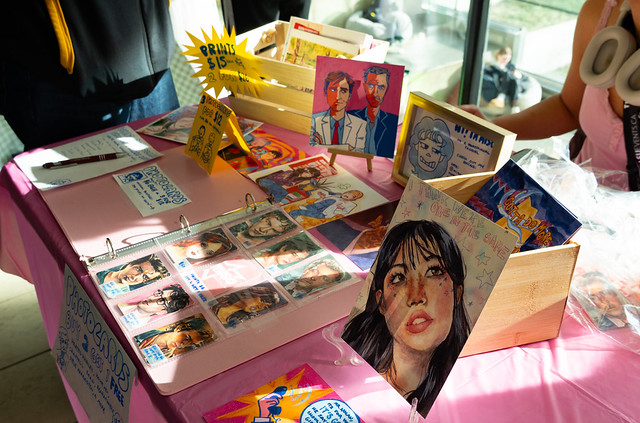
They had tried to put on a similar event the year before, but didn’t work out. This last year, with a lot of passion and a lot of missed sleep, they managed to pull it off.
“We felt like we just wanted to fill a gap in the campus community that we saw,” Rivor said. “Us and a lot of our executives were people who are very involved in going to artist allies, going to other art markets around Edmonton and around other conventions. But we didn’t really feel like there was a space for that for students.”
He added that many of the Art Club’s members wanted to sell their art, but didn’t really know where to start. The Artist Alley gave them a supportive, student-centred space to try it out.
“We all felt very passionate about making Artist Alley happen, so everyone was willing to pitch in a little more, even though it was pretty chaotic at the start,” Zhao said. She credited the success to having a great team of people.
With the success of the event, they were able to take the money and put it back into their community. This year, they are offering scholarships to some members.
“We wanted to reward those who are really trying to still pursue their passion, still do everything that they want to do in art alongside university,” Rivor said.
And they promised that the Artist Alley would be making a return this year.
The evolution of creative expression at the U of A mirrors broader cultural changes in Canada: a move toward interdisciplinarity, a push for equity and representation, and a recognition of art as both personal practice and public dialogue.
More than a century after its founding, the university continues to produce novelists, filmmakers, playwrights, and scholars. But just as importantly, it cultivates everyday creators — students who may not pursue the arts professionally but who leave campus having learned to see storytelling as a tool for understanding themselves and their communities.
In libraries and lecture halls, on stages and screens, creative expression remains a living, changing force. Its forms have multiplied, its voices diversified, and its reach expanded. As the university looks toward a digital-first future, it carries the weight and the wisdom of its past — from the first meetings of the Literary Society to the global reach of today’s digital artists.
If the past century is any indication, the next generation of students will redefine it again, ensuring that the U of A remains a place where the impulse to tell stories that matter never fades.