Community members raise concerns about new home for U of A organ
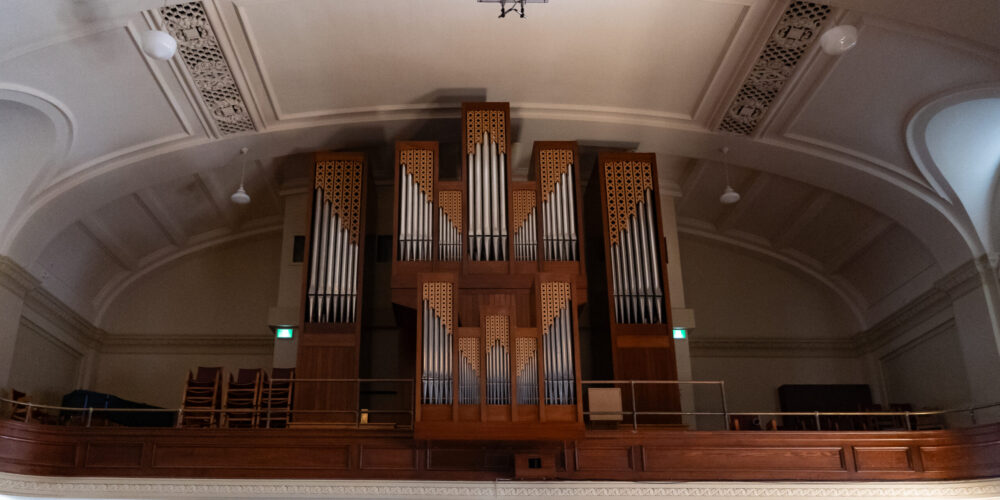
The U of A has announced that the Netherlands Reformed Congregation of Picture Butte will house the 1978 organ in its new sanctuary.

 Leah Hennig
On August 25, the University of Alberta announced that it had selected a new home for the 1978 Casavant organ. The Netherlands Reformed Congregation of Picture Butte plans to house the organ in their new sanctuary.
The 1978 Casavant Organ has been at the heart of controversy after community members discovered plans for the organ to be removed from Convocation Hall. A petition against the removal has gathered over 46,000 signatures.
In June, Robert Summerby-Murray, who the university selected to complete an external review of the organ’s future, released a report. Summerby-Murray recommended the U of A enter into an agreement with a local community organization to relocate the organ.
Reverend E.C. Adams explained that the congregation has two services on Sundays and services during the week. He said that the organ will be played during those services.
He said that the congregation has a few young people interested in playing the organ. “We have some quite talented organists,” he said. “If you have an organ, you also need gifted organists to get the sound out.”
Concerns over distance and access
Haley Simons, an alumna of the U of A music program, expressed concern over the distance of Picture Butte from the U of A. Picture Butte is over 400 kilometres, or a five hour drive, from the U of A’s North Campus. Furthermore, she is worried about the uncertainty of the organ’s future.
“There is no building. There is nowhere for this to be rehomed, except in someone’s imagination. That’s the only building that exists,” she said. “There is no evidence of the building being brought into existence. There is no permitting, there is no design, there is no budget that anyone has seen.”
The congregation is currently in the design stage of building a new sanctuary for its members. Adams said they hope to have construction completed in the spring of 2028. The U of A plans to store the organ for up to 18 months.
U of A media relations said in an email to The Gateway that the congregation had demonstrated the capacity to receive and install the organ. “The congregation is at a stage of planning that will enable optimal accommodation and integration of the organ in the final design and construction of the sanctuary.”
Simons has concerns around how access will be determined. She questioned if a person’s denomination or beliefs would be a factor considered in granting scholarly access.
The report by Summerby-Murray also noted that the Royal Canadian College of Organists recommended, among other things, that the new venue be a secular, publicly accessible space.
Access to the organ will be available through the public services of the congregation, U of A media relations said. Additionally, the agreement to transfer the organ includes a provision “for academic staff in the department of music to access, study, or use the organ for scholarly research purposes, on a case-by-case basis.”
Adams said that the congregation has not yet decided how it will facilitate scholarly access.
Congregation to rededicate organ as a war memorial
The U of A initially denied that the 1978 organ had been dedicated as a war memorial to students and staff who served in the World Wars. However, the U of A accepted Summerby-Murray’s report that stated the organ is a war memorial.
The U of A and Adams have said that the organ will be rededicated once relocated in Picture Butte.
The U of A also has plans to expand the current memorial at the entrance of Convocation Hall in the course of its renovations.
The organ is still a significant loss in Andy Grabia’s eyes. His grandfather’s uncle died at Vimy Ridge and his grandfather served in the Navy.
Grabia completed two degrees at the U of A and went on to work for the university over many years. For Canada’s 150, Garbia wrote a story for the U of A about the staff and students who died in the First World War.
“Knowing why [the organ] was built and the loss that made it happen, those are my reasons for really caring about it,” he said. “And it’s beautiful. It’s gorgeous.”
He described the news of the organ’s new location as devastating.
“Hearing rumours that they’d found a spot, I just thought they found a spot in the city,” Grabia said. “It never would have crossed my mind that they would have found a spot five hours away at a closed, private church.”
Grabia was involved in efforts to stop the U of A from removing its Ring Houses, which sat north of the Windsor Car Park until 2022. Grabia said he’s protective over the campus and its historical buildings and objects. He also remembers when the initial conversations around removing the organ started in 2019.
“I was sort of alarmed then, but then it went away,” he said. “I kind of thought, ‘okay, good, no one’s actually crazy enough to get [rid of the organ.]’”
When the plans to remove the organ resurfaced in April, he “was not surprised that the university did not inform [General Faculties Council], did not inform the students’ union, the alumni association, … or just the general public.”
Grabia said he still sees a path to preventing the organ from being removed and relocated. Beyond his personal attachment to the organ, he said he sees this an opportunity to embrace Canadian pride in a contentious time.
“These were U of A soldiers, but they were also Canadian soldiers,” he said.