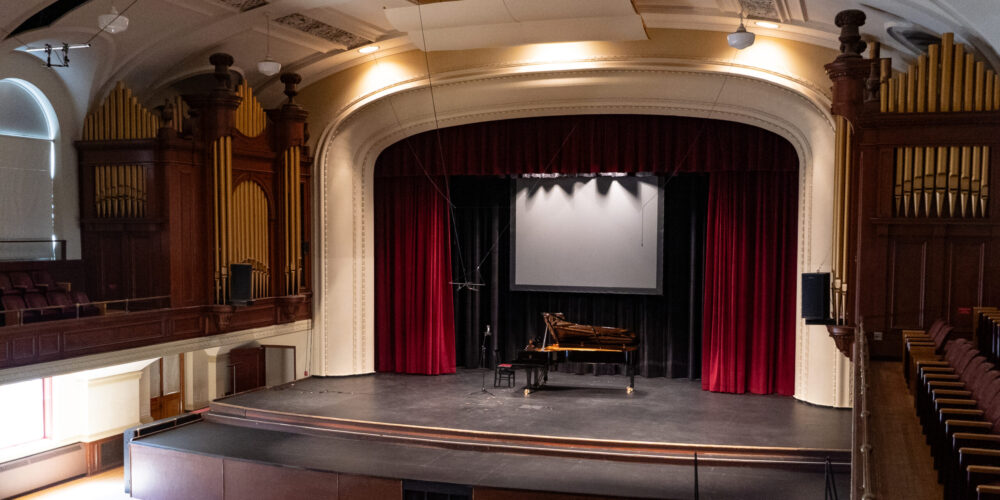
External expert releases report on plans to remove 1978 organ
University says its accepts the reports findings, which states that the 1978 organ is a war memorial and recommends moving ahead with its removal without delay.

 Leah Hennig
Brought on board in May, Robert Summerby-Murray has submitted his report on the future of the 1978 Casavant Organ. The University of Alberta selected Summerby-Murray as an external expert to consult on the removal of the 1978 Casavant Organ from Convocation Hall. Summerby-Murray has experience as a university administrator, a pipe organist consultant, and a veteran affairs advisor.
The U of A released a public statement on its plan to remove the organ in April. Since then, a petition in favour of saving the organ has gathered almost 45,000 signatures at the time of publication. The General Faculties Council (GFC) has also discussed the organ’s future multiple times.
The report is 20-pages long and contains four recommendations. Summerby-Murray outlined his methodology, starting with a visit to the site of the organ and then reviewing documents. He then met with various stakeholders within the university and in the community.
U of A acknowledges 1978 organ as a war memorial
One of the report’s findings, which the U of A has acknowledged in its response to the report, is that the 1978 organ is unequivocally a memorial. The university had repeatedly stated that the organ was not officially a memorial. The U of A has since removed all public statements where it claimed the organ was not a memorial.
Summerby-Murray, however, found that the organ was publicly rededicated to students and staff who served in both World Wars and that the U of A “took advantage” of a federal tax exemption for memorial organs when it purchased the organ.
While the U of A now acknowledges that the organ is a war memorial, it stated in its response that “the report is also clear that honouring the organ’s memorial status does not require it to remain in Convocation Hall.”
Summerby-Murray’s report also critiqued the memorial outside the entrance of Convocation Hall for being poorly lit and having “little attempt to construct a narrative around the role of members of the university who have served.”
His report also stated that the location made it difficult to have active memorialization, including Remembrance Day ceremonies.
U of A media relations told The Gateway in an email that the university’s “position on the organ’s memorial status was clarified through this process.”
“Our focus going forward is on a renewed Convocation Hall that will serve our community for the next century, and on an organ that is honoured, rehoused, and rededicated with the care it deserves,” media relations said.
Report recommends continuing with the renovations and removal of the organ without delay
Summerby-Murray’s recommendations include updating and highlighting the memorial at the entrance of the hall. He recommended potentially including a reference to the Memorial Organ.
His other recommendations included that the university enter into an agreement with a local community organization with a suitable venue for the organ’s relocation. Once relocated, the organ should be rededicated as a memorial, Summerby-Murray said.
The recommendations also mentioned setting aside an appropriate budget for the transition of the organ to a new space.
The final recommendation was for the university to proceed without delay, but to communicate the next steps publicly.
The U of A responded to the report on June 18, accepting “all the report’s findings and will be guided by its recommendations as we move into the next phase of the organ’s life.”
The statement also acknowledged that some community members may be disappointed with the decision to proceed with removing the organ. But, the U of A committed “to being clear, open and transparent about the organ’s future — including our ongoing efforts to find it a suitable home.”
Questions about decision making process
Some questions remain about the governance procedure for the decision to remove the organ.
GFC has discussed the plans for the organ twice. Some GFC members noted that the GFC terms of reference give GFC the delegated authority over university spaces. The Post-Secondary Learning Act also outlines GFC’s authority to make recommendations to the Board of Governors on matters of the betterment of buildings, furnishing and equipping of buildings, and campus planning.
The term of reference specifically gives GFC the delegated authority over the repurposing of spaces. Lise Gotell, a professor of women and gender studies, said the decision to remove the organ constitutes a repurposing of the space. Todd Gilchrist, vice-president (university services, finance, and operations), disagreed and said he has the power to determine what constitutes a repurposing at the May 25 GFC meeting.
The U of A has also said that the decision to remove the organ dates back to 2019. Some community members, however, say that the university has not been able to tell them what governance body made the decision to remove the organ.
Haley Simons has also questioned whether acknowledging the organ as a memorial would have affected the GFC vote to postpone the removal. The vote tied, but failed when President and Vice-chancellor Bill Flanagan abstained.
The Gateway asked what U of A authority made the decision to remove the organ. Media relations told The Gateway it was an “was an operational decision, made through the university’s established process for capital and facilities planning — a process designed to ensure decisions reflect our academic mission, priorities and available resources.”