Book Review: ‘Shelter in Text: Essays on Dwelling and Refuge’
'Shelter in Text' questions how stories shelter us, and how homes we build in text can be just as real as the ones made of brick and drywall.

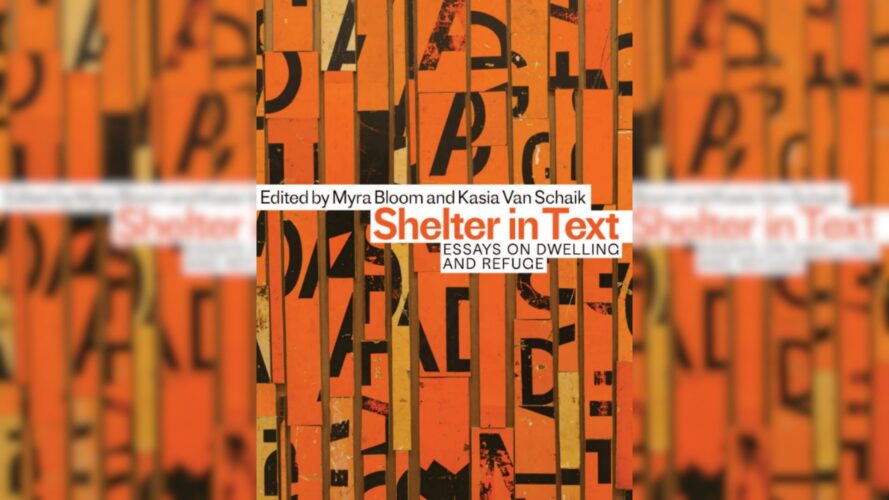 Supplied
What does it mean to be sheltered? Four walls and a roof are an easy answer. Shelter in Text: Essays on Dwelling and Refuge, edited by Myra Bloom and Kasia Van Schaik, spends 19 chapters proving that the answer is not nearly enough. The collection grew out of a 2022 academic conference, conceived during the COVID-19 lockdowns when Bloom and Van Schaik found themselves reaching for stories the way others reached for canned goods. Their central premise is deceptively simple: stories shelter us, and the homes we build in text can be just as real and just as contested as the ones made of brick and drywall. Even a partial read of this collection makes the book’s vast ambitions hard to miss.
The most quietly devastating section is the first. In “Seasons and Stories,” Sarah Gordon and Caroline Lavoie read Innu-written Michael Jean’s novels Kukum and Atuk through the lens of shelter as identity. For Jean’s ancestors, home was never a fixed address. Instead, it was a relationship with the land, with the seasons, and with the knowledge of which bay offered refuge from the northeast winds. The colonial imposition of reservations and government housing projects didn’t just move people into new buildings. It severed them from that relationship entirely. What followed was alcoholism, violence, and loss of language, which the narrator of Kukum names plainly. These were not the problem, but rather “the symptoms of the insidious evil that ate away at Innu people.” It is the kind of passage that demands the reader sit still for a moment.
This idea that shelter is relational rather than structural threads through the entire collection and gives it a coherence that prevents it from feeling like an academic grab-bag. A conversation between Indigenous novelist Billy-Ray Belcourt and diasporic writer David Chariandy, facilitated by Lily Cho, picks up the same thread from a different angle. Both writers circle the word “refuge” and remain suspicious of it. Chariandy describes how often the promise of refuge within nation-states and even in private life can turn out to be illusory. This is particularly true for those Canada has never quite decided to welcome fully. It is a politically urgent piece and a highly readable one. The author presents it as a live conversation rather than a polished argument. For anyone who has ever felt that gap between Canada’s multicultural self-image and the daily reality of being scrutinized within it, this chapter will feel uncomfortably familiar.
The collection’s lighter touch comes in Heather Jessup’s “Library Books for the End of the World,” which recounts the first 70 days of Vancouver’s pandemic lockdown. Jessup describes the six picture books her family checked out before libraries closed with a tone that is funny and tender in equal measure. She cries when her partner forgets to buy potato chips, and she finds herself conducting literary analysis of Mo Willems’s My Friend is Sad while grading exams from a parked minivan. But underneath the humour is something real about what books do for children and the adults trying to hold things together for them. As someone studying elementary education, the essay landed differently than the others. It serves as a reminder that the shelter a picture book builds around a child is not metaphorical at all.
The collection closes with its most harrowing contribution. Andre David King’s “Six Quarantines” moves across hospital rooms, a surgical ward in Shanghai, and a winter in Vienna. King, who was chronically ill with nerve pain, carried books to the edges of bridges he looked over more nights than he later admits. Books, King writes, became “an amulet against the world.” It is the most honest piece in the book and arguably the most necessary. It holds the collection’s central argument to its hardest test by asking what happens when the shelter text provides is the only shelter left.
Shelter in Text is not a breezy read, and some of its more academic chapters require patience. But Bloom and Van Schaik have made smart curatorial choices. Notably, they weave creative non-fiction and poetry between the scholarly essays so the collection breathes. The range is genuinely surprising, whether exploring Indian apartment fiction, Vancouver anti-gentrification poetry, or a wry critical tour of Canada’s literary plaque trail. The cumulative effect is that questions of home and belonging start turning up everywhere. That is the book’s most lasting achievement: it changes what you notice. In a moment when those questions feel more politically charged than they have in years, this book is addressing something that arrives exactly on time.