Play Review: ‘Waiting for the Parade’
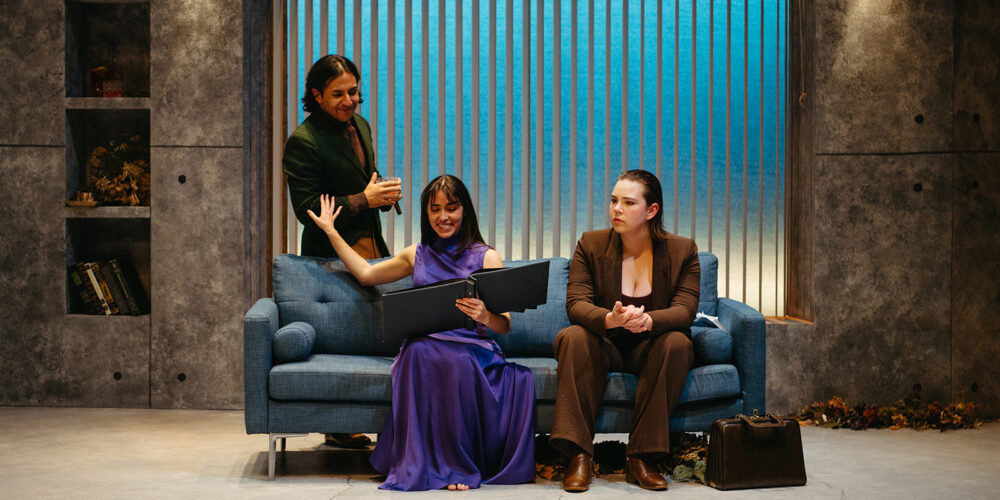
'Waiting for the Parade,' directed by Monica Roberts, brings the World War II Canadian homefront to life with vivid imagination and detail.

 Supplied
War dramas are often centred on the experiences of the battlefield. Its blood and gore, heroics and sacrifices, and the fight for good over evil. These tend to be dominated by the men doing the fighting and dying. Frequently overlooked are the lives of women who stay behind during wartime. They may lack overt bloodshed, but certainly contain no less inner drama. The play Waiting for the Parade by John Murrell explores this often hidden world of suppressed feelings, longing, and the occasional outburst of emotion, animating the homefront with vivid imagination and detail.
Set in Calgary during the Second World War, the play follows five very different women as they each cope with the pressures of war in their own way. The play is a series of 24 slice-of-life vignettes that incorporate music, monologues, and vivid interactions between characters. Through this, the forces that drive the women’s inner struggles are revealed with depth and clarity.
The women’s contrasting responses to the war illuminate its many faces. Janet (Tanya Lawrence), the group’s self-appointed leader, channels her anxieties into relentless and enthusiastic participation in the war effort. Her zeal reads less as patriotism than a shield against the shame she feels regarding her husband, who fulfills his service through reading newscasts on the radio rather than active duty. Her need to control and direct the others sets her in natural opposition to Catherine (Ruth Wong-Miller). Catherine is the play’s most emotionally complex figure, whose husband is overseas and eventually goes missing in action. Where Janet copes through action, Catherine copes by trying to live life to the fullest, war or no war. She takes a job at a munitions plant and becomes friendly with another man. She is not without guilt or grief, however. In one of the play’s most quietly devastating moments, she reflects that her husband’s image is fading from memory piece by piece, until she can no longer reconstruct his face. It’s a profound metaphor for the slow erosion of presence that wartime absence inflicts.
If Catherine represents the tension between waiting and moving forward, Margaret (Anglia Redding) embodies the cost of never moving at all. Both her sons are lost to her — one serving away, the other arrested for distributing Communist propaganda. She is the group’s most rigid fixture, a woman quietly abandoned by a society she can no longer recognize. Marta (Sarah Gibson), meanwhile, occupies a uniquely painful position as a German-Canadian suddenly rendered foreign and suspect. Her presence asks uncomfortable questions about belonging and whose suffering counts in times of national crisis.
Then there is Eve, brought to life in a remarkably endearing performance by first-year University of Alberta drama student Ginny Sandness. Eve is a teacher who tries to hold onto her belief in basic human decency even as the world around her makes that harder and harder to sustain.
Together, these women do not form a united front so much as a friction-filled portrait of a society under strain. Each one personifies a different answer to the same impossible question of how to live, love, and hold oneself together when the world is seemingly unravelling around you.
The intimate stage of Walterdale Theatre captures the scene and setting of the play well. Its closeness to the audience reinforces the homely design and transports us back to the period with ease. Music also does much to set the scene and lift the mood when the emotional weight threatens to overwhelm. Songs like “Bluebirds Over the White Cliffs of Dover” and the haunting “Lili Marlene” — familiar to wartime audiences on both sides of the Atlantic — bring an immediate authenticity to the setting, grounding the drama in shared cultural memory. In a play driven largely by monologue and dialogue, these musical interludes are welcome respites. They are a reminder that even in the darkest of times, people sang, danced, and found moments of joy. That contrast between the lightness of the music and the heaviness of what surrounds it is itself part of the play’s emotional truth.
One of the most striking aspects of the play is its refusal to wrap things up neatly. None of the women’s troubles are resolved, no hardships redeemed by the outcome of the war. When victory arrives, the celebration feels distant, even hollow, against the grief that hangs over the stage. It is this refusal of easy comfort that gives the play its lasting power. The ambiguities of war — who it costs, what it takes, what it leaves behind — are never resolved, because of course they cannot be. As Marta says near the end, declining to judge how others have coped: “The only thing I think is: so that’s how she manages to stay alive. I wonder if it would work for me.” The quiet heroism of getting through each unpredictable day, by whatever means necessary, is the thread that ties the entire story together.