 Supplied
A study at the University of Alberta found a potential new treatment for Alzheimer’s. Poly(lactic-co-glycolic) acid (PLGA) nanoparticles, a type of biodegradable nanoparticle, can drastically reduce disease-induced brain changes and reverse memory deficits in mouse models of Alzheimer’s disease, the most common cause of dementia.
“Once it is taken to the body, it can be broken down into lactic acid [and] glycolic acid and then subsequently can be removed from the body as carbon dioxide and water … so it does not induce any toxicity,” Satyabrata Kar explained.
Kar led the study in collaboration with researchers Simonetta Sipione and Gopal Thinakaran. He has been studying Alzheimer’s disease for the last two decades and is a professor in the neurology division of the U of A’s department of medicine.
PLGA nanoparticles have long been used in medicine. It was first approved by the American Food and Drug Administration (FDA) in the 1970s as a biodegradable suture. Since then, it has been used to deliver drugs.
“As of now, more than 20 drugs, like antibiotics, anticancer drugs, are being delivered using the nanoparticles,” Kar said.
But it turns out that continuous administration of PLGA nanoparticles directly into the brain, without any drug attached to them, may improve hallmarks of Alzheimer’s disease.
In mouse models of Niemann-Pick disease type C, which features brain changes similar to those in Alzheimer’s, Kar’s lab found that dying neurons’ recycling centres (lysosomes) leak their enzymes into the rest of the neuron. This triggers a cascade of events that lead to the neuron’s death.
Lysosomal leakage is a hallmark of other brain diseases as well, including Alzheimer’s and Parkinson’s. So when Kar came across a study that showed that drug-free PLGA nanoparticles applied to Parkinson’s cellular models protected against lysosomal leakage, he decided to test whether it works for Alzheimer’s models, too.
How it works
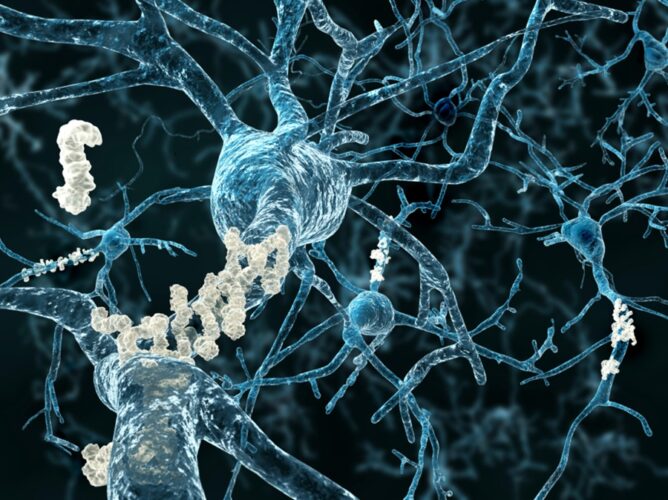
Alzheimer’s disease is caused by increased production and accumulation of beta-amyloid peptides in the brain, which causes another protein called tau to tangle inside neurons. Brain inflammation and oxidative stress, which damage cells, also contribute to neuronal death in Alzheimer’s disease.
In mouse models with beta-amyloid plaques, Kar discovered that PLGA nanoparticles reduce the causes and effects in these mice through multiple targets.
When production of beta-amyloid peptides increases, the peptides aggregate into plaques outside neurons and inside them, in the lysosomes. Enzymes in lysosomes need an acidic environment to function. But the plaques de-acidify the lysosomes, preventing the enzymes from clearing them. This causes lysosomal leakage, leading to neuronal death.
PLGA nanoparticles protect neurons by re-acidifying the de-acidified lysosomes so the enzymes can break the plaques down.
The nanoparticles also regulate brain inflammation and oxidative stress and reduce the production of beta-amyloid peptides.
Furthermore, in vitro studies show that it acts directly on beta-amyloid plaques deposited outside neurons, triggering their disassembly. In test tubes, PLGA nanoparticles also inhibit the formation of tau tangles, an effect that Kar is planning to study further with different mouse models.
His lab is still investigating further details of the mechanism, including which effects are primary and which are consequences and whether PLGA nanoparticles can delay the development of Alzheimer’s hallmarks.
Whether PLGA nanoparticles can reverse later stages of Alzheimer’s is unknown.
On moving to clinical trials and future research
“It is a promising strategy, but it’s a long way to go to the human,” Kar emphasized.
One major question Kar is now studying is whether PLGA nanoparticles can cross the blood-brain barrier, which prevents many molecules in the bloodstream, including certain medications, from entering the brain.
With the Alzheimer’s mouse models, Kar explained, “we injected [PLGA] nanoparticles directly into the brain using the mini osmotic pump. The mini osmotic pump … keeps on pumping the nanoparticle all the time.
“This is not for therapeutic use because there is no way anybody will allow you to [place] a pump into the Alzheimer patient’s brain,” he added.
Additionally, because this is an entirely new concept, even if PLGA nanoparticles are already FDA-approved, Kar’s findings have to be replicated for clinicians to develop the confidence to take it to clinical trials.
Recently, one lab has replicated their findings in the United States.
In the meantime, Kar is working with U of A chemist Michael Serpe to increase PLGA nanoparticles’ half-life in the blood so they remain effective longer. The two are also working with U of A radiochemist Ralf Schirrmacher to attach labels to the nanoparticles. These labels will allow them to use PET scans to detect Alzheimer’s faster.