Robert Wood reflects on first term as arts dean and outlines vision for second
Wood hopes to bring more international students, hire more academic staff, and add new programs to the faculty of arts.

 Leah Hennig
Robert Wood began a five-year term as dean of the faculty of arts on July 1, 2022 and will conclude on June 30, 2027. He hopes to be selected by the University of Alberta’s Board of Governors to begin another five year-term as dean.
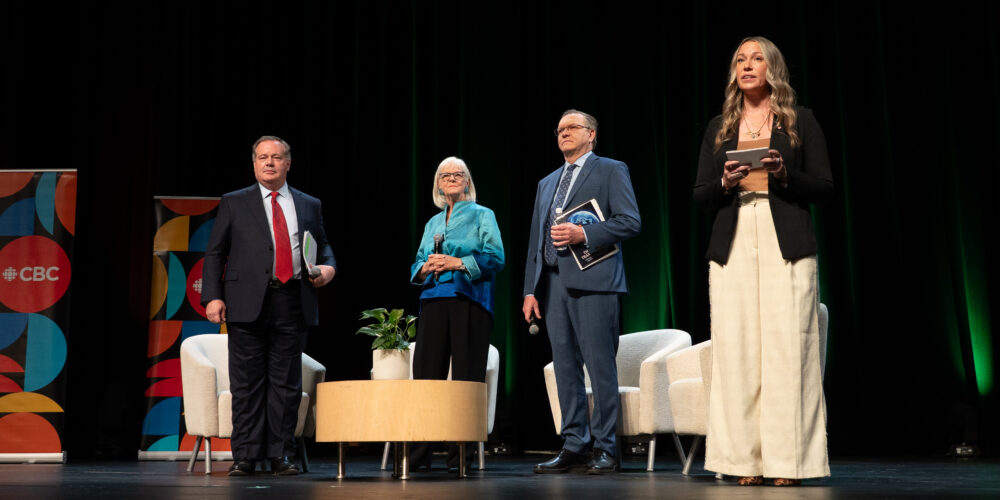
On September 22, he presented at the arts faculty forum to reflect on his work as dean over the past five years and share a vision for a second term if chosen as dean again.
“We will confirm our place as one of the strongest arts faculties in the country and the world,” Wood said.
New Bachelor of Economics and goal to hire more academic staff
Wood started with directing attention towards enrolment milestones that occurred under his tenure as dean.
He cited that this fall, the university reached a historic high. 7,300 total arts undergraduate students well as more than 700 graduate students. Numbers that are unprecedented, and continue to grow annually.
He quoted “unprecedented fundraising success” and pointed to $34 million from philanthropic fundraising in the last five years. This money supports scholarships, speaker series, new teaching positions, and renovations.
The increase in students and demand for arts programs led to the hiring of 58 full-time academic staff. This is not enough, noted Wood. Arts needs 285 full time academic staff to properly support its academic programs.
Right now, faculty members (excluding teaching-intensive faculty) operate under a 40/40/20 split. This means that workload allocation for arts faculty members is divided between 40 per cent teaching, 40 per cent research, and 20 per cent service. Service includes administrative work and serving on university committees.
Wood discussed decreasing the amount of time faculty members spend teaching, so they can allocate more time to research. However, this does require “the right configuration of academic staff and modifications to the way we deliver some programs.” In other words, arts needs more faculty members.
To continue supporting growth, an incoming certificate in artificial intelligence (AI) is currently being developed. Previously, arts has introduced several new minors in recent years. This includes a minor in media and technology studies and recreation and tourism minor that launched fall 2026.
Wood plans to target programs like media and technology studies, art and design, as well as economics. Specifically, the addition of an approved Bachelor of Economics degree.
Currently, economics majors and minors are under a Bachelor of Arts in Economics.
He is also currently in “collaborative discussions” with the faculty of Native studies to potentially add Native studies courses as a requirement for arts students. Right now, the mandatory Native studies course requirement is limited to faculty of science students, and arts students can take Native studies courses as option courses.
Renovations and refurbishments of arts spaces is another continuing goal. Wood highlighted donation gifts to support renovations in Convocation Hall, and improvements to the Old Arts Lounge and Fishbowl in the Humanities Centre.
“I think the faculty of arts could become the most internationalized arts faculty in Canada within the next five years,” Wood says
More international students and travel abroad opportunities would help assist in generating significant net revenues for the faculty.
More than 1,000 international students are currently in the arts faculty, with hopes to expand to 2,300 by 2031.
This target will be achieved by expanding foundation programs, he explained. These will allow international applicants who do not meet the requirements for direct admission to take U of A courses. Once completed, students can officially enter their U of A degree program while keeping the credits from their foundation courses.
International students currently participate in the foundation program through the university’s partnership with Kaplan International, which Wood hopes to strengthen.
China, specifically, is a key target country. Through 4+0 programs, students can complete their degree locally without visiting Canada. He hopes to collaborate with Zhonnan University of Economics and Law to achieve this. This way, students can receive U of A certification while attending campus in China.
As for budget, Wood acknowledged that the current model “simply does not work for arts.” He hopes to change that and help develop a revised budget that meets the needs of the arts faculty.
When asked about regrets during his first term, Wood said creating a new strategic plan from scratch rather than improving the pre-existing one.
The new plan ended up being very similar to the original one, which was a mistake in retrospect. Wood reflected it would have been better to “have a planned rejuvenation exercise.”