Exhibit Review: ‘Climates of Health: The Weather Inside Us’
A climactic crossroad of research and art, 'Climates of Health' captures us in a web of critical relationships between humans and the environment.

 Monet Davies
 If there is one thing that Climates of Health: The Weather Inside Us invokes, it is our oneness with the environment. With contributing artists from Canada, Japan, and the United States, this exhibit at the FAB Gallery makes us reflect on how all of us experience this “interprobleminary” life in different ways, yet the worsening climate crisis impacts every one of us. We are called to confront the ways in which we are interlinked with climate change, from the consumerism that fuels it to the vulnerable communities and immunocompromised individuals who suffer most from it.
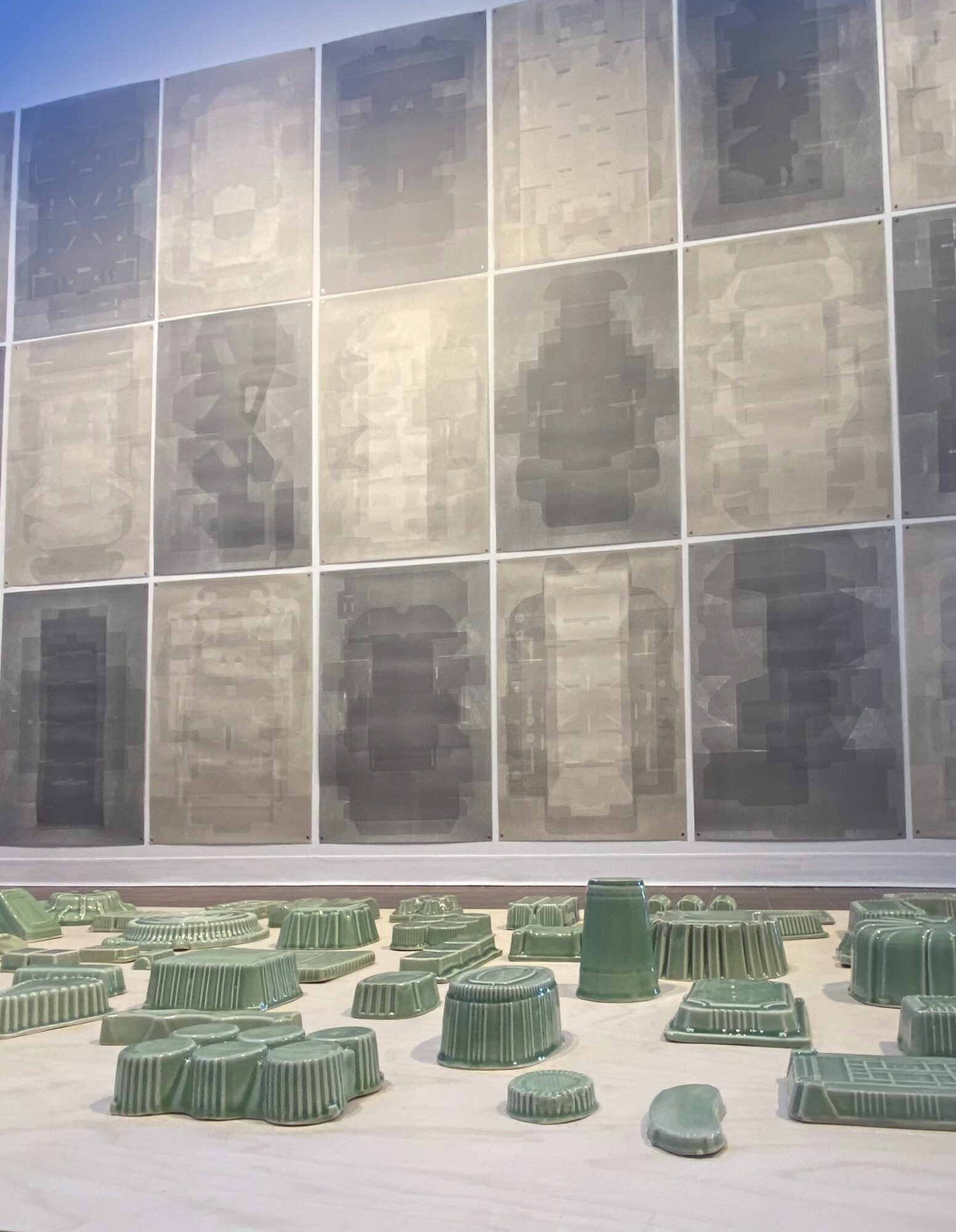
In artist Yoomi Nam’s work, “Unfolding” and “Keeping,” we are disoriented by the familiar. I was confused by the prints of “Unfolding,” which stretched up the wall with overlapping shadows of shapes that reminded me of something I could not quite place my finger on.
The same went for “Keeping,” the smooth, sage green porcelain pieces positioned firmly in the centre of the room. Looking more closely, the ghost of cardboard’s corrugated patterns becomes apparent in “Unfolding,” and eventually our eyes land on the undeniable lid of a coffee cup in “Keeping.” By creating impressions and careful casts of these easily disposed materials, Nam addresses how these objects fade from our attention and forces us to face the permanent impact of our mass consumption.
April Dean carries on this idea of permanence in her piece, “Something to Remember Me By.” Bubble wrap rests on a table next to a matching phone case and plastic container, eerily eternalized as ceramic casts. But Dean also captures permanence more optimistically. Sharing a space on that same table is some prairie grass impossibly growing out of two ceramic jars, woven together into an arch. The thoughtful contrast between the green and yellow grass with the almost uncaring whiteness suggests resilience. Despite everything, we are still trying to mend our relationships with our environment and connect with people from across the world to approach these harsh conditions.
Koichi Yamamoto’s kites, “Jomon ika” and “Fuyu ika,” lean off the wall as if already soaring. The designs on the paper bodies are stunningly intricate, and when you look at them in certain ways, you might even begin to see various faces staring back at you. The optimism that Dean introduced into her work seems to carry over, with Yamamoto invoking the childhood memory of the wind tugging us along by this delicate tether. At any moment, we could let go and lose our precious connection with the sky, or we could hold our ground and strive for that balance we need to approach our environment with.
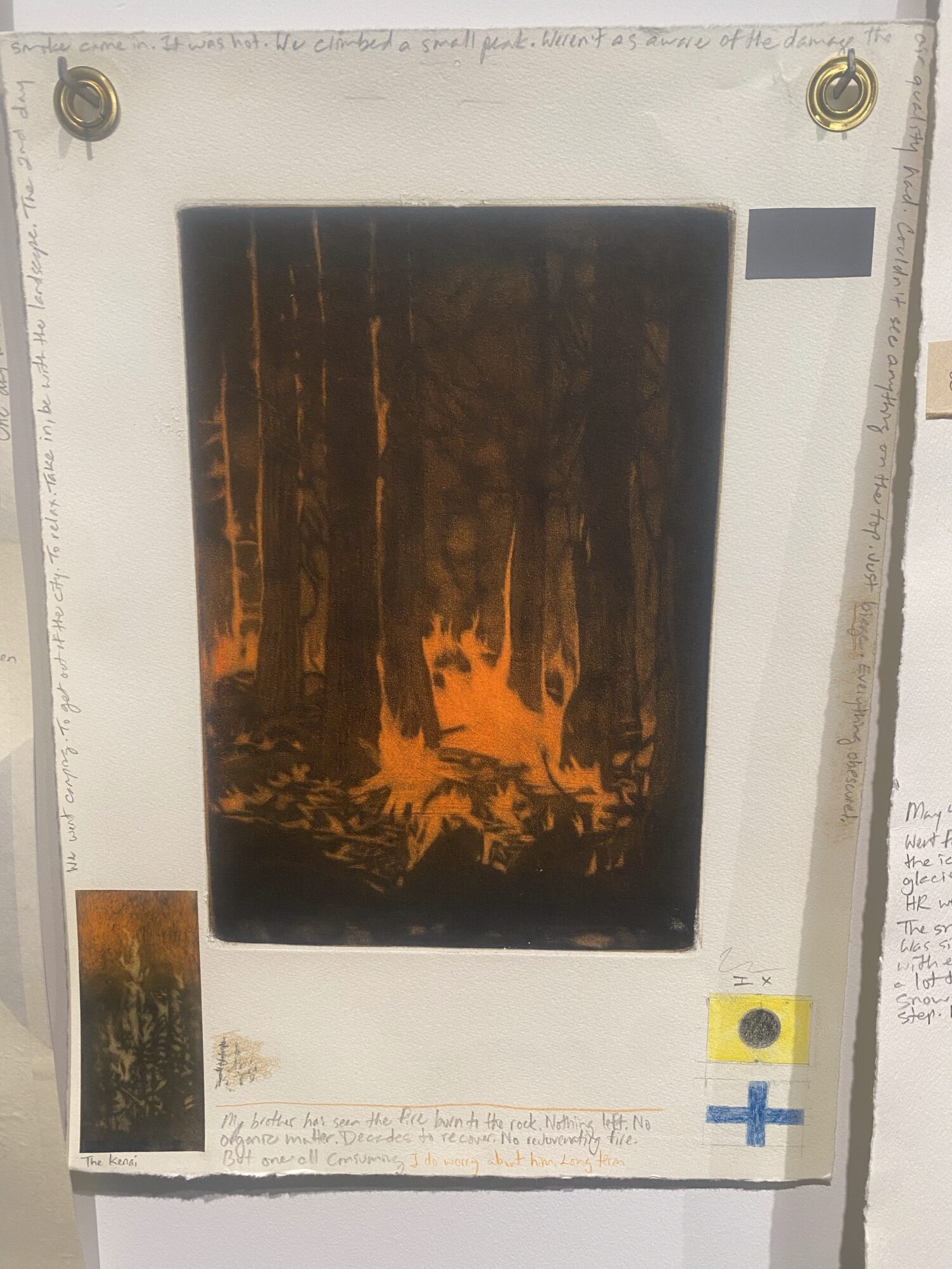
my lungs by Johnathan S. Green
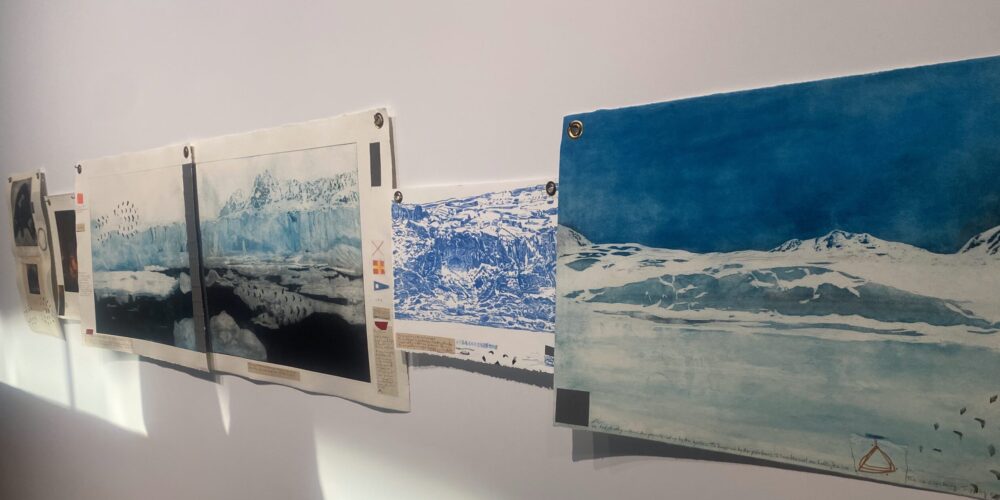
The cost of disrupting this balance is illustrated in “Black carbon – from the forests to the glaciers, into my lungs.” Johnathan S. Green highlights two sides of the climate crisis: the loud disasters and quiet losses. The former is captured in a single image of fire consuming a forest, the darkness of the woods indicating the hush of night, angrily interrupted by the burst of destruction. The latter is shown through four subsequent prints of majestic yet fragile snow-capped glaciers. By spreading the Arctic landscape out between several pages, Green grabs our attention for longer, freezing us in place to consider how these glaciers are actively disappearing. Even though melting ice seems less theatrical than wildfires, the consequences are nonetheless catastrophic.
“Evolving Anatomies III: Mirrored Branches,” by Sean Caufield and Marilène Oliver, approaches the consequences of climate change and our intertwinement with the environment from an explicitly health-centric perspective. My favourite part of this elaborate piece is found in the empty spaces of the LiDAR scan, where Oliver included tiny text from Reddit conversations. Having to get so close to the piece to read creates a sense of intimacy, which feels necessary as you engage with the conversations of parents with children who have respiratory issues, asking for advice during dangerously smoky summers. It feels uncomfortably appropriate that these personal stories blend so easily into the background, since the voices of our most vulnerable populations are so often left out of international climate debates.
Climates of Health contains a variety of other provocative pieces, including an interactive Arctic light exhibit and an experimental performance video.