Judy Mill’s work on HIV recognized with Distinguished Alumni Award
After many years researching the impacts of HIV on women and teaching at the U of A, Mill was honoured with an award.

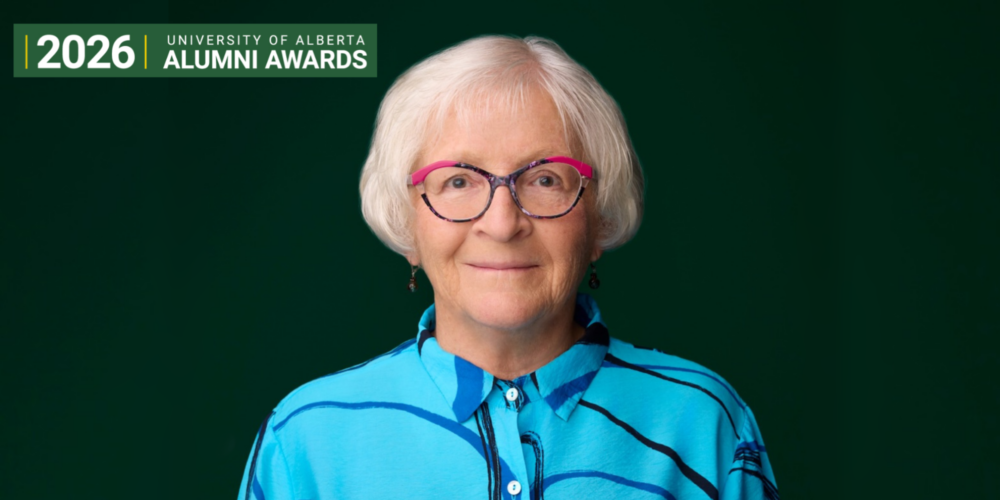 Supplied
Judy Mill never thought she would go to university. Instead, she initially took a two-year nursing diploma at the Toronto General Hospital to get her education over with. But years later, she was drawn to research and teaching in public health and nursing.
“If anyone had told me when I finished my diploma in nursing that I would go on to teach and do a post-doc and PhD in the faculty of nursing here, I wouldn’t have believed them,” Mill said.
But she did, and she was given the University of Alberta’s 2026 Distinguished Alumni Award.
Visiting countries overseas and seeing other perspectives of health and treatments laid the foundation for her academic career. After returning from Zambia and Malawi, Mill pursued higher education again with a Bachelor’s in Nursing at the University of Calgary.
She later pursued graduate studies at the U of A, completing her Master of Nursing in 1996 and her PhD in 2000.
Her research focus was on how AIDs and HIV impacted women, particularly those in Africa. For her Master’s she interviewed women living with HIV in Canada, and then went to Ghana to do the same.
“Women are often stigmatized if they become HIV positive, in my experience in Canada,” Mill explained. They often have experiences with substance use disorders or contracted HIV from their partners.
In Ghana, the stigma was heightened. “Women’s power and ability to make decisions was often secondary to the men’s in their relationships,” she said.
Sometimes, if a husband had other partners and women challenged them, the women would be blamed for bringing HIV into the relationship. Due to the women’s economic dependence on their husband[s], they would often stay in the relationship.
Education is key to combating stigma for those living with HIV
“There’s been some change, but there’s still a lot of stigma related to HIV and people living with it,” Mill said. “They often have to hide their diagnosis from other people, from families, from friends.”
She noted that while organizations like HIV Edmonton can provide support, they sometimes don’t openly advertise their name on the building due to the stigma people seeking support could face.
Education is key to combating this stigma. Education can help people realize that “these are human beings and deserve to be treated like the rest of us,” Mill said.
Mill also worked with Indigenous communities in Canada on HIV. Enoch Cree Nation honoured Mill with an eagle feather for her work. The man who gave her the eagle feather attended the alumni awards celebration.
Some of Mill’s students that she had taken to Ghana for their clinical practicum also attended the awards ceremony.
“They had heard I was getting an award and came to the ceremony,” she said. “They said to me, being in Ghana for three months changed their whole perspective on nursing. It was very nice to hear that that had had a real impact.”