Book Review: ‘Duckweed’ by Kathryn Lennon
Kathryn Lennon’s Duckweed explores the beauty of the in-between.

 Supplied
In her debut poetry collection, Edmonton writer Kathryn Lennon comments on her hyphenated identity as a Chinese-Canadian. Duckweed incorporates language-learning exercises. This incorporation works for a mainly English-speaking readership but also invites older Chinese generations to open up and explore poetry. Specifically, “Someday I Will” welcomes the reader to learn some key phrases of Cantonese and Mandarin. In turn, most of Lennon’s poems embrace and accept the reader for who they are and where they are in relation to speaking Cantonese or Mandarin. Duckweed challenges the norms of bilingual books by giving kindness to its readership in poems like “Someday I Will.”
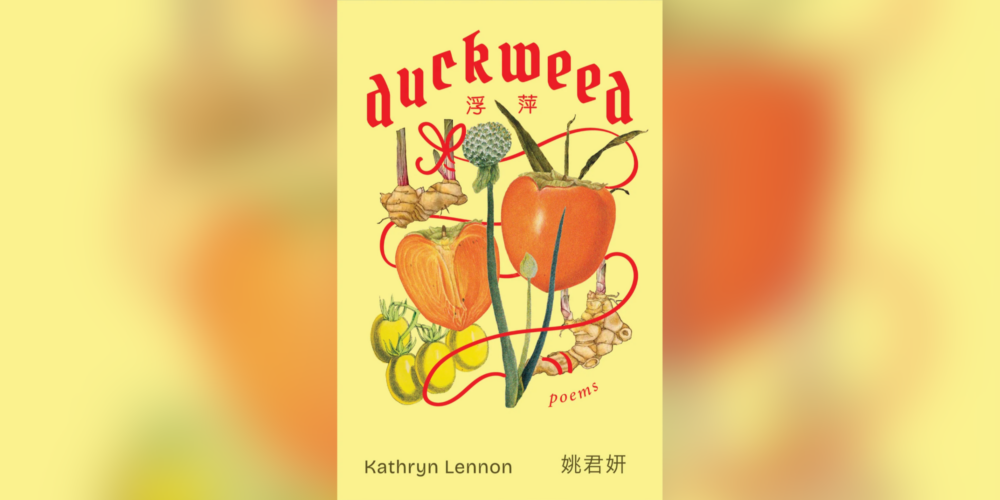
The book cover of Duckweed, illustrated by Celine Chung, presents a plethora of fruits and herbs based in Chinese medicine. The main subject focused on the cover is an orange persimmon, and it comes as a stark contrast to the highlighter yellow background that coats Duckweed in its entirety.
In keeping with the theme of hyphenated identity, Lennon explores the diasporic feeling of longing in her pieces. In “Dragons Might Have Been Here,” Lennon references the Chinese Immigration Act of 1923 and, consequently, the Central Pacific Railroad. Nearly 90% of its workforce were Chinese immigrants. Lennon writes: “Under every foot track in the Fraser Valley/ lies the body of one Chinese railroad worker.” These two lines evoke a great sense of anguish over history. Her poetry deals with difficult subjects, like intergenerational trauma and colonialism, and is unapologetically confrontational with its readers.
This confrontation comes as a type of kindness, too. A kindness that invites the reader to tackle hard conversations about the roots of racism and colonization. I appreciate the unabashedness of Lennon’s words. The strength in them carries the reader through Duckweed. It takes courage to confront prejudice within oneself and learn lessons about rehumanizing marginalized groups, which Duckweed so eloquently does. It welcomes the harsh recollections of colonized history and braves the storm with the reader.
In “Act II, Scene 1,” Lennon writes: “One hundred years since the Chinese Exclusion Act was passed. A-MA is standing alone in her kitchen, rice cooker and wok in front of her, preparing dinner. The backdrop is coloured by catastrophe, genocide, and a kind of racism that’s shifted shape but still perpetuates their foreignness.” This quote nods to the intergenerational trauma that ripples through the Chinese-Canadian diaspora.
Generational gaps in both language-learning and trauma shape Duckweed as a diasporic text. In the last poem, “Jo Sun, Poh Poh” (Good morning, Poh Poh), Lennon writes in a beginner-level Cantonese to her grandmother. As the reader says this last poem outloud, its bittersweetness melts on the tip of their tongue. The beginner-level Cantonese subverts its simple and playful nature with its serious topics of loss of language and hyphenated identity.
Duckweed paints an image of intergenerational attitudes, in-between languages, and colourful metaphors about Chinese-Canadian diaspora that reaffirms its reader in their relationship with Cantonese, Mandarin, and the Chinese diaspora.