Beginner’s guide to Canada West football
University of Alberta Golden Bears football is back in action, and it is time to learn about the rules or recieve a refresher.

 University of Alberta Athletics
 Football season is starting again on campus. The University of Alberta’s Golden Bears are back in action. They started with their home opener on September 4, which is followed by the upcoming game on September 18 against the University of Saskatchewan Huskies.
For those new to football, the inner workings of the sport may seem daunting or confusing. After learning the rules, watching and understanding a game will be a piece of cake.
The Bears play within Canada West (CW). The division represents universities from Manitoba all the way to Vancouver. Like the Canadian Football League (CFL), CW follows the rules for Canadian football. This is a bit different from American football rules and the National Football League (NFL).
General rules in Canadian football
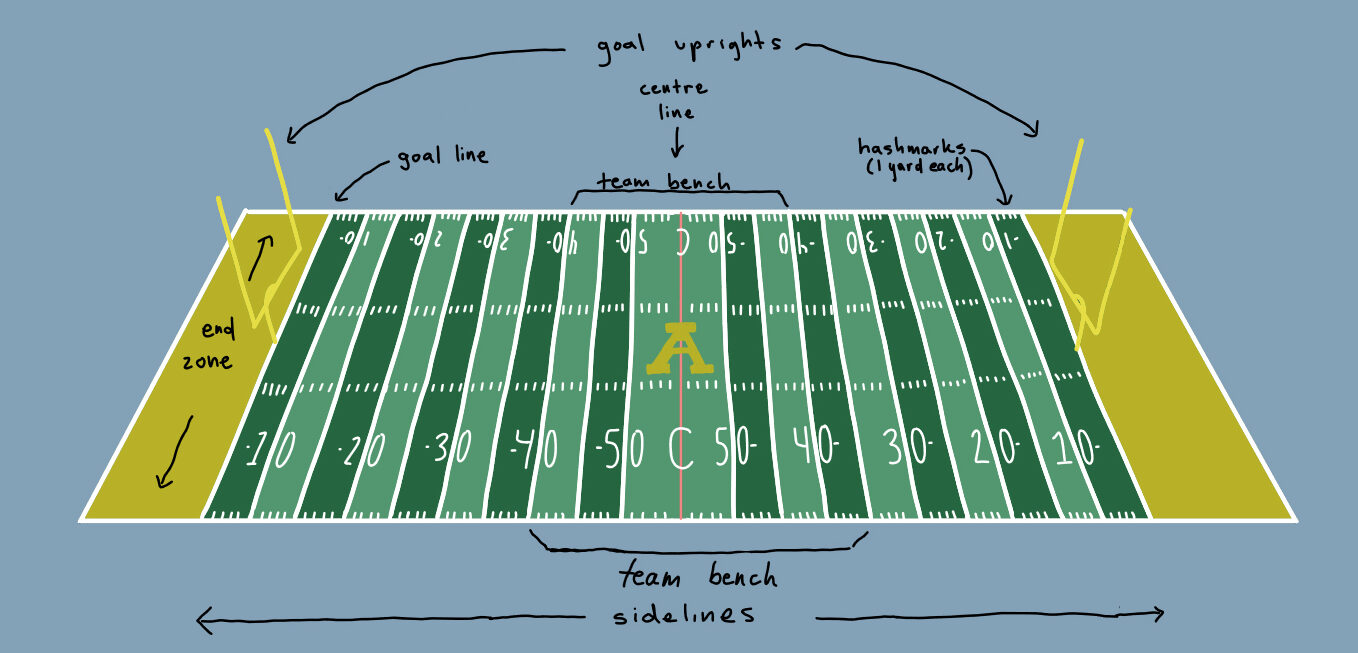
Canada’s football pitches are 150 by 65 yards, or 100.6 by 59.4 metres. Officials use yards on the pitch during play. They determine the yards with the lateral lines found width-wise on the field every five yards. The centre line is marked at 55 yards, or with a “C” on the pitch. The end zone starts near the goal posts and is 20 yards deep.
The main objective of football is to place the football into the opponent’s end zone area, which results in a touchdown. Running or passing up the field is the goal, all while working against the opponent who is trying to stop your forward progress and gain the ball for themselves.
Each game consists of four 15-minute quarters, for a total of 60 minutes. The team with the most points at the end of the game wins.
Scoring Opportunities
- Touchdown: worth six points; done by running, passing or catching the ball in the opposing team’s end zone.
- Field goal: worth three points, done by kicking the ball between the goalpost uprights and over the crossbar.
- Safety: worth two points, when a ball-carrying player gets tackled in their own end zone.
- Convert: completed after a touchdown to attempt to add more points to their score. Worth one point by kicking the ball between the goalpost uprights after a touchdown. Or worth two points by passing or carrying the ball into the end zone.
- Rouge: special to Canadian football, it can be worth one or two points. One point is awarded after a team’s kick enters the end zone of the opponent without the opponent returning the ball into the field of play. Two points are awarded when the ball is out of bounds inside the end zone after a kick by the other team.
The game starts with a coin toss between the two teams. The winner of the toss can choose to either receive or kick off at the start to begin the game. Each team consists of 12 players, with a variety of positions across offence, defence and special teams.
Field positions
Offence: When a team has the ball, they are now on offence, also called attack. While on offence, the team has three downs, or three plays, to gain at least 10 yards towards the goal post.
If a team gains 10 yards before they have reached three downs, they are given three more downs to get another 10-plus yards and remain on offence. If the offence fails to reach 10 yards, or the other team intercepts the ball, the team is now on defence.
Some roles of offence include the offensive line: a wall of strong players who protect the quarterback from being tackled. The quarterback starts every play with the ball and executes plays either by passing or handing it to another player.
Defence: this is when the team does not have the ball and defends against the attack from the other team. Their goal is to stop the offence from gaining ten yards during their three downs, or to intercept the ball and get possession of it for themselves. If the defence is successful in stopping the offence, they come off the field as it is now their offensive teammates’ turn.
Special teams: the players who are a part of special teams play neither offence nor defence. They have special roles such as kicking, receiving, punting, field goals, conversions and kickoffs. This sounds like a lot, but these players stand out on the field due to their special roles.
A punt is when a player drops and kicks the ball before it lands on the field. During a punt, only the receiving team, the kicker, and those behind the kicker can touch the ball.
To learn further about individual roles within these three categories, check out this page on football positions.