Student’s survey sparks progress for DATS accessibility
Carmela Spadafora conducted a survey to pinpoint issues with accessing DATS on campus, and the data sparked a real change.

 Leah Hennig
Carmela Spadafora has used Edmonton’s Dedicated Accessible Transit Service (DATS) since she was about 21-years-old. She said it makes her life a lot simpler than it would be if she had to take the bus. But it’s not without its challenges.
Spadafora was taking Humanities (HUM) 101, a course hosted by the Community Service Learning program for adult learners on campus. She ended up surveying her classmates and other community members about their experience with DATS.
Through that survey, she was able to gather data that drove real changes on the University of Alberta campus.
“We keep having problems here at the U of A because none of our stops are properly labelled,” Wade says
Spadafora and her fellow classmates faced similar issues when using DATS. A big issue was DATS drivers having trouble locating the stops on campus.
Spadafora said that sometimes it feels dangerous trying to find where the DATS vehicle is.
Jay Friesen, an instructor for HUM 101, said that it’s really difficult for DATS drivers to find pick-up locations on campus, largely because there’s no real street addresses.
To order a DATS, you have to call three days in advance and tell them exactly where they need to pick you up from. Without an exact street address for drivers to find, it creates a lot of confusion.
One time Friesen and Spadafora were waiting in the Students’ Union Building (SUB) for a DATS ride and the driver was telling them that they had arrived. But Friesen and Spadafora couldn’t see the DATS ride anywhere.
As it turns out, the driver had ended up by the Computer Sciences Centre where they had no way of seeing him.
This wasn’t a new problem either. Lynn Wade, a support worker with Spadafora, said that the DATS stops at HUB Mall were also a consistent issue.
There’s two stops at HUB Mall — one at the north end and one at the south end. Drivers would frequently end up at the wrong side for pick up.
“I’m running in and out to look for it, as a support worker, to see if the DATS is anywhere around because they say they’re there and then they’re not there,” Wade said. “I’m running around, but I also have to keep three people safe. As a support worker, it is one of the most aggravating and scary situations there is … you’re leaving behind the people that you’re supporting.”
For those with intellectual disabilities, that was sometimes dangerous. She said that they could wander off or have disagreements or fights without her present.
“There’s many, many folks that have used DATS for all different sorts of reasons and all different pockets of the campus,” she said. “We keep having problems here at the U of A because none of our stops are properly labelled.”
Affects go beyond physical accessibility to access to learning
Friesen said that they would order the DATS properly and they would be waiting in the proper place. But it would still go wrong.
And the issue wasn’t just being late. If the person who ordered a DATS got marked as a no-show, that could impact their ability to order future DATS. After three no-shows a person can’t order a DATS anymore.
Lisa Prins, the manager of adult and community education, said that she knew people who would end up getting marked as a no-show because the driver went to the wrong pick-up location.
“The stress of getting a no-show could pre-occupy someone so much to the extent that they can’t even attend class anymore because the consequences of losing their access outweighs the access,” Prins said.
“It’s not only physical access, it’s to learning,” Friesen said. “Learning with other people is a fundamental human experience and it is threatened when you can’t make it there because you’re worried about a no-show coming up on your account.”
Survey data unlocked process for change
With the survey data that Spadafora collected, Friesen was able to go to one of the strategic infrastructure planners at the U of A, Kyle Witiw.
Witiw had previously worked with the City of Edmonton and was familiar with DATS. He helped get a list of stops on campus and a list of over 40,000 trips over the last three years to different DATS stops.
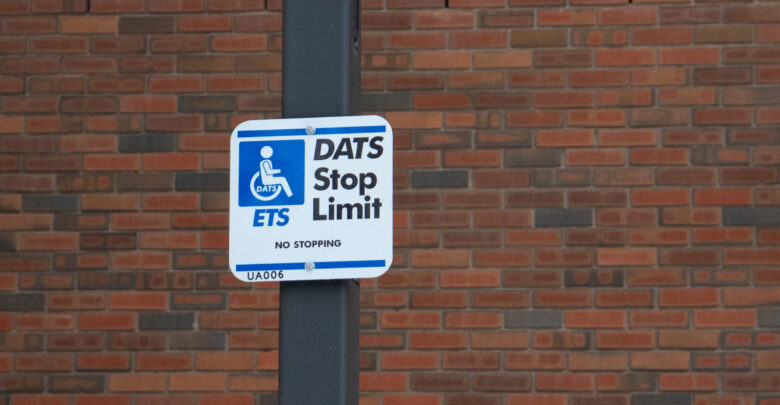
HUM 101 sent students out to these different stops to do an audit of the stops. They went in different seasons to see the different conditions of each at different times of the year. Afterwards, they identified the best, most important, and most accessible stops on campus. Then new signs were made with specific numbers for each stop.
Now, using the numbers, it’s easier for DATS to find the specific stops on campus.
Friesen said it can be hard to actually drive change forward, but “what unlocked this process at the university was [Spadafora] was able to bring the survey and the responses to the campus community.”
Friesen said the survey gave Witiw the tools to make that change happen.
“It’s just one less thing to try to figure out every week,” Prins said. “I’m just grateful to everyone and all the work they’ve done. [Spadafora] was able to reinvigorate the process.”