Students host town hall to discuss transit safety concerns
Edmonton mayor, superintendent for transit peace officers, and community outreach lead discuss concerns around transit safety for students.

 Leah Hennig
Five University of Alberta students hosted a transit safety town hall on November 20 as their leadership capstone project. Maya Bezubiak, Bian Kheiri, Benson Meja, Ayah Sellam, and Bismah Zaidi put the town hall together to create “an open space for conversation, where you can talk directly to community members … and leaders.”
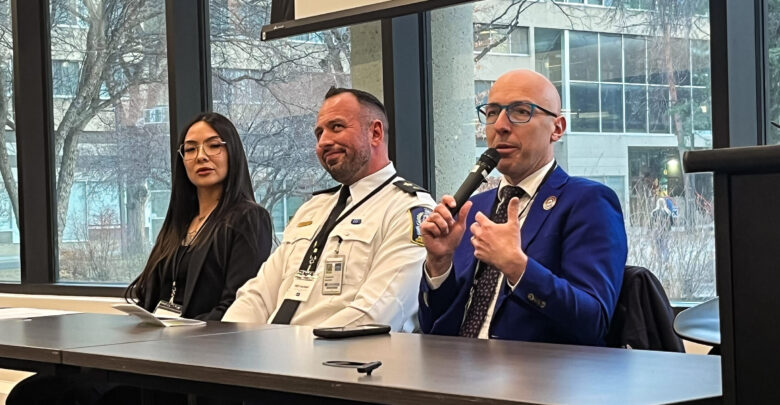
Edmonton Mayor Andrew Knack, Superintendent for Transit Peace Officers Fred Macham, and Team Lead of the Edmonton Community Outreach Transit Team (COTT) Mariah Eshkakogan answered questions from the organizers and students. The panel was moderated by Daniel Witte, the chair of Edmonton Transit Riders (ETR).
One of the topics covered was the gap between statistics around transit safety and the perception of safety on transit. In 2024, data showed a six per cent decrease in crime severity in transit centres. In the same year, a survey showed that 61 per cent of riders felt safe using transit.
Knack said a person’s perception of safety is often tied to their lived experience.
“I’m 41-years-old, this is what I look like when I use our transit system. I generally feel really safe,” he said. “But there’s many people who are racialized, who are younger, who are maybe seniors who don’t feel that same experience.”
He said that the city hasn’t done a good enough job communicating the improvements with transit safety.
Knack also mentioned how social media plays into perceptions of safety.
“I’ll go on reddit and see a post about somebody’s unsafe experience, and then there’s gonna be a bunch of other people who say ‘yeah, I feel the same way,’” he explained.
But, according to Knack, people post less frequently about their good experiences on transit because that’s just what they expect.
Macham said that there’s been a 19 per cent decrease in drug related incidents and a 47 per cent decrease in violent crime in 2025. Additionally, he said there’s been a 15 per cent decrease in Edmonton Police Service (EPS) calls for transit safety concerns.
Outreach for unhoused folks and contacting Transit Watch
Eshkakogan added that people often treat houselessness as a criminal act. In her work, outreach teams approach unhoused folks to check on them and offer resources.
“I feel like sometimes negative perceptions can really harm the humanity,” she said.
She encouraged people to also check in on unhoused folks, or to contact the outreach team if they don’t feel comfortable approaching someone. Eshkakogan said that the team can help with things as simple as someone not having shoes.
Knack mentioned his first motion as mayor, which was to increase the amount of day shelter spaces in Edmonton. He said that this gives people an alternative space to stay warm in the winter and helps connect them to resources.
All three panelists encouraged people to be active transit riders, as opposed to passive riders. If a rider sees concerning behaviour in transit centres, they’re encouraged to call the Transit Watch at 780-442-4900. Transit peace officers or COTT outreach times can then respond to the situation.
Knack did note that while there is no cell service in many of the LRT stations or tunnels, service can be expected sometime next year.