Notes from Council: Multiple student groups raise concerns during open forum
Additionally, Umayr Rafiq was ratified as the engineering councillor, and Stephanie Dickie presented on the Enhancing Academic Advising Project.

 Leah Hennig
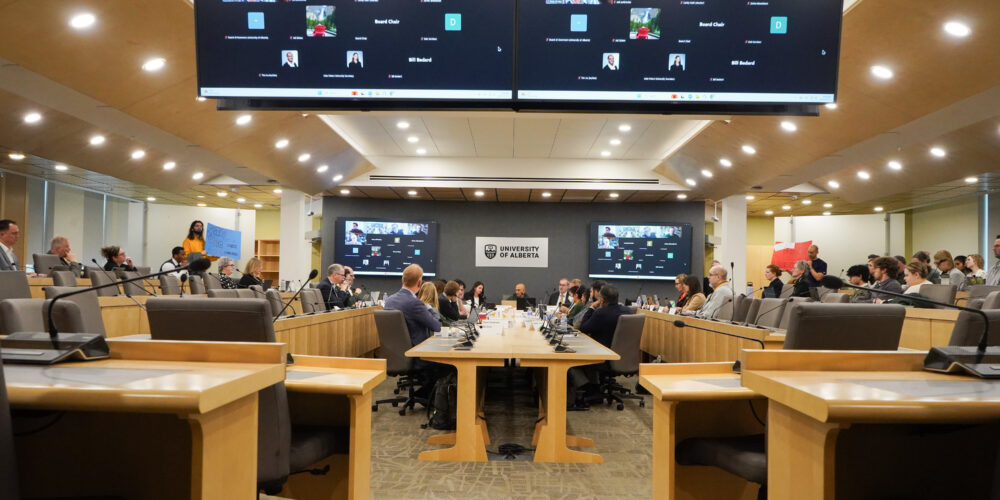
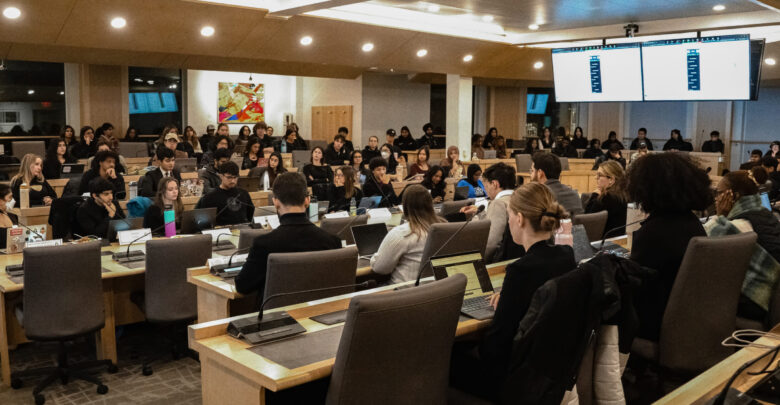
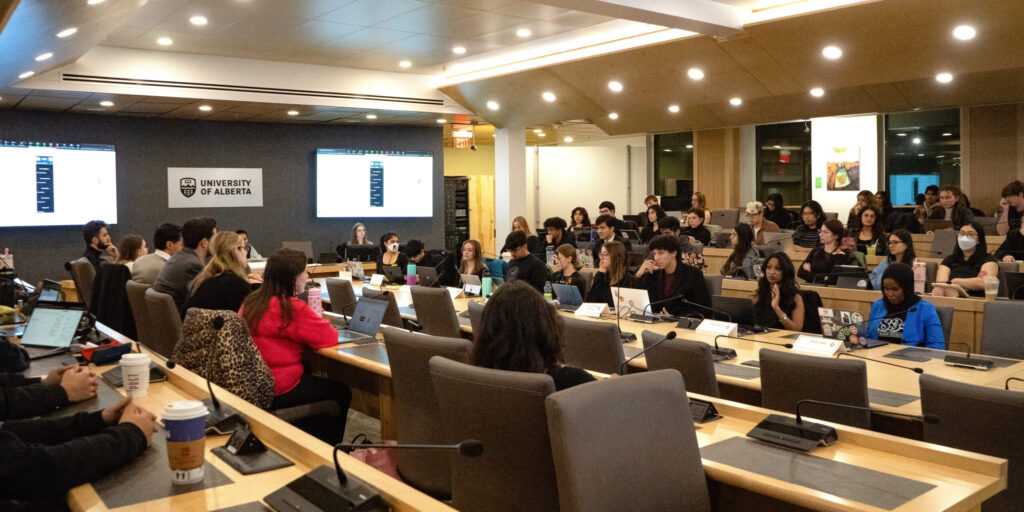
At the University of Alberta Students’ Union (UASU) Students’ Council meeting on December 2, various student groups raised questions and concerns to UASU executives during the open forum. Approximately 100 guests of council attended the open forum.
Additionally, Umayr Rafiq was ratified as an engineering councillor and Stephanie Dickie presented on the Enhancing Academic Advising Project.
Open forum
Among the groups present at the open forum were the U of A Black Students’ Association (UABSA), Indigenous Students’ Union (ISU), International Students’ Association (ISA), the Italian Club (ITALUA), the Latin American Students’ Association (LASA), the Organization for Arts Students and Interdisciplinary Studies (OASIS) and the Lister Hall Students’ Association (LHSA).
The Gateway asked Vice-president (external) Abdul Abassi how much a recent Canadian Alliance of Student Associations (CASA) anniversary event cost, and how much of the student population’s money funded it. Abassi stated that he would look into it.
Emma-Leigh Snow, ISU president, shared her concerns about the potential reduction of UASU election forums into a single forum. Snow emphasized that the forums are safe, highly engaged spaces that must be taken seriously.
“This [executive] team have told us that they believe in reconciliation and action. The UASU is bound to it and here we stand to the proposal to end consultations in forums … the foremost place for dialogue for student governance and policy,” Snow said.
“It has been mentioned that the ISU and ISA forums are not important. However, these forums have the greatest engagement and turnout, not to mention these are spaces that are specifically made to create safe space for these students, respectively.”
Snow directed her question to those involved in the Elections Task Force (ETF).
Vice-president (operations and finance) Nathan Thiessen said ETF “does not itself have any power to change anything about our elections, as any regulatory changes are up to bylaw and council.”
He said this potential change was a drafted recommendation, but it’s “not necessarily set in stone.”
Thiessen spoke about the recommendation to change the forum model to a debate model, saying that the UASU would organize a debate for each race with a dedicated number of questions for satellite campuses and student organizations.
Additionally, he said he plans to suggest that the recommendation be withdrawn.
Concerns over alleged comments made by executives
Manyu Rathour, co-vice-president (communications) of the ISA, said that Thiessen disrespected an ISA executive in a consultation meeting. He alleged that Thiessen joked about increasing international students’ tuition by 50 per cent.
Thiessen said the comment was made to contextualize the powers of EFT, as it does not have the ability to control tuition.
“[It was] in effort to refocus the conversation on what [EFT] can focus on,” Thiessen explained.
Rathour then asked UASU President Pedro Almeida about the reasoning he gave for removing the ISA and ISU forums. Almeida allegedly said that the ISA and ISU forums weren’t that important.
Almeida denied saying that the forums weren’t that important, rather talked about the attendance levels.
Amaan Khan, a science councillor, testified that Almeida said that the ISA as a student representative association is dysfunctional.
Almeida responded, “yes, okay sure, that is a different thing than the forum problem.”
Rathour requested the meeting minutes for EFT. Thiessen explained that EFT was not created as a committee and as such, meeting minutes do not exist in a “comprehensive manner.” Rather they are informal meeting notes.
Armaan Singh, co-vice-president (communications) of the ISA, questioned Vice-president (academic) Katie Tamsett about alleged comments made at Dewey’s.
The question was about an alleged joke referencing colonial-era gifting of blankets infected with smallpox to Indigenous Peoples. Singh asked why an executive would make such a comment. Singh justified this question as relevant, as the alleged comment was made in a UASU-owned business and it speaks to the behaviour of executives.
Tamsett denied making the comment, saying “the depiction is not accurate.”
“I recognize that I am a settler on this land and that I have British ancestry. On a daily occurrence, I am reminded of this and the impact that my people have had, and how I bear responsibility for this as a white, privileged woman,” Tamsett said.
Khan was asked to testify that Tamsett did make a comment as a witness.
“I was at that meeting, at that gathering, and I was taken aback from the comment,” Khan said.
In a closing statement, Khan said that when he testified, he wasn’t confirming the comments.
“I just said that I was in the room, and the appropriate concerns have been brought to the appropriate people.”
The Gateway sought clarification from Tamsett on her alleged comment. Tamsett denied making the comment, and said that “in these situations, I understand the challenge that individuals face, because there is so much harm that is being brought to so many individuals.”
Transparency concerns
Multiple speakers brought up concerns with a lack of transparency within the UASU. One such speaker was Jennifer Toro with the Political Science Undergraduate Association (PSUA). Toro asked why there haven’t been executive committee meeting minutes since July 11.
Courtney Graham, the UASU’s governance manager, explained that staff turnover has caused delays in posting minutes. She added that the minutes dating back to July will be posted soon.
Later on, ISA President Abdullah Al Anik expressed frustration with a lack of communication from the university to international students as it relates to tuition. Anik claimed that the U of A has failed to address the needs of suffering international students. He mentioned the UASU’s plans to increase engagement at forums through efforts such as free food, asking why the same efforts cannot be made for the ISA and the ISU forum.
Almeida welcomed the feedback, stating he looks forward to conversations between the ISA and the U of A.
Guests of council raise concerns with accountability
Toro spoke again, this time asking Vice-President (student-life) Logan West if she has done enough to support groups like the ISA and ISU.
“Do you believe that the SU is providing meaningful support to these communities, and what specific initiatives have you taken [to] meaningfully support the ISA and cultural groups in addressing their specific challenges in so they feel reflected and heard under your position?” Toro asked.
West responded, saying that she thinks it’s “up to the student leaders who I would seek to collaborate with to tell me whether or not I’m doing enough of a job.”
Hannan Sandhu, former co-president of the ISA, questioned West again later in open forum. Sandhu built off of Toro’s question, asking what is being done by the UASU to ensure student groups like the ISA are supported.
Sandhu said that the ISA’s vice-president (student life) has been waiting for a reply from West to an email about an event for three weeks.
“I am deeply sorry that there has not been a response to the email from November. I am not a perfect person. I am an incredibly imperfect person. I don’t think anybody in this room could say that there are not,” West said.
During her response, West broke down and asked for grace to be extended to her, saying that her grandfather is dying, and that it has been a tough time. West then left the council chambers, returning later.
Open forum ended after roughly two hours.
Enhancing Academic Advising Project
After the open forum, Stephanie Dickie presented on the Enhancing Academic Advising Project. Dickie outlined her core vision for advising at the U of A.
“What I want is a university where advising is clear, accessible, transparent, human-focused, and supported by effective, well-designed systems and intuitive, proactive technology,” Dickie said.
She went on to say that advising should be a coherent system, and not a confusing maze for students.
Dickie spoke about her consultations with students, staff, faculties, colleges, and the registrar office. She also studied the advising models of other institutions. The key issues mentioned were accessibility, long wait times, and inconsistent information.
Dickie mentioned that clear structure, training, and better technology are priorities going forward.