Ceremony held for anniversary of École Polytechnique de Montréal femicide
Community members gathered to mark 36 years since a femicide that killed 14 women in an engineering class at a Montreal Polytechnic.


 Leah Hennig
Community organizations held a commemoration ceremony on December 5 at Campus Saint-Jean (CSJ) to mark the anniversary of the femicide at École Polytechnique de Montréal. A man killed 14 women in a mechanical engineering classroom on December 6, 1989.
The Coalition des Femmes de l’Alberta, and the Association des Universitaires de la Faculté Saint-Jean (AUFSJ) organized the ceremony.
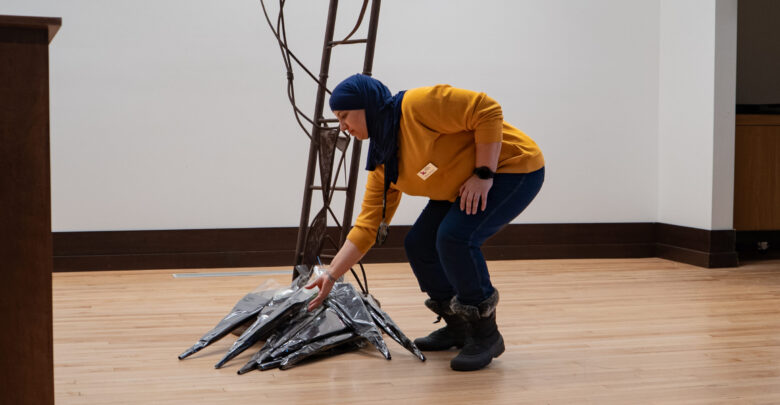
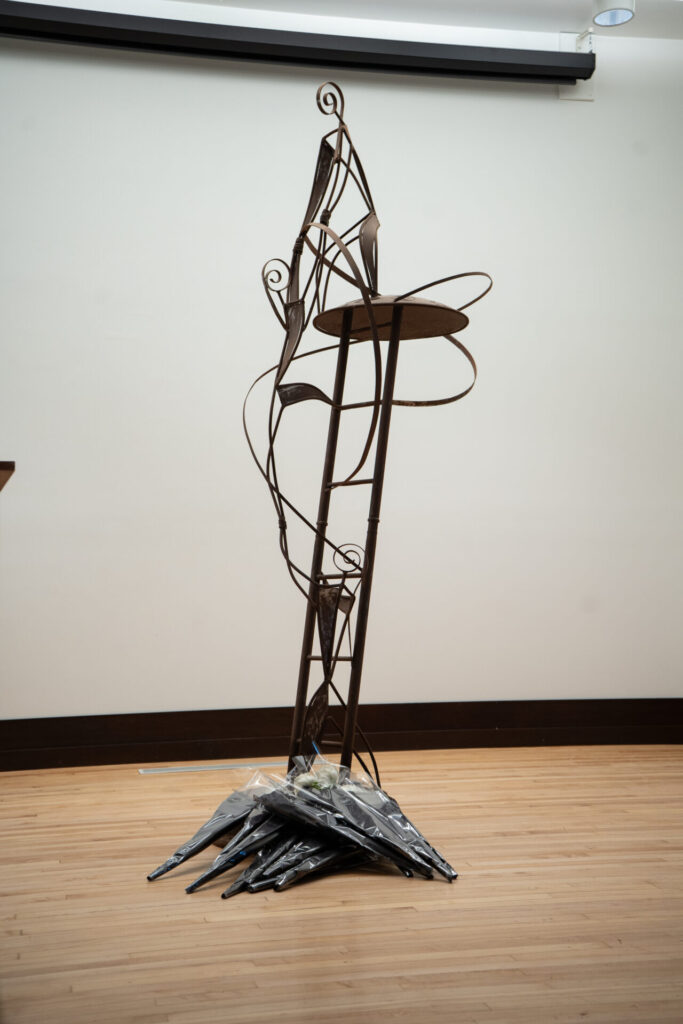
Members of the University of Alberta community laid 14 white roses at the foot the Trinity statue by Patrick Jacob.
Jason Carey, the dean of CSJ, spoke at the event.
“Thirteen future engineers and one future nurse were cowardly murdered simply for who they were and what they were about to achieve: building a better world and challenging the status quo in traditionally male-dominated fields,” Carey said.
“Today, we are fighting not only open hatred, but also the inertia and silence that perpetuates this inequality and violence within us.”
Change still needed, dean says
He said that violence against women is not a thing of the past. The rise of social media has also opened the doors to more sexual and gender-based violence (SGBV), Carey said.
Carey also noted that violence against Indigenous women and girls happens at an even higher rate.
“As an engineer, the husband of an engineer and a father of a daughter who, for now, wants to be an engineer, I have been fighting for years for equity in our profession,” he said. “It is heartbreaking to see that, more than 36 years after this massacre, the male-to-female ratio in engineering programs is still often three to one at the national level.”
“I sincerely believe that the engineering world and professional and academic communities have failed to honour these 14 victims by not accelerating this change sufficiently,” he said.
He reiterated the U of A’s commitment to addressing SGBV on its campuses. Carey said the U of A’s SGBV Policy is an essential document that guides the community.
“Equity is not a passive ideal; it is a daily action,” Carey said. “We have the power to change the narrative. We have a responsibility to be more than just witnesses.”
“I do not want to forget that this tragedy still reflects the challenges … women face in academia today,” Erica Norton says
Erica Norton, the president of AUFSJ, spoke at the ceremony.
“As a student representative, but also as a woman, I do not want to forget that this tragedy still reflects the challenges of disparity and discrimination that women face in academia today,” she said. “The university is supposed to be a space where ideas circulate freely, where everyone can develop their potential without fear of violence, judgement, or exclusion.”
“This occasion allows us to reaffirm our commitment to the total eradication of [SGBV] against women and girls on our campus,” Norton said. “The team at [AUFSJ] is committed to building a campus where gender-based violence no longer exists.”
She said that AUFSJ is also committed to providing proper and adequate support to victims of SGBV violence.
“This moment should be for everyone to reflect on the place our institutions occupy and to fully recognize the importance of the roles they play,” Norton said.
Speeches were translated from French by Gabriella Menezes