 Harold Hisona
Prasanna Neelakantan, a clinical dentist turned researcher, and his team may have just found a new dental filling that solves some of the problems with conventional fillings.
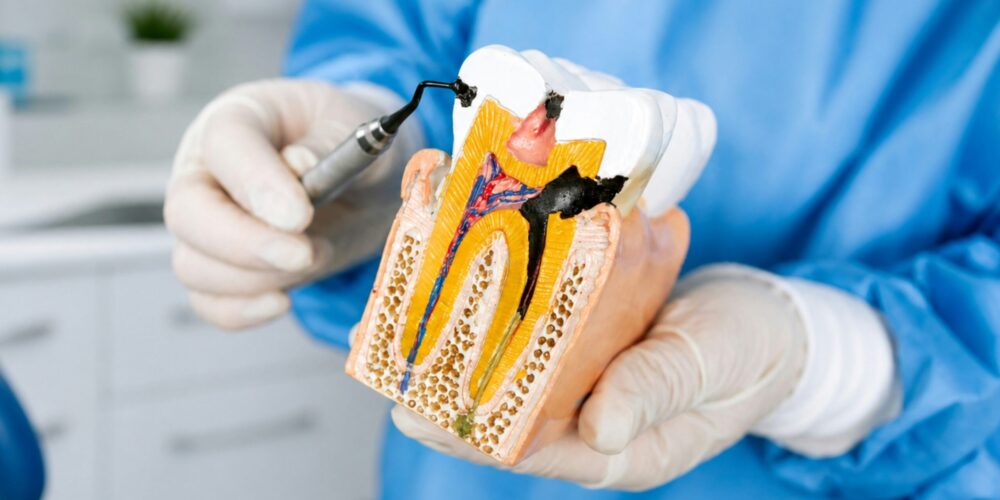
Dental fillings are commonly used when decay develops in a tooth or a tooth breaks in some kind of injury. The first case is quite common as “every adult would have had at least one decay within their lifetime.”
Historically, a silver-mercury combination called dental amalgam is the most common material used for fillings. Although dental amalgam is very strong and can last for decades, there have been environmental concerns with the production and storage of mercury.
“There are environmental issues because when you do them in the clinic, there could be some free mercury where you end up discarding them,” Neelakantan explained.
As a result, there has been a global effort to phase out of the use of mercury fillings by 2034.
Issues with current dental fillings
Another issue with dental amalgam is the aesthetics. Dental amalgam is usually grayish black in colour but because of that, some people do not prefer it being used for front teeth and prefer fillings with a similar colour to teeth.
This is why the most common filling now is a polymer-based filling called a resin composite. Although this has a similar colour to our teeth, making it great for aesthetics, it still has one issue: it shrinks when it hardens.
Although “you can’t see that shrinkage with the naked eye, it’s small enough for bacteria to go and sit there and continue growing.” This bacterial invasion can cause the tooth to decay, “which means the patient has to go back to the clinic, have that filling removed, and then place a new filling,” losing more of their tooth structure in the process.
Moreover, these composites can still be damaging to some of the cells in your body as they produce Bisphenol A (BPA), commonly found in plastic bottles.
Because of the above concerns, Canadian dentists are “searching for newer filling materials which can be as good as amalgam, but overcomes the environmental concerns and processes,” Neelakantan said.
One of the possible solutions is a polymer-based filling that has a short-term blue light and electrical current release that kills bacteria around the dental filling material.
A driving force behind the blue light and electrical nature of this polymer is that “we don’t want these chemicals coming out and killing the bacteria because bacteria will develop resistance to all of these chemicals,” he explained. Just adding microbial properties to the polymer is not good enough.
Thinking outside of the box
To find a suitable alternative, Neelakantan decided to think out of the box. “Why can’t we think of designing a kind of chemistry that will by itself be able to kill the bacteria around it without releasing any kind of chemical at all?”
Fortunately, there was a polymer discovered by a Philadelphia-based researcher that emits strong blue light when loaded mechanically and also produced an electrical current. The blue light and electrical current serve to kill bacteria without damaging our bodies.
Neelakantan and his team are trying to optimize those two properties of the polymer to make it a more ideal alternative for dental fillings. This is different from other people’s research, as many of them “are working with existing systems and trying to improvise it … the key thing to do here is completely out-of-the-box.”
Despite this, there are still some hurdles to clear before this can actually be used in dentistry. One of which is “identifying funding opportunities to further develop this towards a clinical application.” There is “very limited” funding in Canada, Neelakantan said. Luckily, his team received funding from the New Frontiers in Research Fund.
Neelakantan thinks a lot of communities can benefit from a new filling material. “I think communities which are at very high risk of decay, low economic situations, people in northern provinces where they have much less access to care will all significantly benefit by this new material.”
His team also needed the help of experts from other departments to figure out the chemistry and engineering elements of the new material.
“For me as a dentist, I can envision what I want to do, but then I’m not an expert in chemistry or in polymers or in the mechanical testing,” Neelakantan said.
Neelakantan’s message to students interested in dental research is to always want to know why for for everything. That is what helps students better understand how much goes behind the scenes before something can actually come to fruition.