Protest erupts in response to Jesse Brown town hall
Jesse Brown said he was invited by the Office of Access, Community, and Belonging to host a town hall on anti-Semitism and anti-Zionism, but the U of A denied any involvement.

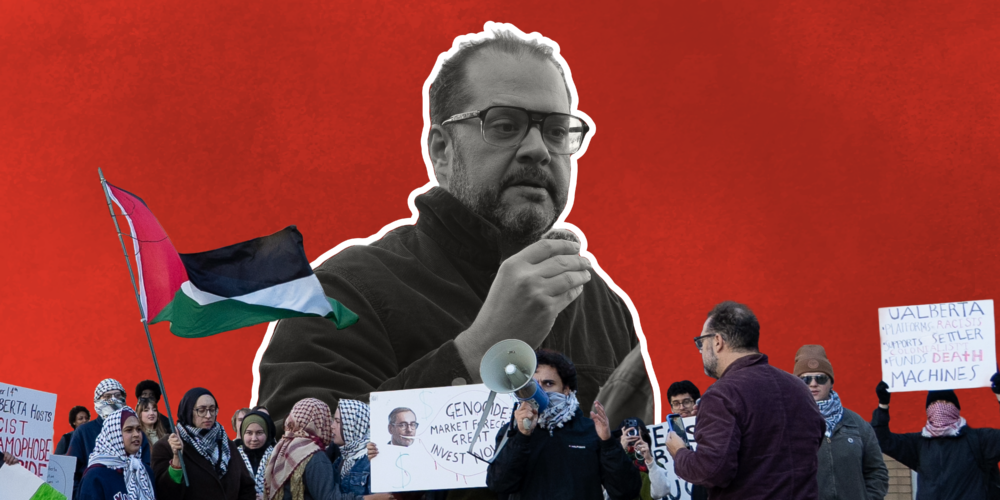 Graphic by Leah Hennig
On October 14, a town hall featuring CANADALAND founder Jesse Brown sparked a protest on campus. Students for Justice in Palestine (SJP) criticized the event for platforming Brown because of his pro-Israel views.
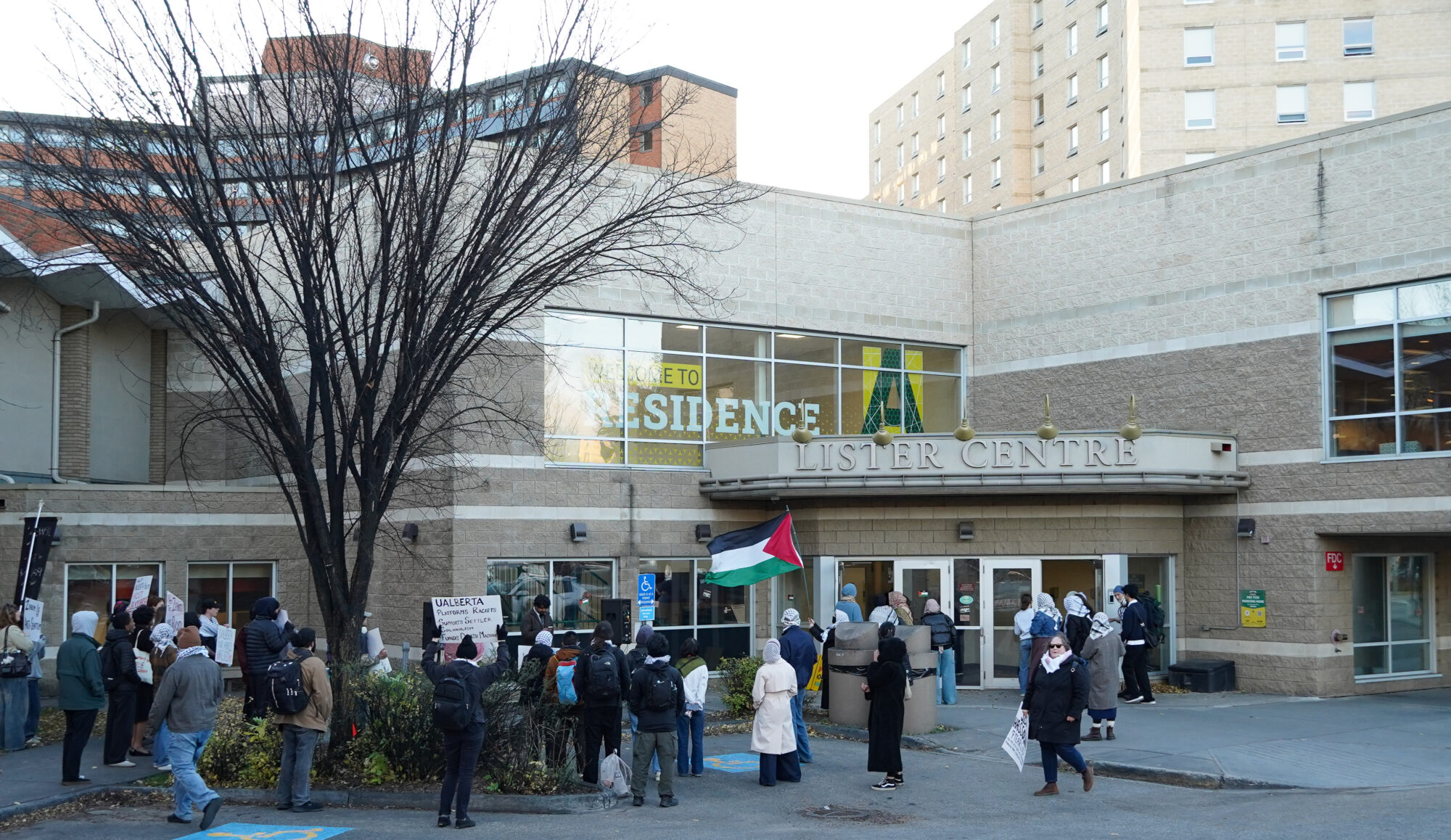
About 100 people gathered outside the Lister Centre, where the event was held. Lister is the primary first-year residence and is home to the Lister Conference Centre. Brown met protesters outside around 5:00 p.m. With his phone and a mic out, he confronted some protesters and invited them to join the event.
Quinn Wallace, who made a video ahead of the event criticizing it, declined Brown’s invitation. “I’m not going to engage in dialogue with some liberal Zionist.”
Brown pushed back over the label of Zionist multiple times when talking to protesters.
When asked by a protester if he is not a Zionist, Brown responded, “It’s sort of like, is everybody a Swiftie or a Swiftie-hater? Some people just like a couple of songs.”
“That’s not the same,” the protester responded, with others laughing at Brown.
Brown continued to push back on being labelled as a Zionist and dividing people into pro-Palestine or Zionist.
Protesters criticize U of A for hosting Brown
After Brown left the protesters and went into the Lister Centre, speakers began talking about issues with the suppression of Palestinian voices in academia. Specifically focusing on the U of A and MacEwan University.
“The issue is they’ll always be protected by our institutions,” Nour Salhi said, a former U of A student who transfered to MacEwan University. “Until we force their hands, until we show up like this over and over and over again, and we demand that they hear us.”
One of the students who confronted Brown about whether he identified as a Zionist or not spoke as well. She said, “What was clear to me is he was afraid to say that he was a Zionist, and I couldn’t be more happy because we did that.”
Michael Litwack, a professor of English and film studies at the U of A, spoke too. He noted that an Israeli airstrike burned a mother, Reem Asaad Awad, alive while her daughter, who survived, watched.
“Every university, every government, every institution, every shitty podcaster who normalizes Zionism conspires to make burning Palestinians alive seem ordinary, but this shit is not ordinary and it’s not normal. It’s unbearable,” Litwack said.
Protesters reiterated their demands for the U of A to disclose their investments and divest from companies implicated in what many international organizations have called a genocide in Gaza. They also criticzed the U of A’s Dual-Use Ecosystem for Future Engineering, National Defence, and Sovereignty (DEFENDS) program.
“Somebody’s got to try something else,” Brown says
Brown said the U of A’s Office of Access, Community, and Belonging (ACB) invited him to host the event.
Brown told The Gateway ahead of the event that “because there’s been this terrible surge of anti-semitism, [the ACB office] want to also do events that recognize the fact that there’s a problem with anti-semistim.”
He said that CANADALAND partially funded the event, and the ACB office funded the rest.
U of A media relations denied any involvement of the ACB office in the event. It also told The Gateway because it “did not organize the event, we cannot speak to how much the overall event cost or how it was funded.”
Media relations did note that the ACB office does offer small grants for initiatives aimed to “engage in constructive dialogue around complex topics impacting members of the community.” However, it did not confirm whether the event received a grant.
Brown recently announced he is stepping down as host of CANADALAND podcasts to commit himself to the “Palestine issue.”
“We’re not going to solve these very troubling issues in one townhall,” he said. “But it’s been three years of these ‘you’re a genocider, you’re a baby killer,’ and then the names come from the other way as well. Somebody’s got to try something else.”
Brown said he hoped to have an open discussion about how October 7 and the following bombardment of Gaza are impacting people here.
“I was like, I’m going to go out there and try to just get on that level,” Brown said. “By the end of it, once the chanting starts, the lizard brain kicks in and I need to get out of there.”
When asked about his beliefs, Brown said he’s most concerned with the threats of violence that the Jewish community in Canada is facing.
“I’m just trying to act locally,” he said. “I care about people on all sides of this and I’m just trying to start some kind of conversation that is different than what we have had so far.”
Disagreements in the town hall over anti-Semitism and Zionism
The event began around 6:30 p.m. with an introduction by professor emeritus of women and gender studies Felice Lifshitz. Lifshitz asked attendees not to record inside the town hall. She called the event “Anti-Semitism, anti-Zionism, anti-Jew hate in contemporary Canada.”
She opened with a land acknowledgement and by saying that she is an “October 8 Jew.”
Lifshitz recounted that she formerly advanced anti-Israel positions and other socialist, leftist ideas. Her prior involvement in progressive spaces led her to “unthinkingly absorb an attitude towards Israel that ranged from hostility to indifference.”
She admitted to yelling at an Indigenous student who stated that Hamas is a terrorist organization. He told her she reminded him of the nuns in residential school, and that sparked a shift in her thinking.
Lifshitz gradually began to recognize anti-Israel discourse as “Jew hatred.”
“This event is a small thing I am trying to do now to combat it instead,” she said. “When I heard Jesse Brown … announced that he would like to bring discussions of the issues to university campuses, I thought it was a good way to atone for my decades of complicity.”
Alexander Marcus, the Belzberg Family and Jewish Federation of Edmonton assistant professor of Jewish studies at the U of A, joined Brown and Lifshitz in moderating the town hall. Lifshitz credited Marcus with securing funding from the ACB office for the event.
Attendees mentioned losing relationships with friends or colleagues over disagreements on Palestine and Israel since October 7.
Videos from the event also show attendees noting Israel’s violence in Gaza and the West Bank. They criticized the town hall for conflating anti-Zionism with anti-Semitism.
Three hour sit-in called a success
As the reception before the event began, some protesters moved into the lobby of the Lister Centre. They held signs criticizing Brown and the U of A.
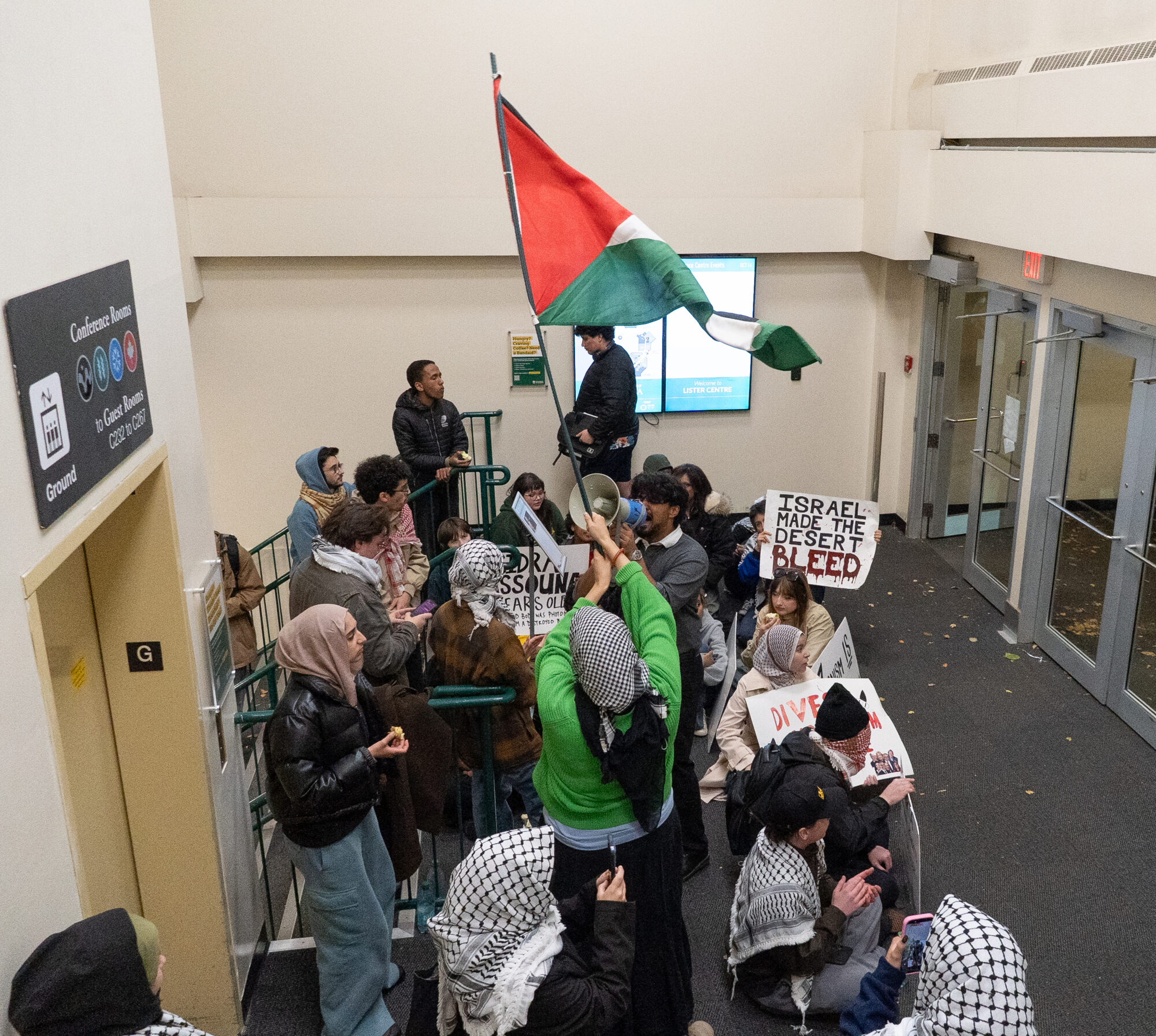
U of A Protective Services officers contained the protesters in the main landing of the lobby. Officers blocked the stairs up to the Maple Leaf Room where the event was being held. Other officers stood at the exterior doors and at the bottom of the stairs leading into the rest of Lister.
The doors to Lister were eventually locked, and residents were required to tap their OneCard to enter. Non-residents, including an editor with The Gateway, were not permitted to enter by UAPS officers.
Protesters began a three-hour sit-in in the lobby, chanting and singing. The demands of the protesters were for the U of A to send out an email to students and staff dissociating themselves from the event. Protesters said this would only be fair because the U of A has done the same for pro-Palestine events. The U of A did not send an email about this event.
A few residents joined the sit-in or brought water and food to protesters. Others appeared confused or laughed at the protest.
After the event concluded, some attendees left through the main entrance, walking past protesters while they chanted. Other attendees, including Brown, left through an alternative entrance.
An officer informed the protesters when all of the attendees had left Lister, and the protesters declared a successful sit-in.
Media relations told The Gateway that “academic freedom and freedom of expression are core values” of the U of A.
“Universities are forums for rigorous debate, where scholars are free to hold unpopular points of view and challenge conventions,” media relations said. “The U of A encourages respectful dialogues and activities in university settings as we navigate through current geopolitical events.”