MLA and U of A political scientist breakdown upcoming referendum
Jared Wesley and David Shepherd talked through the immigration, constitutional, and separation questions with students and young people.


 Julia Derus
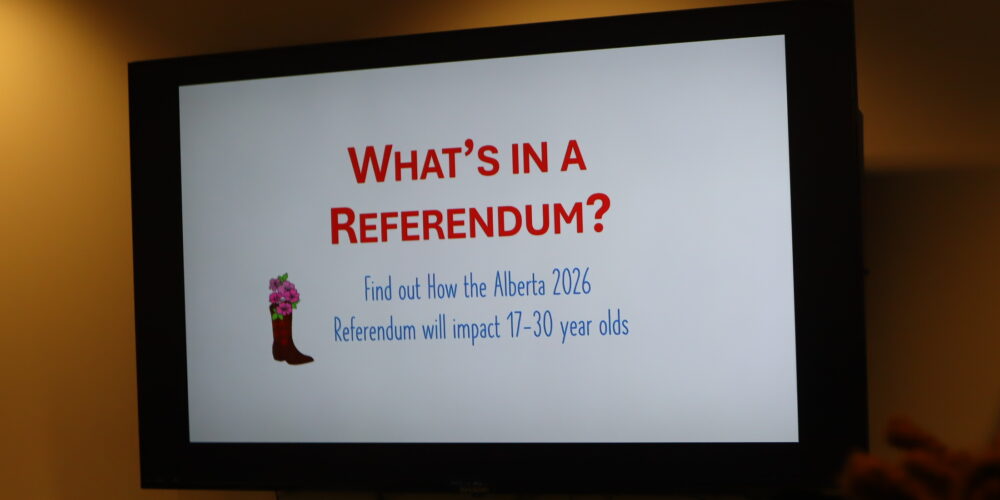
On September 23, University of Alberta political science professor Jared Wesley and Member of the Legislative Assembly (MLA) David Shepherd sat down to talk to students and youth about the October 19 Alberta referendum.
The event, “What’s in a referendum for students and young professionals,” clarified the 10 referendum questions, as well as ambiguities relating to potential Alberta separation.
The upcoming referendum will include 10 questions across three categories: Immigration and provincial policy, constitutional amendments, and separation. Shepherd and Wesley reviewed the implications of a yes vote and a no vote for the questions in each category.
Immigration questions
The first five questions are on immigration and provincial policy. Specifically, the treatment of non-Canadian citizens in Alberta.
They were tabled at a time when Alberta’s budget was projecting a deficit. This means that the provincial government was expected to spend more than it would bring in.
In the past five years, Alberta has also welcomed an estimated 600,000 newcomers — many of them temporary residents. Government of Alberta videos cite this increase as a reason for the rise in youth unemployment. The province has argued that temporary workers fill up entry-level positions.
Wesley explained that the questions were framed around bringing the provincial budget back into balance while education and health care are still paid for.
Voting “yes” would give the premier a reason to push forward legislation that would make it harder for newcomers to access services like health care and education, Wesley said. It would make newcomers wait longer to receive these social services, as well as impose a fee and other barriers.
This means that individuals like international students would pay an extra “$2,000 a year,” he estimated.
Another question concerns proof of citizenship when voting. “This is in response to a problem with election integrity,” Shepherd said. He noted that this question similarly targets newcomers.
On the other hand, a “no” vote on the immigration questions sends the message that non-citizens are not to blame and that the provincial government needs to find better ways of managing the budget without restricting social services.
Constitutional questions
The next four referendum questions are Constitutional questions. They ask whether Albertans support the provincial government working together with other provinces to amend the constitution. If successful, it would mean giving the provincial government greater power.
The federal government would need to agree to give up a “sizable amount of power,” including giving up control over the appointment of senior judges in Alberta, Wesley explained. It would also need to give up federal laws taking precedence over provincial laws.
“Most of the amendments that [Alberta] is proposing would require every single province to agree,” he said. “As importantly, the federal government would have to agree.”
For this to happen, the federal government would ask for something in return. Most likely to have control over Alberta’s oil and gas development and collect some revenue from oil sands.
“If you’re voting yes, you’re giving the premier leverage, and sending a message that we are upset with the balance of power in the Canadian Federation,” Wesley said.
Wesley cited Jason Kenney’s government introducing a similar amendment to remove the equalization principle from the Constitution. However, it “went nowhere.” The example is a testament to how much negotiation is required and a warning that Albertans might not get everything they vote yes to.
A “no” vote on these questions says Alberta should instead work in a collaborative way to gain greater authority. One that does not reopen the Constitution, but instead looks at alternative methods.
Separation question
The final question on the referendum is regarding separation. The question asks whether Albertans want to separate from Canada or remain a province. Any outcome of this vote will not lead directly to separation but will rather start the process of formally exploring separation.
Option one is to remain in Canada and option two means wanting the government to “start a process towards a second referendum where we have, more or less, a leave or stay vote,” Wesley said.
Separatists, Wesley says, are saying that voting option two gives the premier more leverage to negotiate a deal for Alberta. The argument says the vote is not merely for separation.
“Critics will point out, as soon as you ask for leverage, publicly you give up all your leverage,” Wesley added. “The separatists are trying to sell option two as a strategic vote.”
The government would deem the idea of separation irrelevant and unwanted if option one got a majority vote. If option two were to get the majority vote, there may be another referendum.
Furthermore, the government will have to extensively consult First Nations because of treaty rights. There will also be further debate regarding topics of the federal government’s treatment of Alberta. The Premier has said that if the separation were to achieve a yes vote, she wants a binding vote on staying or leaving Canada in the spring.
If the vote was a majority for option one and Alberta remained in Canada, there is unlikely to be a referendum in the future. The government would likely not discuss separation further. By voting for option one, Wesley says the government is getting the message to focus on “our affordability crises, our health care, and our education.”
Question and answer session
Attendants had the opportunity to ask questions during the ending question and answer session.
An audience member asked about the method Premier Danielle Smith plans to use to implement healthcare fees for immigrants. At a recent roundtable, the Premier stated that temporary residents might have to pay the $1,900 yearly health-care fee out of pocket.
Shepherd questions whether people will be less likely to access health care as a result. “They ignore that symptom until it drives them into the emergency room, and into the hospital, where the costs are even higher for us than if we would have just given them access to that care to keep them healthy to begin with.”
In addition, another attendee asked if immigrants access government-funded programs more than Canadian citizens and residents. There is no straightforward answer to this question, Shepherd says. However, he notes that it is important to acknowledge that “temporary foreign workers, international students, and asylum seekers, when they’re employed in this province, are paying taxes.”
Furthermore, the federal government sends money for health care, education, and welfare. This money is based on the total population living here. Newcomers are accounted for in funding.
Shepherd stated, “It’s a business ingenuous, that we have the premier arguing that they’re not covering the cost of what we’re paying for, and therefore, we have to charge people. This is the common agreement that we all hold as a society. We have these things in place for us when we need it.”
An attendee questioned other issues Albertans and the government should discuss, outside of the ten questions in the referendum. Polling shows that Alberta’s top concerns are the affordability crisis, health care, and education. Shepherd emphasized that results show that only 10 per cent of Albertans view separatism as being a number one issue.
Shepherd and Wesley again emphasized the importance of voting. “If you do not make your voice heard on this, the government will read that as, we’ll just continue to have more of these debates and more of these referendums,” Shepherd said.
In response to a question on how the economy would run if Alberta separated from Canada, Wesley said there is no straightforward answer. “All of those details would need to be negotiated,” Wesley added. The Government of Alberta would have to “negotiate its way out.”
The Supreme Court of Canada has decreed that a Constitutional amendment must be negotiated for a province to separate. All other provinces and the federal government would have to agree.
Economists predict there will be many losses to the economy and job market. “We’re looking at a major reduction in our GDP, major job losses in the short-term, and a very uncertain gain in the long-term,” Wesley noted.
One attendee asked how students could make an educated choice when voting. Wesley and Shepherd emphasized websites and organizations that can provide arguments and resources to educate individuals on the choices in the referendum. Videos and speeches exist online to give further information and understanding. For those with English as a second language, there are translation services and online resources that break the questions down into simpler language.
Wesley added, “It’s not as if you wake up on October 20 and we’re an independent country … but we can make a choice that will lead us down a path towards more and more of this discussion from the years ahead.”