 John Pattison-Williams
The Grassland Learning and Knowledge Hub is a five-year project that began in 2024. John Pattison-Williams, an adjunct professor at the University of Alberta’s Augustana campus, is the lead researcher on the project.
The hub is one of five across Canada dedicated to ecosystem and grassland conservation. The network includes hubs focused on grasslands, wetlands, forests, as well as two Indigenous-focused hubs.
Goals of the hub
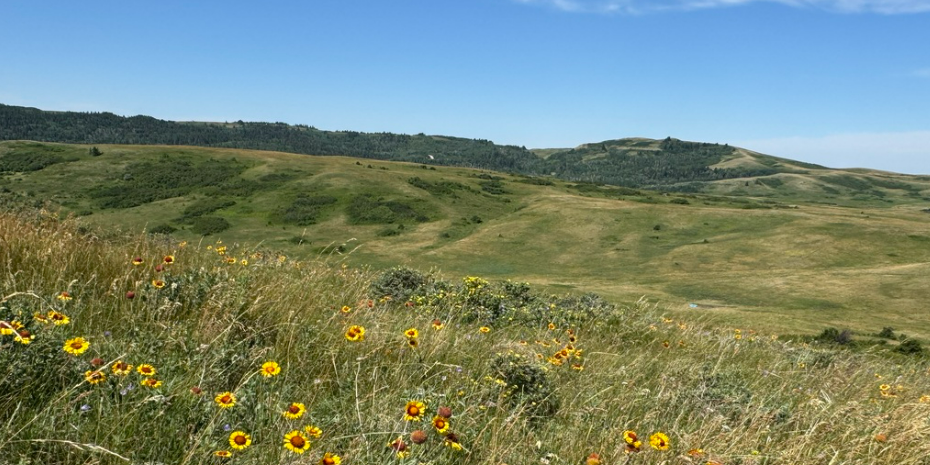
Pattison-Williams explained that grasslands play an important role both nationally and provincially in Alberta. He described them as a “foundation of our ranching world” in Canada, and an important source of carbon sequestration provincially.
Grasslands capture and store carbon dioxide — making them an important source of combating climate change. “They’re a climate and fireproof storage unit for carbon in the sense that their root systems of native grasslands are really deep,” said Pattison-Williams.
Protecting biodiversity is another important factor. Grasslands are home to many endangered species, including sage grouse and other grassland birds. The ecosystem is also “great for filtering … and storing water,” according to Pattison-Williams.
“What’s unique about our work is we’re moving into the social, the cultural, the economical, and the political realm of grasslands,” Pattison-Williams said.
Questions guiding the research
Grassland conservation becomes a polarizing question when considering producers (farmers and landowners) who convert grasslands into cropland for farming. Most of the landscape is privately held, and it’s easy to blame the problem of grassland loss on producers.
Pattison-Williams acknowledged that agriculture has contributed significantly to grassland loss. It is the hub’s goal to consider the economic factors of producers, and ask key questions regarding their motivations behind grassland conversion. The aim is to better understand producers’ economic motivations for converting land, and attitudes towards grasslands.
Faith communities are also part of the conversation. Many settler communities have strong Christian or religious backgrounds. A key question guiding the hub’s research is how these beliefs and values impact their values regarding grasslands, and whether or not they prioritize environmental conservation.
In regard to policy, the hub looks at the legal implications around conversion of a landscape. Keeping the grasslands comes at a cost to the smaller group of producers. Therefore, the hub asks what policy instruments could incentivize conservation.
Collaboration of various groups and faculties
Indigenous understanding of grasslands is also important. The hub collaborates with the RAD Network, an Indigenous-led organization, to incorporate both Indigenous and Western perspectives.
Pattison-Williams acknowledged that Indigenous perspectives are often “tagged on the end” in terms of research and academics. “We’ve tried not to do that,” he said. Instead, the hub integrates Indigenous perspectives from the outset of all its research.
The hub also involves researchers from various areas, including agriculture, kinesiology, and Native studies. “We meet monthly as a group to make sure no one feels left out,” Pattison-Williams said.
Education of grassland conservation is another goal of the hub. “I think there’s a hidden beauty in these landscapes,” said Pattison-Williams.
“If we have an even incremental change towards educating or informing people around these ecosystem services, that would be amazing.”