Records dispute claim that Casavant Organ isn’t a war memorial
Organ was publicly rededicated in 1978 and Veteran Affairs Canada says it has no official registry of memorials.

 Leah Hennig
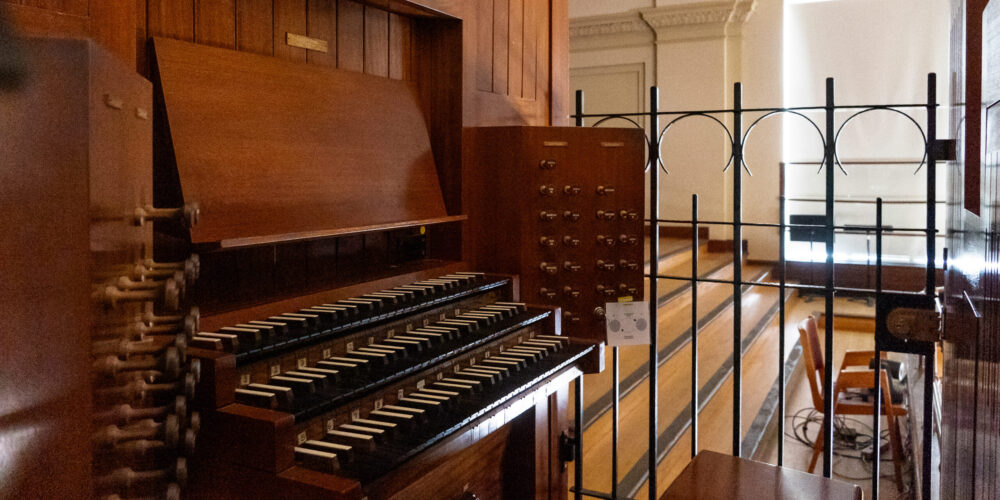
 The University of Alberta is planning to remove the 1978 Casavant Organ in its renovations to Convocation Hall. The decision has sparked backlash from students, staff, alumni, and community members. A petition against the removal started by Marnie Giesbrecht, a professor emerita of the U of A and organist, has garnered over 43,000 signatures.
The U of A has said in public statements and during the April 27 General Faculties Council (GFC) meeting that the Casavant Organ has no official designation as a war memorial. The U of A dedicated the original 1925 organ to students, staff, and alumni who lost their lives in the World Wars.
The university has stated that the designation was not transferred when the organ was replaced in 1978.
Archival documents compiled by Tammy-Jo Mortensen, a U of A alumna and organist, contradict the university’s claim.
The documents show that the U of A sought a federal tax exemption for the purchase of the organ. The exemption was for war memorials and required a plaque be affixed to the memorial.
In 1978, the assistant to the vice-president (planning and development) sent a document to the chair of the music department, which outlined that the U of A would receive a $22,200 tax exemption for the organ.
U of A media relations said it was looking into “the procedures and processes related to specific tax exemptions.”
U of A publicly rededicated organ in 1978
Archival documents also show an invitation to three concerts celebrating the “inauguration of the Memorial Organ” from 1978.
A recording of the first concert includes speeches from both then-president of the U of A, Harry E. Gunning, and then-acting chair of the department of music, Brian Harris. Harris introduced Gunning to rededicate the organ.
“I would like to emphasize that this new organ, this new tracker organ … is in fact a memorial organ and that it reaffirms the dedication associated with the old organ,” Gunning said.
Gunning said that the plaque from the original organ, which stated that the organ is a permanent tribute to students and staff who served in both World Wars, would be reaffixed to the 1978 organ.
A statement from the U of A on April 22 stated that Gunning only “symbolically rededicated” organ.
U of A media relations told The Gateway that Dean of Arts Robert Wood’s comments at the April 27 GFC meeting that the organ doesn’t have a memorial designation “was referring specifically to its status with Veteran Affairs Canada.”
Veteran Affairs Canada told The Gateway that there is no official registry of war memorials. It has a page of memorials across Canada, but Veteran Affairs Canada does not make official designations of war memorials.
The Gateway asked for clarification on what status media relations was referring to, given Veteran Affairs Canada’s explanation. The Gateway did not receive an answer before publication. Media relations also did not answer a question about how the U of A decided whether the organ was a memorial or not.
Alumna says U of A has misrepresented memorial status and didn’t follow proper governance
Haley Simons, a U of A alumna of the department of music, said that the alumni fundraised for the original 1925 organ to be a memorial. She said the memorial wasn’t just a plaque; it was a living instrument that could be experienced by people together.
Simons said that she and other community members were invited to a meeting in mid-May with the external expert, Robert Summerby-Murray, to discuss the organ.
In that meeting, she said that they were told no one could find the memorial plaque.
The Gateway asked U of A media relations about the plaque, but did not receive an answer.
“The university’s position was ‘well then, it must not exist, it must not be a memorial organ,’ rather than acknowledging that it was another failure, another epic institutional failure of stewardship,” she said.
For Simons, there is no ambiguity around the designation of the organ as a memorial.
Her further concerns with the plans to remove the organ lie with the governance process. Simons says there has been no public authorization, by any university body, to remove the organ.
“Every single governance procedure, every check was bypassed,” Simons said.
She also feels that the memorial status of the organ has been misrepresented in GFC meetings.
On May 25, GFC voted on whether to pause the removal of the organ. The vote tied, and Bill Flanagan, president of the U of A and chair of GFC, abstained from the vote. As a result, the vote was defeated.
“We contend that [the vote] was based on the incorrect assertion from administration, from the dean of arts,” Simons said.
CORRECTION: A correction was issued at 10:15 p.m. to amend the spelling of Harry E. Gunning’s surname.