Documentary Review: ‘In the Room’
'In The Room' provides a candid portrayal of Afghan women away from the Western gaze.

 Supplied
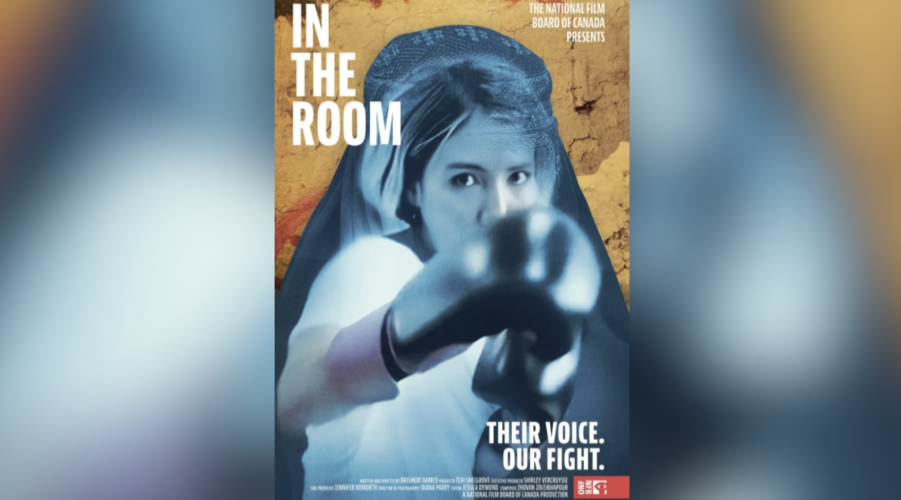
Recently, the Art Gallery of Alberta showed a screening of In the Room. The showing was part of an event by Right to Learn Afghanistan. The documentary was directed by Brishkay Ahmed, an Afghan-Canadian filmmaker based in Vancouver.
Ahmed originally made the film to represent Afghan women in a way that is powerful and “cool.” Because of Afghanistan’s association with oppression, she noted she felt shame connected with her identity before eventually accepting the importance of her heritage.
She interviews five women to show the world that Afghan women are more than simply oppressed by the country they come from. It showcases the hope that peace and freedom will become a reality for girls and women in Afghanistan.
The film expertly draws attention to problematic Western media depictions of Afghanistan and Afghan women. Nelofer Pazira, an Afghan-Canadian actress and director, mentions how she was asked to wear a burqa to the premiere of her film Kandahar. She then dramatically took it off on the red carpet to showcase her newfound freedom in Canada. The media wanted to use this moment to gain online traction for the film. They treated female oppression as something they could use to their advantage, rather than as a serious issue. In reality, the media did not truly concern itself with helping women in Afghanistan. They stopped talking about Afghanistan once it was no longer convenient or popular to do so.
Ahmed’s talk with Mozhdah Jamalzadah addressed similar themes. Jamalzadah’s story illustrates how the Western world’s concern for Afghan women is often portrayed as performative. After singing at the White House to draw attention to human rights abuses in Afghanistan, she returned home and was labelled an “American agent.” Thus, her life was put at great risk. However, the United States (U.S.) never provided Jamalzadah with any protection, despite knowing the dangers that were waiting for her in Afghanistan. However, Jamalzadah still struggled to garner Western attention to female rights abuses. The U.S. government is criticized for appearing to care about Afghan women to improve their image, but not taking action to ensure those such as Jamalzadah are safe.
Western media commonly depicts Canada and the U.S. as saviours to women who come from countries such as Afghanistan. Sahar Parniyan, an affluent Afghan actress, noted that it was not America that saved her, but hard work and determination that allowed her to leave Afghanistan and rebuild a new life for herself.
These five women all made sacrifices to give Afghan women a voice. Even if it meant leaving their home and family in Afghanistan behind. Vida Samadzai was banned from returning to Afghanistan after representing the country in a beauty pageant overseas. She became the world’s first Miss Afghanistan. However, because of a photograph of her wearing a red bikini, she was no longer permitted to go back home. Ahmed remarks on the irony that Vida can never return to the country that she tried to fight for.
Lastly, Ahmed sits down with Shogofa Desiqui, an Afghan news director. The two remark that there is still hope for Afghanistan. They assert that “a regime which functions on violence and oppressive acts will never triumph.” The suffering that female rights activists in Afghanistan went through are not pity stories, but rather stories that can help others and give them hope. The most important point made in In The Room is that human rights have been proven throughout history to be precarious. Rights and freedoms should never be taken for granted.
In the Room is overall an excellent documentary, which provides a candid and accurate portrayal of Afghan women, away from the Western gaze we are all accustomed to.