Province gives U of A $21 million for defence research
The funding is aimed at connecting post-secondary researchers with industry and military partners to advance defence innovation.

 Leah Hennig
 The Government of Alberta is investing $21 million in the University of Alberta to fund defence research and innovation. The funding will go to the Dual-Use Ecosystem for Future Engineering, National Defence, and Sovereignty (DEFENDS) program at the U of A.
DEFENDS aims to connect research, industry, and military partners to advanced defence technology in Canada. The program was launched in late March with a $3 million investment from the federal government.
Nate Glubish, Alberta’s minister of technology and innovation, announced the funding on May 19.
Glubish noted that the Government of Canada has made significant investments in defence spending, which will include research and development.
“The [U of A] is exceptionally well-placed in Alberta to play a leading role in what comes next,” he said. “We have world-class talent here, we have world-class researchers here, we have world-class facilities here.”
Glubish added that many of the research projects underway at the U of A have direct or dual-use military applications. This includes robotics, radio and telecommunications technology, and artificial intelligence.
In addition to providing the military with cutting-edge technology, he said that DEFENDS will help create jobs and attract investment.
DEFENDS to connect research and industry and give students hands-on training
U of A Vice-president (research), Aminah Robinson Fayek, said that the investment will allow the U of A to expand its secure research infrastructure and to drive Canada’s defence research initiatives.
“[DEFENDS’s] goal is simple: to transform innovative dual-use ideas into practical, real world tools for the Canadian Armed Forces,” Robinson Fayek explained. “By providing access to state of the art facilities, we are helping local businesses test and refine products while giving our students hands-on training with the latest technology.”
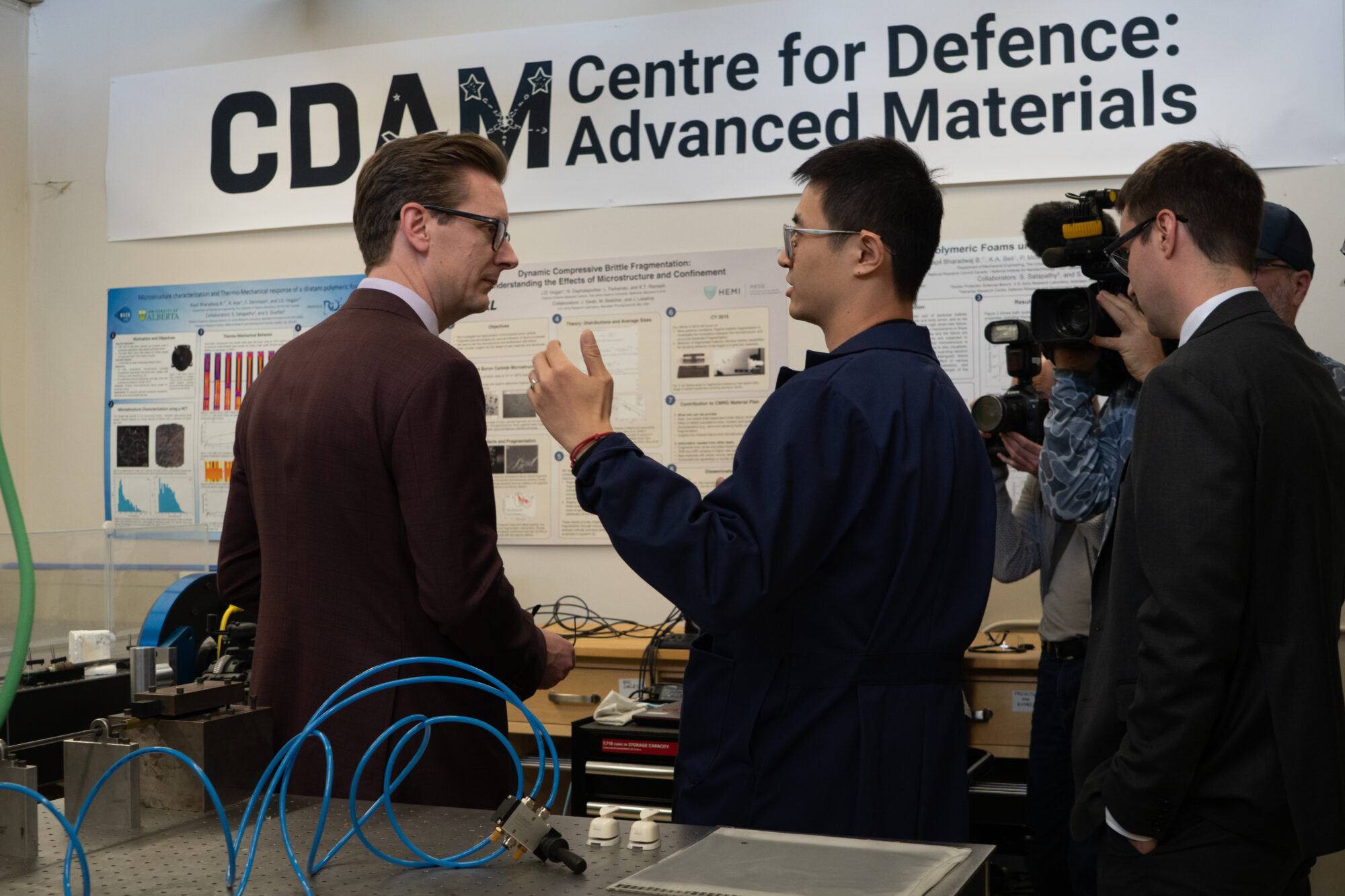
She added that these innovations can also aid in everyday challenges like fighting wildfires.
“Canada needs secure research capacity that can move defence ideas from concept to capability, and the [U of A] is proud to help lead this work,” she said.
James Hogan is a professor in mechanical engineering, a director of Centre for Applied Research in Defence and Dual-use Technologies (CARDD-Tech), and a lead for DEFENDS. He said that Alberta can lead defence innovation in three key areas: advanced electronics and intelligence sensing, space and aerospace technologies, and uncrewed systems and platforms.
Hogan also added that DEFENDS can “provide the training pipeline Canada needs, from engineers and researchers to technologists and skilled trades.”