BoG approves tuition increases and draft recruitment policy
Additionally, UASU President Pedro Almeida argued for a one-year hold on domestic tuition.

 Leah Hennig
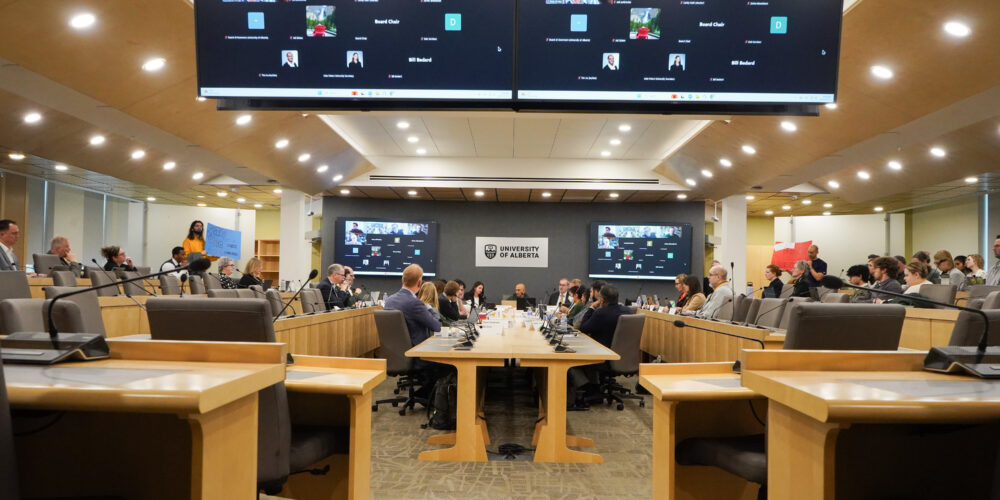
At the March 27 Board of Governors (BoG) meeting, the University of Alberta’s proposed tuition increases were approved. This is the seventh consecutive year BoG has approved tuition increases.
Additionally, BoG approved a new recruitment policy, which excludes equity, diversity, and inclusion (EDI) language.
In his report, President and Vice-chancellor Bill Flanagan said the university was pleased to see an increase to its operating grant in Budget 2026.
He also mentioned that the university “continues to operate within a very fiscally constrained environment” and will “continue to balance rising costs and enrolment pressures.”
Lise Gotell presented a recommendation from General Faculties Council (GFC) opposing the elimination of EDI from the draft recruitment policy.
GFC passed a motion opposing the elimination of EDI from the draft recruitment policy on January 26. Following that meeting, many students have raised concerns with what the proposed elimination means for the university community.
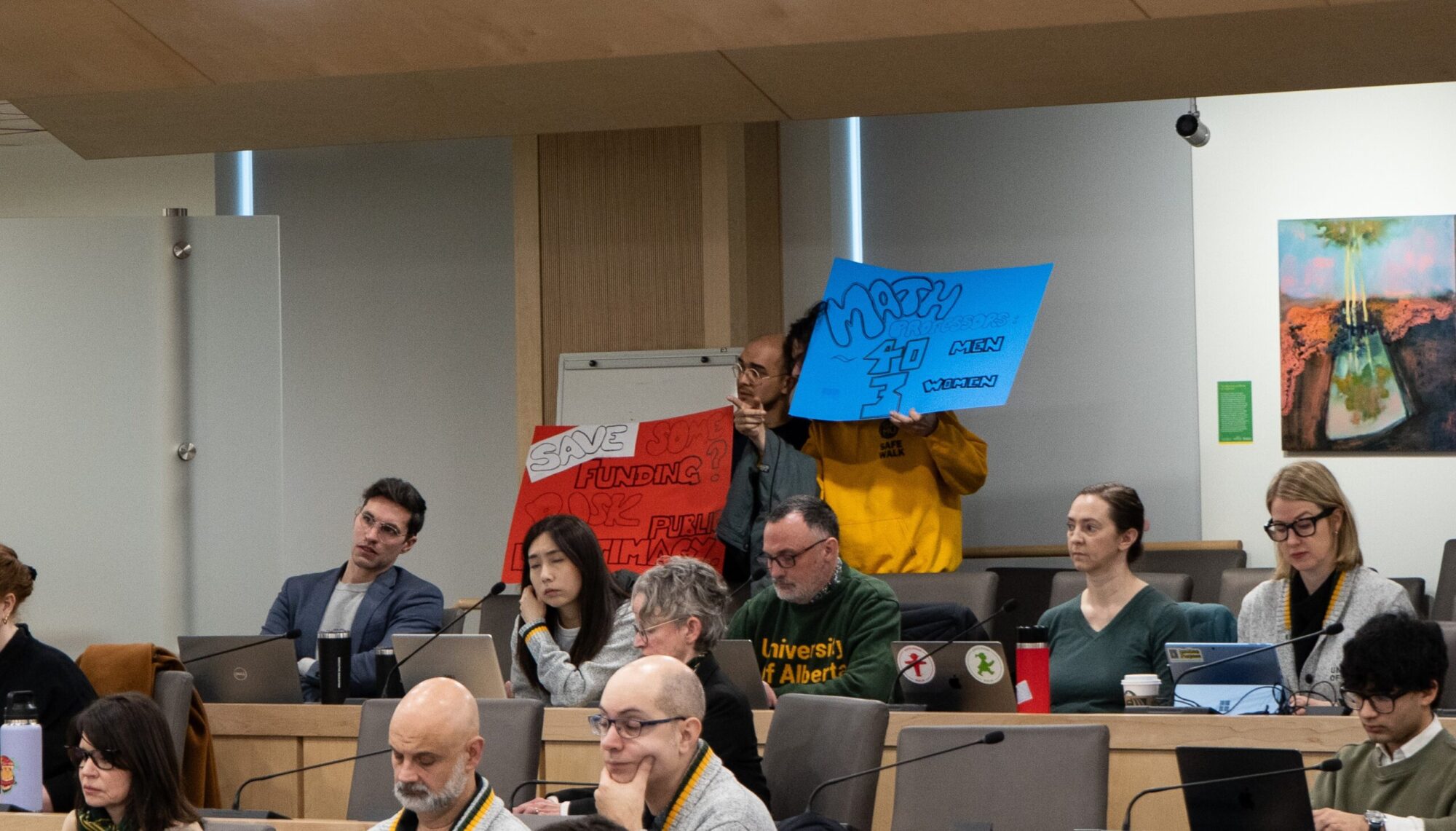
Several student protestors were present at the March 27 meeting. Some held posters expressing opposition to the proposed elimination of EDI.
Gotell argued that the removing explicit commitments to EDI “risks reducing equity to procedural fairness alone.”
“Hiring in universities is not just an [human resources] process. Academic hiring determines who produces knowledge, who teaches students, and whose perspectives shape the intellectual life of the institution,” Gotell said.
“We have been compliant every single year around the EDI requirements, as defined by Tri-Council,” Yiu says
BoG member Kevin Kane raised concern with the university not being in compliance with the Canada Research Chairs Program (CRCP), which has EDI requirements.
In response, Provost and Vice-president (academic) Verna Yiu emphasized that the university “[has] not put research EDI at risk.”
According to Yiu, the university has been in touch with the federal Tri-Agencies and there were “no concerns on their end.”
“We are not at risk of non-compliance,” she said. “We have been compliant every single year around the EDI requirements, as defined by Tri-Council.”
President of the U of A Students’ Union (UASU) Pedro Almeida said that in his discussions with students about this matter, he has recognized a “sense of distrust in the work the university is doing to enrich its community.”
He advised delaying the approval of the policy and conducting a regular review of how these policies have an impact on diversity.
Janice MacKinnon spoke in favour of the new policy. She said that discrimination is wrong, but that if “you come here, we’re going to assess you on the basis of what you can contribute in the broadest sense of the word. We’re not going to assess you on the basis of characteristics you were born with.”
The motion to approve the draft requirement policy passed. Almeida, undergraduate BoG representative Karina Banerji, and President of the Graduate Students’ Association Aashish Kumar were among those who opposed the motion.
UASU president argues for a one-year hold on domestic tuition
Almeida presented a UASU report on domestic tuition and argued that domestic tuition should remain flat this year.
He argued that another increase to domestic tuition is not necessary considering that the university received an increase to its operating grant, which was not anticipated when the tuition increase was first proposed.
According to Almeida, the increase “would generate some additional revenue, but it would do little to change the broader story students, families, government, and the public are hearing about how the university responds to its internal community.”
In response to Almeida’s argument, Flanagan said that although the additional financial support is welcomed by the university, “the additional three per cent comes nowhere close to addressing the growing costs of the university.”
U of A presents a balanced budget for 2026–27
Additionally, Todd Gilchrist, vice-president (university services, operations, and finance), presented a balanced budget for 2026–27. The university also has balanced projections for the next few years, Gilchrist said.
He described this year’s budget as “stable-ish” and emphasized that “stability does not mean the pressure is off.”
BoG passed the motion to approve the proposed two per cent tuition increase for domestic undergraduate and graduate students for fall 2026.
As of publication, the U of A is still waiting for the Minister of Advanced Education to approve exceptional tuition increases (ETI).
BoG approved the ETIs proposal in December last year. These include 75 per cent increases for course-based and thesis-based master’s of nursing programs, and a 20 per cent increase to nursing PhD programs. The proposal also included an increase of 50 per cent for the master’s of school and clinical child psychology program.
The motion to approve the 5.5 per cent tuition increase proposed for international undergraduate and course-based graduate students passed. The motion also included higher increases for international students in computing science, with a 26 per cent increase, and in nursing, with a 20 per cent increase. It decreased international thesis-based tuition by 5.5 per cent. All changes for international student tuition will come into effect for students starting in fall 2027.
Additionally, the motion to approve the university’s 2026–27 consolidated budget passed.