SU Elections 2026: Presidential debate
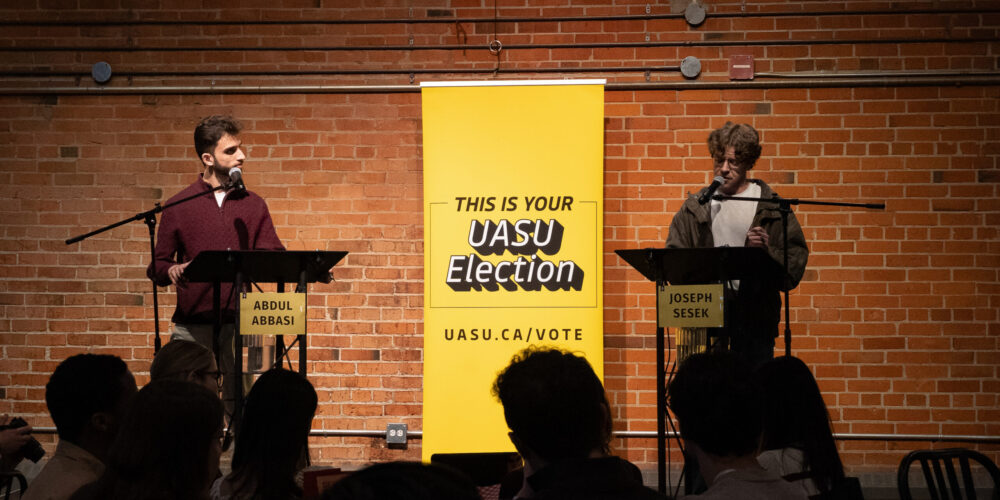
On March 2, a presidential debate for the University of Alberta Students’ Union 2026 elections was held at Dewey's.
 Leah Hennig
 On March 2, a presidential debate for the University of Alberta Students’ Union (SU) 2026 elections was held at Dewey’s. This was the final elections event before voting begins on March 4 and 5.
There are two presidential candidates this year — Abdul Abbasi and Joseph Sesek. The debate was moderated by Megan Garbutt, the chief returning officer (CRO). Themes included affordability, operating funding, safety, and Indigenous representation.
Candidates began with an opening statement, then Garbutt asked prepared questions to both candidates. They were each allowed a rebuttal. Candidates were able to ask each other a series of questions, with rebuttals and responses. Audience questions followed the candidates’ questions.
Candidates set out their approaches to the presidency
In his opening statement, presidential candidate Abdul Abbasi mentioned that he first got involved in the SU because, as an Augustana student, he “felt how it felt to be overlooked.”
He discussed his work as vice-president (external) (VPX) over the last two years and his ability to “deliver on [his] promises.”
“I’m not here to keep the status quo. I’m here to bring pragmatical, structural changes to the SU so it works better for the students,” Abbasi said.
In his opening statement, presidential candidate Joseph Sesek reiterated his commitments to “increased security through better lighting, monitored CCTV, and expanded ONEcard access.”
He also mentioned that he would emphasize to the president, the Board of Governors (BoG), and the General Faculties Council (GFC) that his platform’s “zero cost initiatives would receive worldwide recognition.”
“I will be a president who makes next year a safer, fairer, and better student experience,” Sesek said.
Garbutt asked the candidates why they think they deserve to be the SU president and what makes them think that they will do a better job than their opponent.
Sesek said that he will bring “ a really fresh perspective to the SU” and “an optimism that has actually died.”
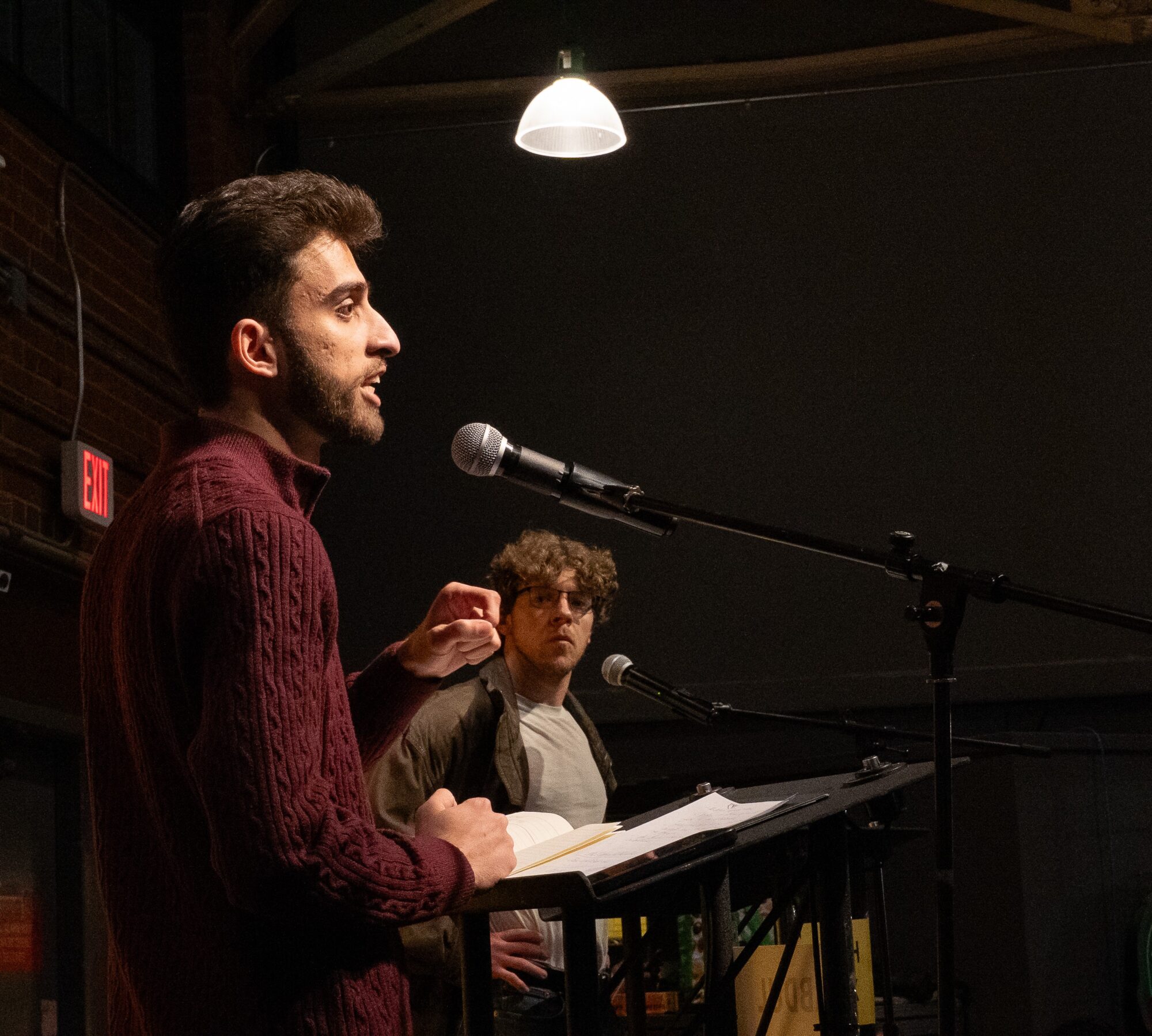
He stressed that through mobilization, the SU could “make some serious threats to the provincial government.”
Abbasi said that he has seen firsthand “what the president, with experience and without experience, can have an effect on the team and on the executives as well.”
He emphasized that the SU has “achieved a lot of wins this year,” and that it continues to improve the lives of students.
Sesek emphasized that the SU “has a lot more power than we think.” He said that what the SU has been able to produce has been “underwhelming,” considering the SU’s proximity to the legislature and the SU’s budget.
Abbasi said his opponent “talks about public advocacy as if [the SU has not] done it.” He stressed his external advocacy efforts, particularly through the Canadian Alliance of Student Associations (CASA).
Tuition, operating funding, and rent rationalization
Garbutt asked the candidates what their plan is to address tuition, as the average undergraduate tuition in Alberta has historically been higher than the Canadian national average.
Abbasi highlighted that this is the first year in four years that the U of A has seen an increase to its operating grant. Now that the university has seen this increase, he said he plans to push the university to not increase tuition.
Sesek called the increase a “step in the right direction,” but highlighted that the U of A is “still the lowest funded, on a per student basis, major university in Western Canada.”
“We need to fight with the provincial government to secure more funding and that’s why I want to mobilize so badly,” Sesek said.
Abbasi emphasized his plan to advocate for the Mintz panel recommendations.
“Right now, there is no model when it comes to operating grant, so that is why my push is to increase that funding,” he said.
Sesek discussed his plans for student mobilization, including “taking a day off and dedicating it to putting students from Campus Saint-Jean (CSJ), Augustana, bussing them all out, and we’re talking large-scale mobilization in the legislature.”
Garbutt asked the candidates how they will advocate for more affordable and accessible residence options, while ensuring that on-campus housing remains safe and supportive.
Sesek said it is “completely immoral that we have over 20 per cent vacancy, and we’re still trying to raise rent for students.” He also emphasized that students are paying more for service and receiving reduced quality.
Abbasi said that he has heard concerns about rent rationalization. He said his goal is to “work with the residence associations to do a review of those residences to make sure that students are paying for the quality and students are paying for what they can afford.”
Sesek said that this is something he and Abbasi agree on. He called rent rationalization a “completely bogus system.”
“No matter who gets elected, it’s getting addressed and it’s getting fixed,” Sesek said.
Improving awareness of how to escalate concerns and student well-being
Garbutt mentioned that “according to the SU 2025 annual survey, half of undergraduate students report being somewhat unaware of how to escalate a serious academic concern.” Garbutt asked the candidates what they would do “to ensure that these processes are accessible and all communicated to students.”
Abbasi said that an important part of his platform is continuing the work that the university has done on advising and ensuring that students know how to get the proper information.
Sesek said that he is, as of now, “not the most well informed” on this issue, but he is confident that the incoming vice-president (academic) “is most likely going to be a really successful candidate.”
“I’m standing on the shoulders of giants, and I’m relying on other people’s great information to create a good SU this year,” Sesek said.
Garbutt asked the candidates how they plan to support student well-being, considering that one third of students “report being unable to participate in campus groups due to competing commitments, and half indicate that they always or often feel tired.”
Sesek said that “student well-being is the forefront of [his] campaign.” He said that students experiencing burnout need more resources and his team will work to provide them to students.
When it comes to addressing student well-being, Abbasi emphasized providing better support to student groups, modernizing the SU’s event approval system, and delivering on “small things that make a difference,” like accessible microwaves and water fountains.
He also mentioned his plan to advocate for the expansion of the Leisure Access Pass.
Garbutt asked the candidates what campus-led initiatives or infrastructure improvements they would prioritize to improve commuter safety.
Abbasi said he plans to focus on bus rapid transit and pairing social works with peace officers on transit.
Sesek emphasized the importance of transit safety, and stated his plan to improve the lighting and camera coverage in the bus loop.
Abbasi said that Sesek’s plan to increase the amount of CCTV cameras on campus poses a privacy concern due to the increased surveillance. He said it is important to consult with different groups — including the Black Students’ Association, the International Students’ Association, and the Muslim Students’ Association — about such concerns.
The role of the president in the executive team
Garbutt asked the candidates how they plan to collaborate with their team to advance their individual goals and ensure that their goals are reachable.
Referring to current SU President Pedro Almeida, Sesek said he’s “seen firsthand what a good leader can do for the students.”
“He really elevated his co-workers, and that is something to aspire for,” Sesek said.
Abbasi agreed that Almeida did a good job this year. He said as chair of CASA, he has worked with board members to find consensus.
Sesek said that he is planning on taking a $10,000 salary cut, as he promised during his presidential campaign last year. He said he will put this money towards “extending this exam period at [Rutherford, Cameron, and Sperber] libraries, four hours a day.”
Abbasi emphasized that his goals are pragmatic. He mentioned his goals to ensure the SU is “providing those opportunities for underrepresented groups to get involved in Students’ Council, in the SU executive,” and said “that is not possible with the $10,000 break.”
In a question to Abbasi, Sesek mentioned that The Gateway gave him a report card grade of a C-. Sesek asked Abbasi to explain this grade.
Abbasi credited the grade with working “under a president who didn’t have that experience, who couldn’t support the team.”
“I don’t know the politics of two years ago too well, but I do know even if I had a bad president, I would still do a good job,” Sesek said in response to Abbasi.
“It is unfortunate that you don’t see the role of the president is to better support the vice-presidents. If you go ask my previous president, she will tell you that she wished that she had that experience so that she could better support the team,” Abbasi said.
In a question to Sesek, Abbasi said that each time Sesek has run for president, he has “left out the importance of building relationships.”
Abbasi asked why students should trust Sesek to effectively work with stakeholders and leaders, and asked who he has consulted with as he developed his platform.
Sesek said that he has not burned as many bridges as Abbasi may think.
Abbasi told Sesek he is not sure how much his campaign changed from last year. Sesek said that there is much less of a financial emphasis this year.
When it comes to the student fee freeze, Sesek said “ it’s very abundantly clear it’s not a priority.”
Disagreement over jurisdiction and priorities
In a question to Abbasi, Sesek mentioned that in January 2025, the SU released a report which cited that two per cent of U of A students have experienced homelessness while attending the U of A. He mentioned that residences are running with a vacancy of 1,200 empty beds, asking Abbasi if it occurred to him that temporary student homelessness could be solved with these vacancies.
Abbasi said he is proud of his external advocacy as it relates to housing, mentioning that the SU is working on a tenant rights awareness campaign with the City of Edmonton that will be coming out next year. He emphasized that his role of VPX does not particularly pertain to residence.
Sesek told Abbasi that he “cannot hide under the gaze that is not under [his] jurisdiction.”
Abbasi asked Sesek how he plans to achieve the “many ambitious structural changes to university operation” he has promised.
Sesek emphasized that “there are some things that are insurmountable, but it doesn’t mean we don’t fight for them.”
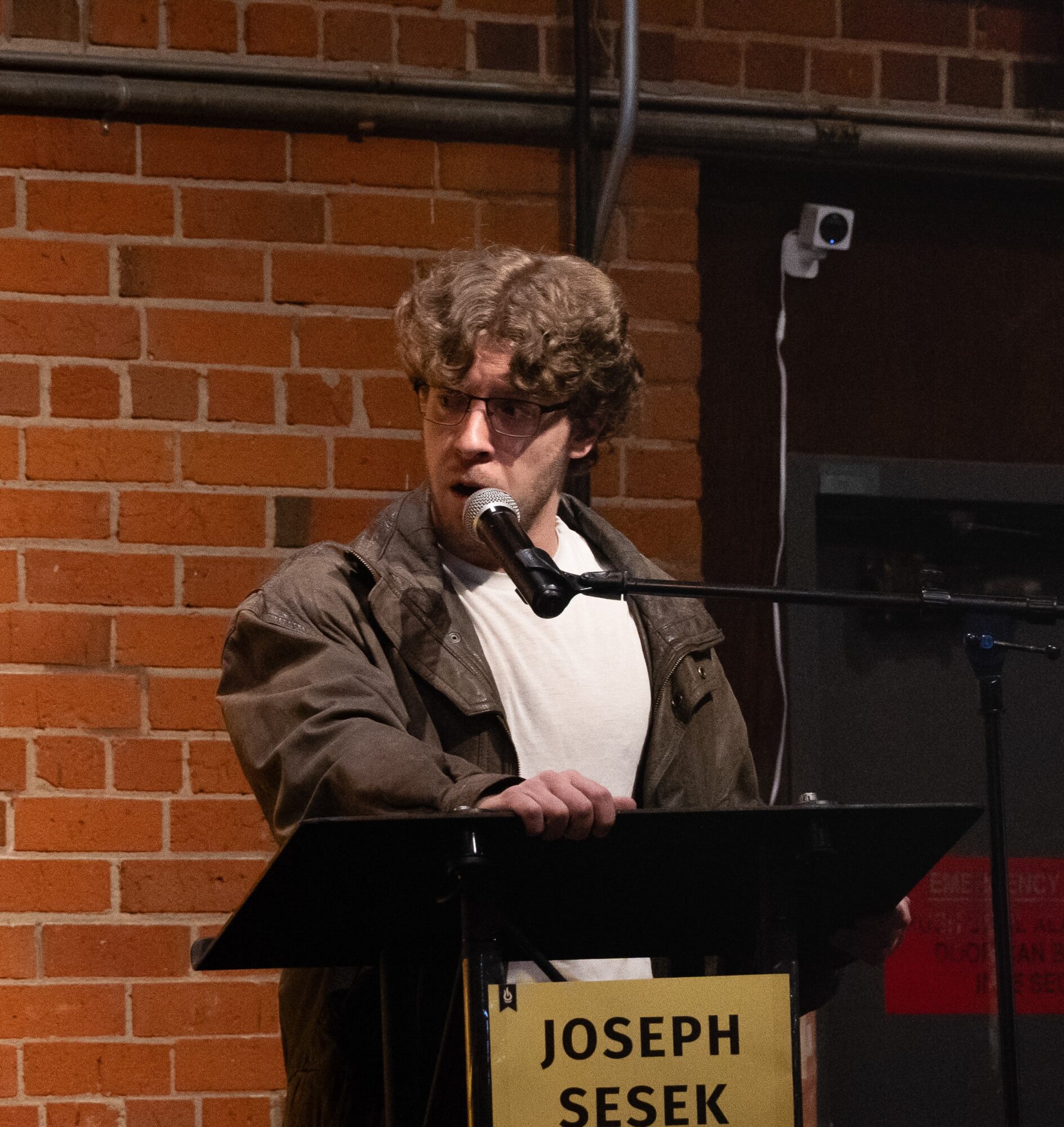
Sesek said that Abbasi’s only concrete proposal is the expansion of the Leisure Access Pass. Sesek asked Abbasi if he thinks there are more pressing matters to put his energy to. He also asked why there is no mention of residence rate increases and the lack of proper residence maintenance in his platform.
Abbasi said that the demand for access to gym and recreational facilities is something he has heard from students. Abbasi reiterated his plan to review rent rationalization.
Abbasi asked Sesek about what his vision for the SU as an organization is.
“I haven’t seen you talk about your vision outside of protests,” Abbasi said.
Sesek said that his vision is clear, and has been since he published his platform at 9:00 a.m. on the first day of campaigning.
“I don’t think there’s any confusion as to what I’m fighting for and what I believe in,” he said.
Abbasi said he doesn’t see anything Sesek wants to do internally with the SU in his platform, aside from freezing SU fees.
Sesek pointed to his vision as outlined on his poster, of student safety, extended library hours, opposing the Course Materials Access program.
“Every student would benefit from this even more so than microwaves. Honestly, I think it’s crazy that this is the standard we uphold now, it’s such a low bar,” Sesek said.
Collaboration, individual accountability, and realistic promises
Sesek asked Abbasi what he has done directly to address student financial and living insecurities in the past two years.
“What have you done directly? Directly, not just you with the aid of others, and you just signing off on it,” Sesek said.
“I can see where [Sesek] does not understand that when we work externally, we work in collaboration,” Abbasi said.
He pointed to his role as chair of CASA and the achievements of the organization.
“[Sesek] talks a lot about mobilization, talks about coming together, but he doesn’t see coming together when we come together as a coalition so that we get more power in that sense,” Abbasi said.
“Your entire premise is ‘we have done this together.’ Keep that in mind because I think it contradicts everything you’re saying,” Sesek said. “It puts the blame on other people, and I think you need to take a little bit of individual accountability.”
Abbasi said that Sesek is still promising the freeze SU fees and lower than in subsequent years in his SU bio, but has not discussed this during his campaign. He asked if Sesek still believes in this.
Sesek said that while there’s more pressing issues, this is still part of his campaign because he believes the SU should lead by example.
“If we can’t control our own house in the SU … how do we expect the U of A to respect us and also sort their own issues out. We need to lead by example in that regard,” Sesek said.
Abbasi said Sesek’s goals, like implementing a European model for tuition, is not pragmatic.
“It’s just about making promises and talking about the moon and the stars,” Abbasi said.
“I think that’s incredibly disingenuous. If you have paid attention at all to my campaign, you’re taking the two least important points of my campaign and really summing it up around them, everything else.”
He referenced his promises for extended library hours and syllabus and course material cost transparency as things that are free to implement. Student safety is something that has a larger cost associated with it, but “it’s still practical and important.”
Operating grants and international student tuition
Miley, an audience member, asked candidates about the actions they would take to ensure sexual violence cases are dealt with and prevent repeat offenses.
Sesek said they need to establish a “proper culture of consent and constantly reaffirm this culture.”
He emphasized continual education around consent, as well as efforts to expand ONEcard access after 6:00 p.m.. Sesek added that non-judgemental and co-ordinated support are also important to help victims who come forward.
Abbasi said that SGBV “is something that is embedded in our campus.”
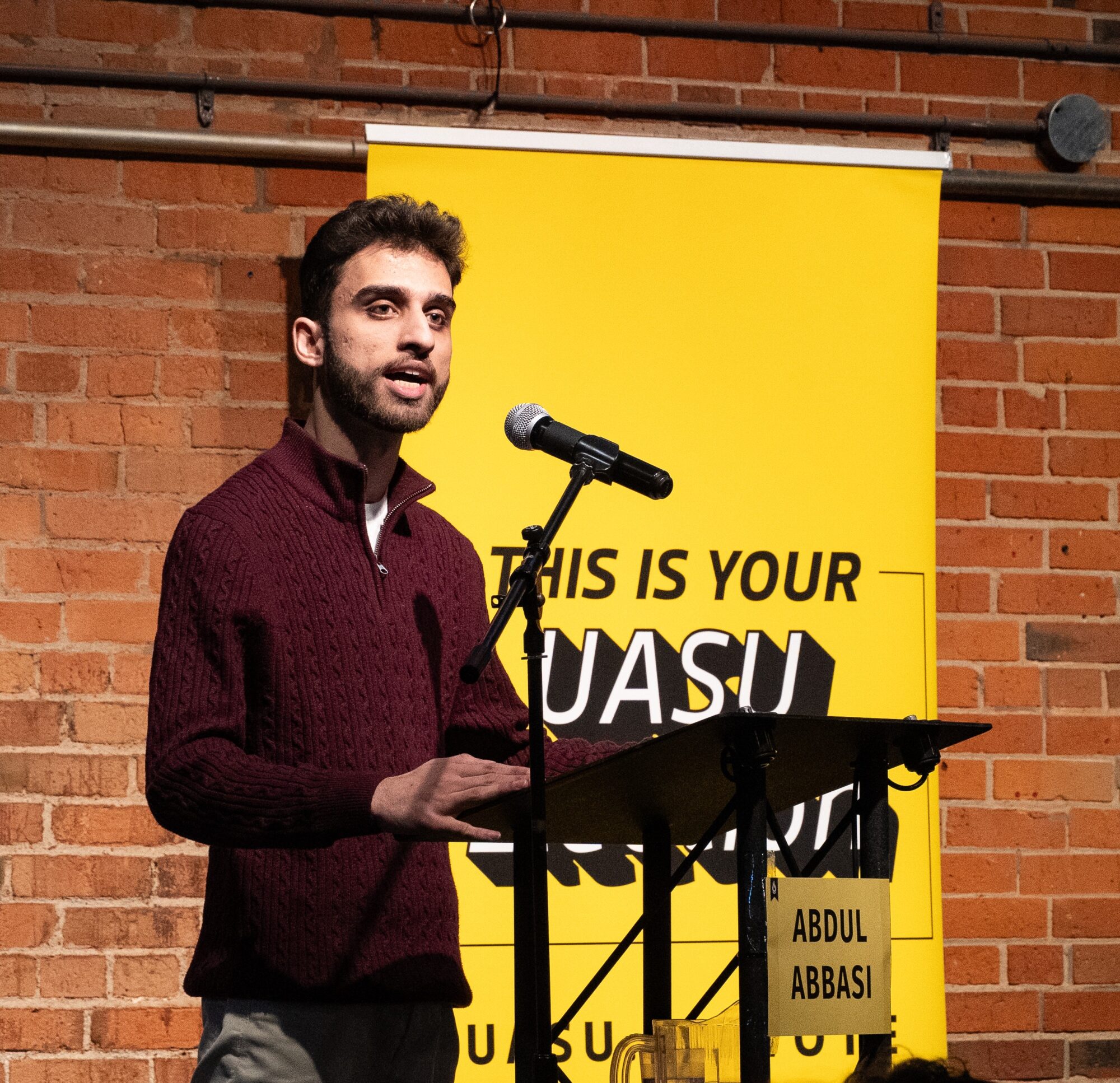
He cited statistics from a 2023 survey that found 64 per cent students at the U of A experienced SGBV, compared to 43 per cent for post-secondary students across Alberta.
Abbasi’s goal would be to work with the vice-president (student life) to implement the 11 recommendations from the SGBV Task Force Report.
At a March 2 GFC budget briefing, Todd Gilchrist, vice-president (university services, operations, and finance) said the $13.1 million increase to the U of A’s operating grant would go towards covering the negotiated increases to staff salaries. The Gateway asked how the candidates would ensure the increased funding makes its way down to students.
Abbasi said that the anticipated two per cent domestic student tuition increase would have made the U of A $5 million. He would push for increased student supports, whether that’s advising or more research opportunities.
“My vision is to talk about alignment where possible, and escalation where necessary. This is one of those avenues where we will have to explain and making sure we are making a lot of noise on this and getting that support for students,” Abbasi said.
Sesek agreed that mobilization is necessary, “and there needs to be a big push for fighting for increasing the operating budget.”
Another audience member asked why international students are facing $40,000 of tuition without extra academic or social benefits, but added financial strain.
Sesek said that international students are in an unfortunate predicament.
“They are affected most by safety issues and rent issues, and they pay the most for their tuition.”
He said he would work to address issues of safety and rent for international students.
Abbasi explained that international tuition is higher because the provincial government does not cover the costs of their education. However, he would focus on improving transit safety and pushing for a review of rent rationalization.
Abbasi mentioned hearing concerns over international students having to apply for a separate work permit for co-ops or internships.
“That is something that [Immigration Refugees, and Citizenship Canada] has said they’ll be moving away from, so that you don’t have to spend money and time on those regulatory things,” Abbasi said.
Consultation with students ahead of campaigning
The Gateway asked how candidates will ensure engagement with the Indigenous Students’ Union (ISU) is not performative and how candidates will address barriers that may prevent Indigenous students from engaging with the SU?
Abbasi said that relationships are important to Indigenous students. He would work on making it easier for Indigenous students to get involved in council by providing child care or support.
“The most important thing is relationships, while getting the stuff done, while making sure we are delivering for students, making sure we are doing those consultations.”
Sesek said that he continues to hear promises that Indigenous students will be in the room and will be listened to for key policy decisions. However, “being in the room as a guest, it’s not the same as having power. We’ve seen enough lip service from the SU. It’s time for structural change.”
He promised that he would add a permanent vote for Indigenous students on Students’ Council.
Julia, an audience member, asked Sesek to clarify what consultation he has done with student groups while preparing his campaign.
Sesek said that his consultations came from students he encountered while gathering signatures and campaigning.
“I’m a full-time student, at the end of the day, this is [Abbasi’s] job … yes you’ve consulted people, I haven’t had the privilege of doing that,” Sesek said.
But he promised he would drop two courses immediately if elected to begin doing that work and preparing for the position.
Abbasi questioned if Sesek had consulted the ISU on adding an Indigenous councillor seat to the Students’ Council.
Sesek said he hadn’t, but would consult them and follow their direction, whether they want the seat or not, if elected.
Abbasi further questioned why Sesek was running on a platform he hadn’t consulted students on.
“I’m providing a vision, a vision that I believe in, a vision that I think a lot of people believe in,” Sesek said. “But, there’s obviously room for scrutiny within this vision and I’m always open to criticism when it comes to that.”