SU Elections 2026: International Students’ Association forum recap
The fifth University of Alberta Students' Union 2026 elections forum was hosted by the International Students' Association.



 Leah Hennig
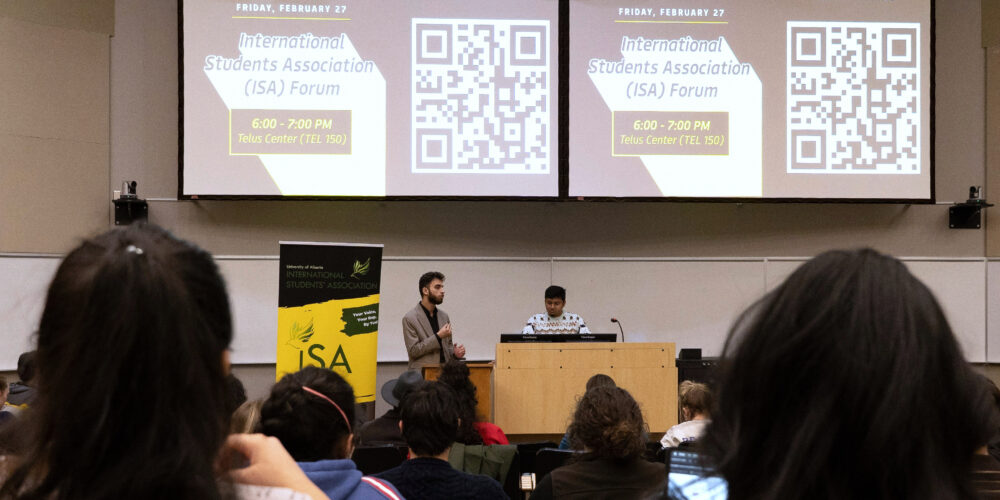
The fifth forum of the University of Alberta Students’ Union (SU) 2026 elections was hosted by the International Students’ Association (ISA) on February 27. The event was offered in-person and online.
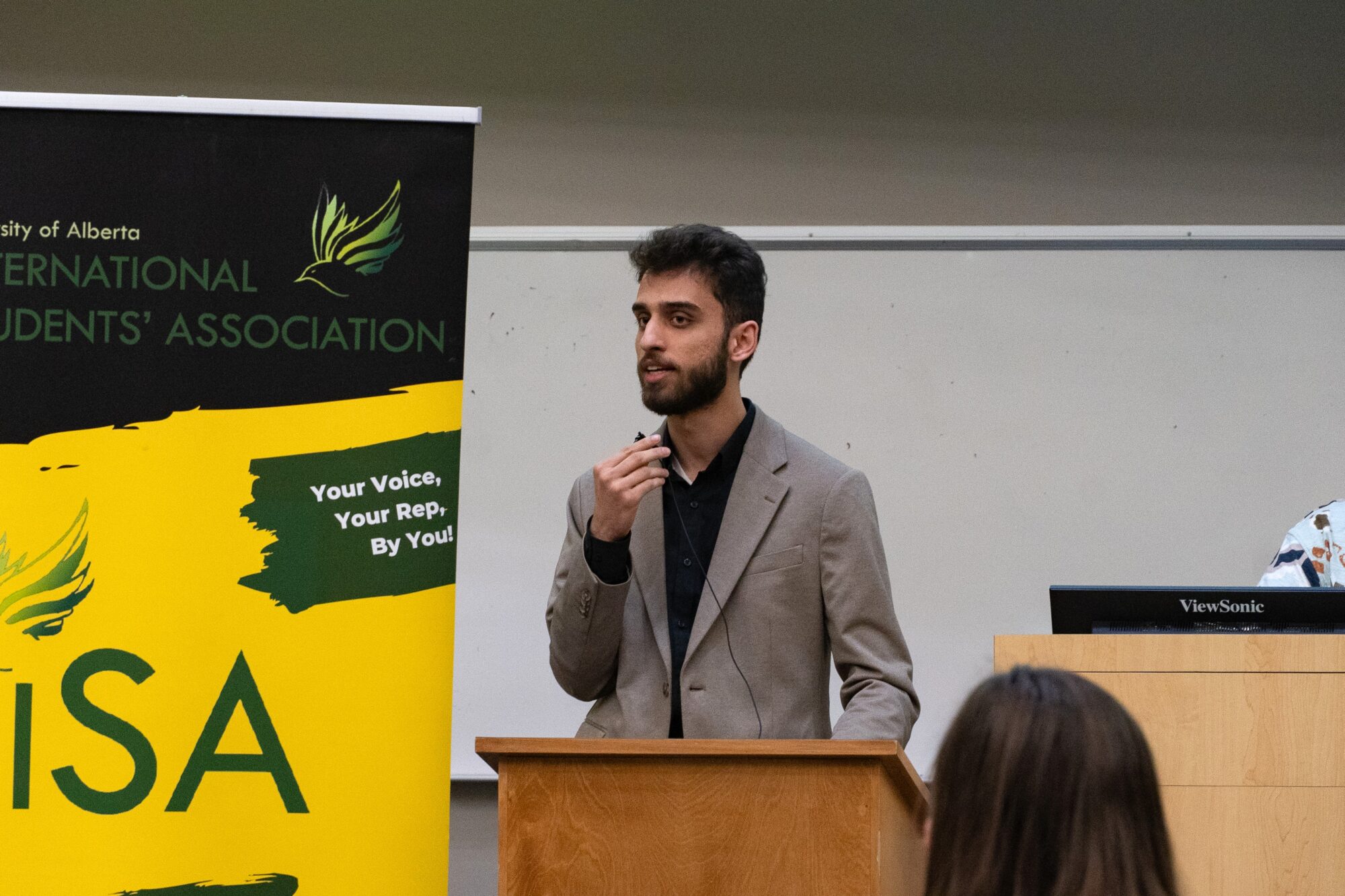
ISA President, Abdullah Al Anik, moderated the forum. Candidates were given 90 seconds to deliver their opening statements. Then Anik asked each race two questions prepared by the ISA. Audience members were allowed to ask question, and candidates were given the opportunity to ask each other questions.
Here is the TL;DR version of this forum:
- President: candidates outline their commitments to address international students’ concerns.
- Vice-president (external) (VPX): candidates address transit safety issues and financial concerns.
- Vice-president (operations and finance) (VPOF): accountability, financial issues, safety issues, and advocating for the ISA.
- Vice-president (academic) (VPA): hopes to implement structural changes to aid international students with their academic needs and remove barriers.
- Vice-president (student life) (VPSL): candidates advocated for better residence services and the increase of events targeted to international students.
- Board of Governors (BoG) Representatives: tuition for international students, federal immigration caps, and equity, diversity, and inclusion policies.
Presidential candidates discuss international student consultation and representation
In his opening statement, presidential candidate Abdul Abbasi said that although he pays domestic tuition, he “understand[s] the challenges that international students have to face.”
He said he intends to review rent rationalization, advocate to the municipal government as it relates to transit safety, and look into how the Peer Support Centre (PSC) “can better support mental health,” particularly for international students.
In his opening statement, presidential candidate Joseph Sesek reiterated his commitments to changing Bylaw 100 to give international students a permanent seat on Students’ Council, add additional lighting CCTV cameras, and expand ONEcard access to all campus buildings after 6:00 p.m. and on weekends. He also said that Residence Services needs an overhaul, not just a review.
“My opponent asks for a third term to do something in the future. But where was he for the last two years while students paid him $115,000 in salary and benefits?” Sesek asked.
Anik asked the presidential candidates what escalation strategy they would realistically pursue
if university administration refuses to freeze or reduce international tuition.
Abbasi emphasized his use of public advocacy during his last two years as VPX.
He said that although it is important to find “areas of alignment” with the university and government in order to work together, the SU needs to use its voice and utilize public avenues on areas of disagreement like tuition.
Sesek said he intends to listen, assess, and negotiate and repeat this process. He added that he will, if necessary, “act wisely” through mobilization.
Additionally, Anik asked the presidential candidates if they would publicly oppose university leadership if a decision harms international students, even if it strains relationships.
Abbasi said he would, and that it is something he has been currently doing at the federal level through Canadian Alliance of Student Associations’ (CASA)’s recent petition. He mentioned that when it comes to advocacy in this regard, “not every hill is where we die.”
Abbasi also emphasized that although his focus has been on external advocacy as VPX, he will, if elected, he “[make] sure [he is] continuing that momentum internally and getting the wins delivered for students in a pragmatic manner.”
Sesek emphasized that international students “are hit the hardest by any issue that persists on campus” and are “one of the most resilient and powerful bases we have.”
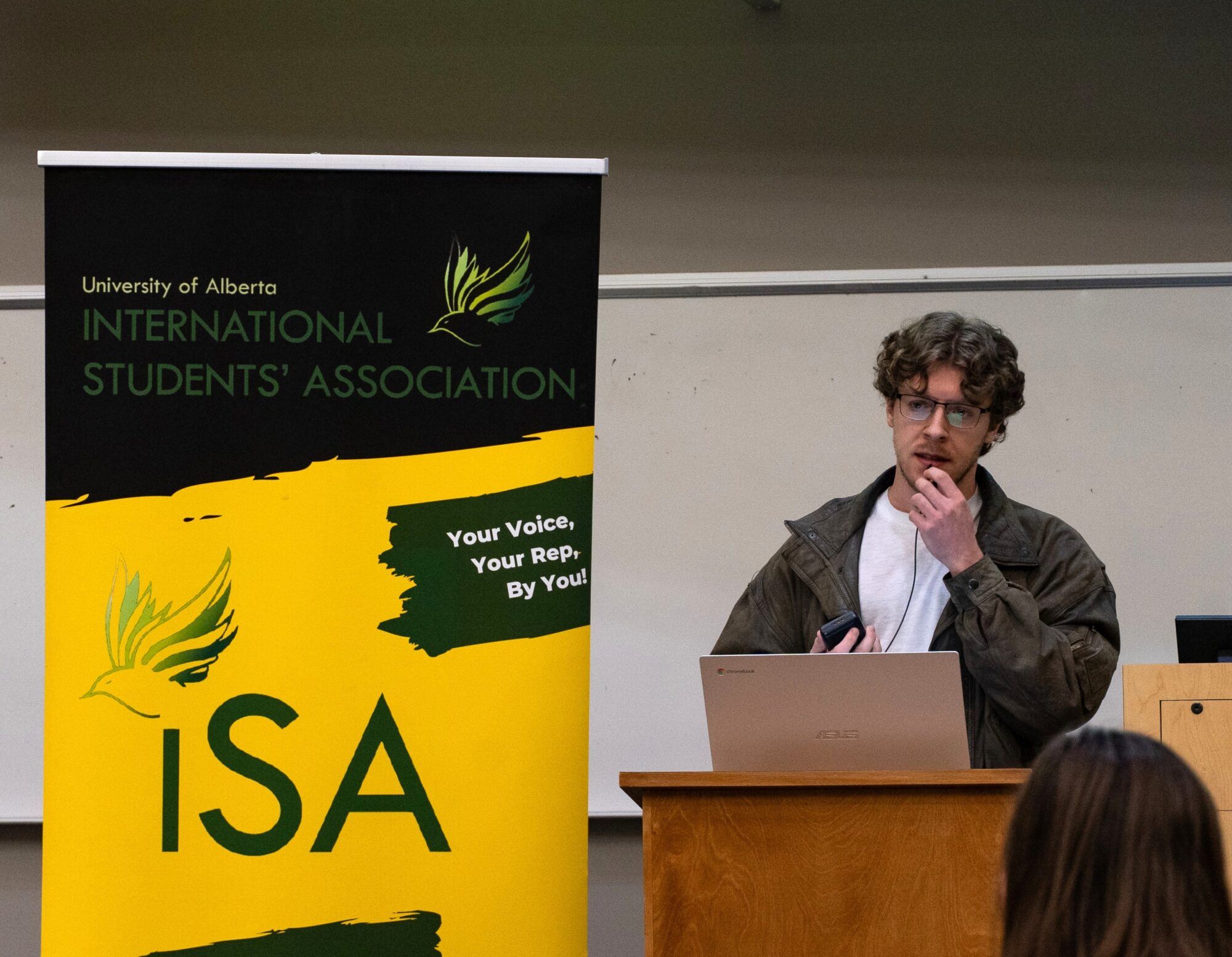
He added that he will “fight with the government and oppose them if it means being on the side of the international students.”
In a question to Sesek, Abbasi mentioned that Sesek is advocating for a safer campus “with visibility as the first line of defense on a campus that is proactively watched.” Abbasi asked what safety issues are informing his proposed policies and who has been consulted about increased surveillance “which would increase surveillance of students overall.”
Sesek answered that the safety issues informing his proposed policies come from living at St. Joseph’s College and “seeing people assaulted outside [his] college, people on transit, having friends harassed, [and] having knives brandished at them.”
He said that he has not consulted anyone and he is “not a VP elect yet, and this is not [his] job.”
If elected, he will “drop two courses immediately and pursue full-time figuring out how to be job ready May 1.”
In a question to Abbasi, Sesek pointed out the discrepancy between kindergarten to grade 12 funding and post-secondary funding. He asked Abbasi if he takes credit for the cuts to post-secondary funding outlined in Budget 2026.
Abbasi emphasized that the cut to student loans is an estimate. He also said that part of his platform is focused on Mintz panel recommendations “so that we can get more of that funding.”
Additionally, Tala Mojarrad, BoG representative candidate, asked Sesek how his platform ensures international students can continue their academic journey when facing uncertainty and political crisis back home.
Sesek said that his commitment to giving international students a seat on Students’ Council will address this. He also mentioned that he will address their rent and safety concerns.
In his closing statement, Abbasi said he is focused on pragmatic approaches, not “talking about giving the ISA a seat while talking about cutting the salary by $10,000, which affects underrepresented students.”
Councillor seats are unpaid, however Sesek has promised in his SU bio to cut his own salary by $10,000 on the first day of his term.
—Kathryn Johnson
VPX candidates outline their plans for increasing safety for students on transit and the financial concerns that international students face
During the opening statements, VPX candidate Arman Chauhan recognized the stress that international students face with a 10 per cent tuition hike. She assured students that she would advocate for them “to keep rates competitive.”
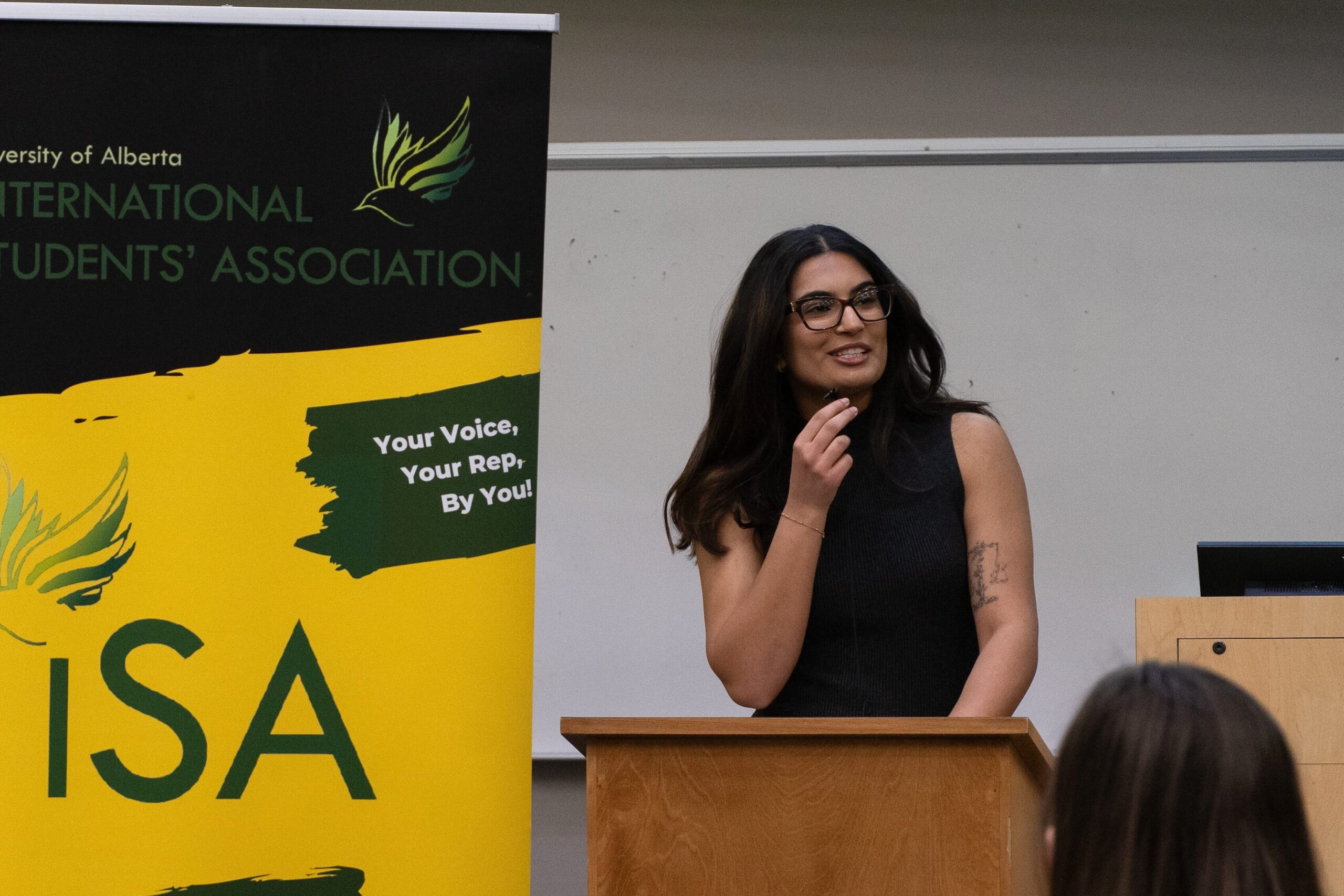
If elected, Chauhan aims to push for two things, “a predictable tuition model that guarantees the price you start with is the price you finish with.”
The U of A already has a guaranteed tuition program, which means international students’ tuition cannot be increased after they are admitted.
Secondly, she hopes to lobby for a double-point Express Entry System with the federal government.
Following Chauhan, VPX candidate Angel Raina opened by stating that she aims to advocate for peace officers on transit to be partnered with social workers. Additionally, she hopes to work with “other levels of government to make sure the money funnels down to Edmonton” from federal grants for residence and non-profit student housing.
Raina also wants to partner with newcomer support organizations and the upcoming VPSL to “make sure students have access to these resources at the start of their academic year.”
In his opening statement, VPX candidate Dustin Rodenbush stated that, if elected, he will continue the current VPX’s project of increasing underground cell service on the LRT. The City of Edmonton has finalized a deal to bring cell service to LRT tunnels and stations by spring 2026.
He hopes to increase the cleanliness of “campus and surrounding area.” Rodenbush will also “advocate for all levels of government to improve access for entry level jobs,” and the co-op and research opportunities available to international students.
Anik asked the VPX candidates about the specific actions that they will take to increase safety on public transit.
Chauhan began by stating that along with pairing social workers and peace officers, she also aims to work with the city and the Vibrancy Fund to “beautify LRT stations, [where] it’s been proven that it does impact safety.”
Raina stated that investing in cleanliness on transit is another important factor to the “culture of safety.” Secondly, if elected she will be “advocating to reinstate a coordinated outreach program, such as through reach crisis diversion teams” to make de-escalating situations more efficient.
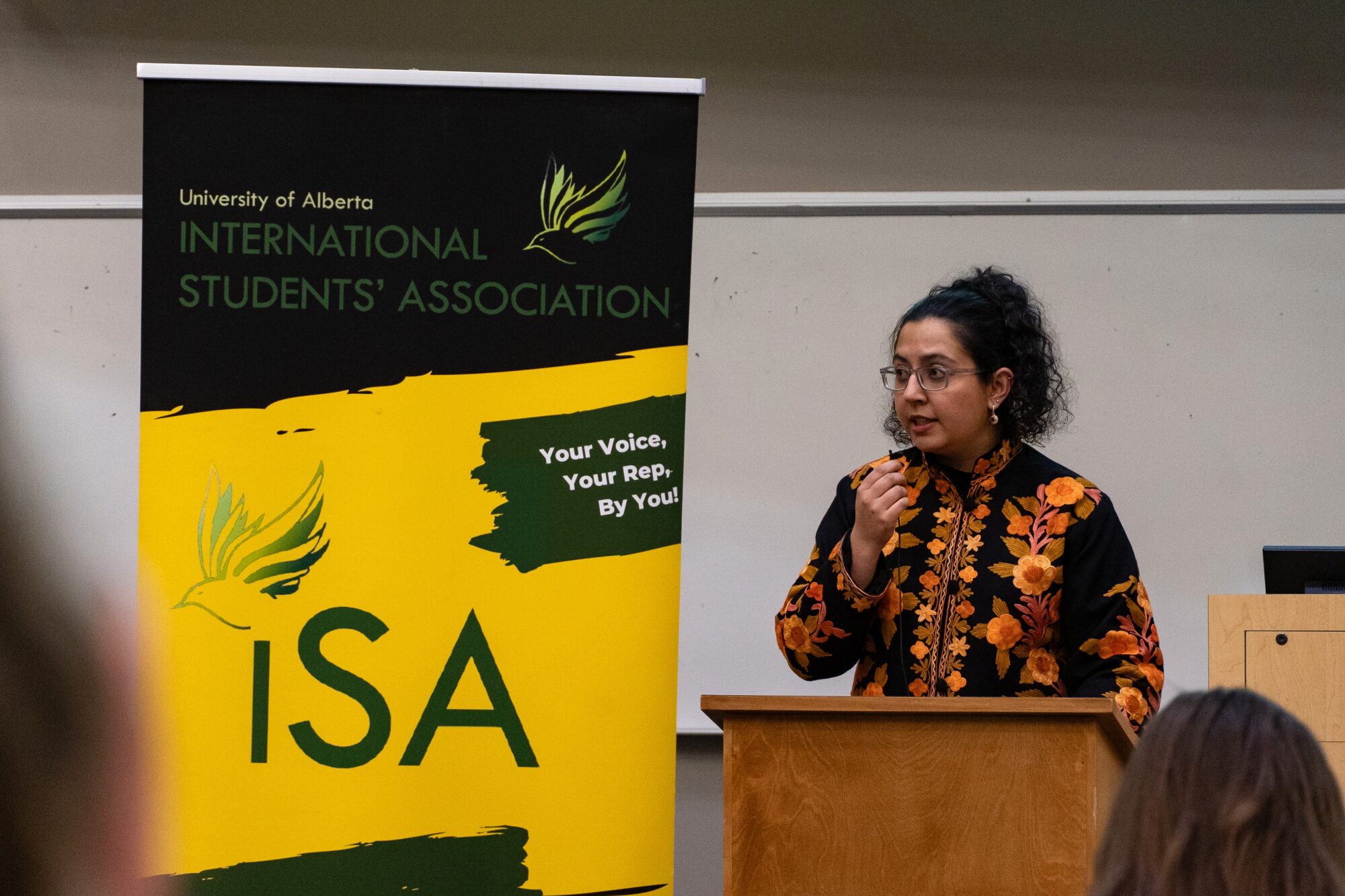
Following Raina, Rodenbush also aims to “increase peacekeepers, or peace officers, and social workers.”
Additionally, he would ensure that escalator maintenance is done “at times not inconvenient for people … which will reduce the chances of violence breaking out.”
Additionally, Anik asked the VPX candidates to address the federal government’s change to reduce unlimited work hours for international students, and “what the SU [got] right and what pieces should be changed.”
Chauhan began by stating that, from her understanding, “it’s not feasible to push for extended hours beyond the 24 hour cap that’s [currently] instated.” Although, she is willing to learn further and work with the ISA and CASA to get hours that would better support students.
Raina followed by saying that it’s important to partner with CASA to increase the hours “so students are able to support themselves and alleviate financial pressures.” If elected, Raina aims to take a holistic approach by advocating for more affordable housing and mental health supports, and addressing food insecurities to lift some of the financial pressures students face.
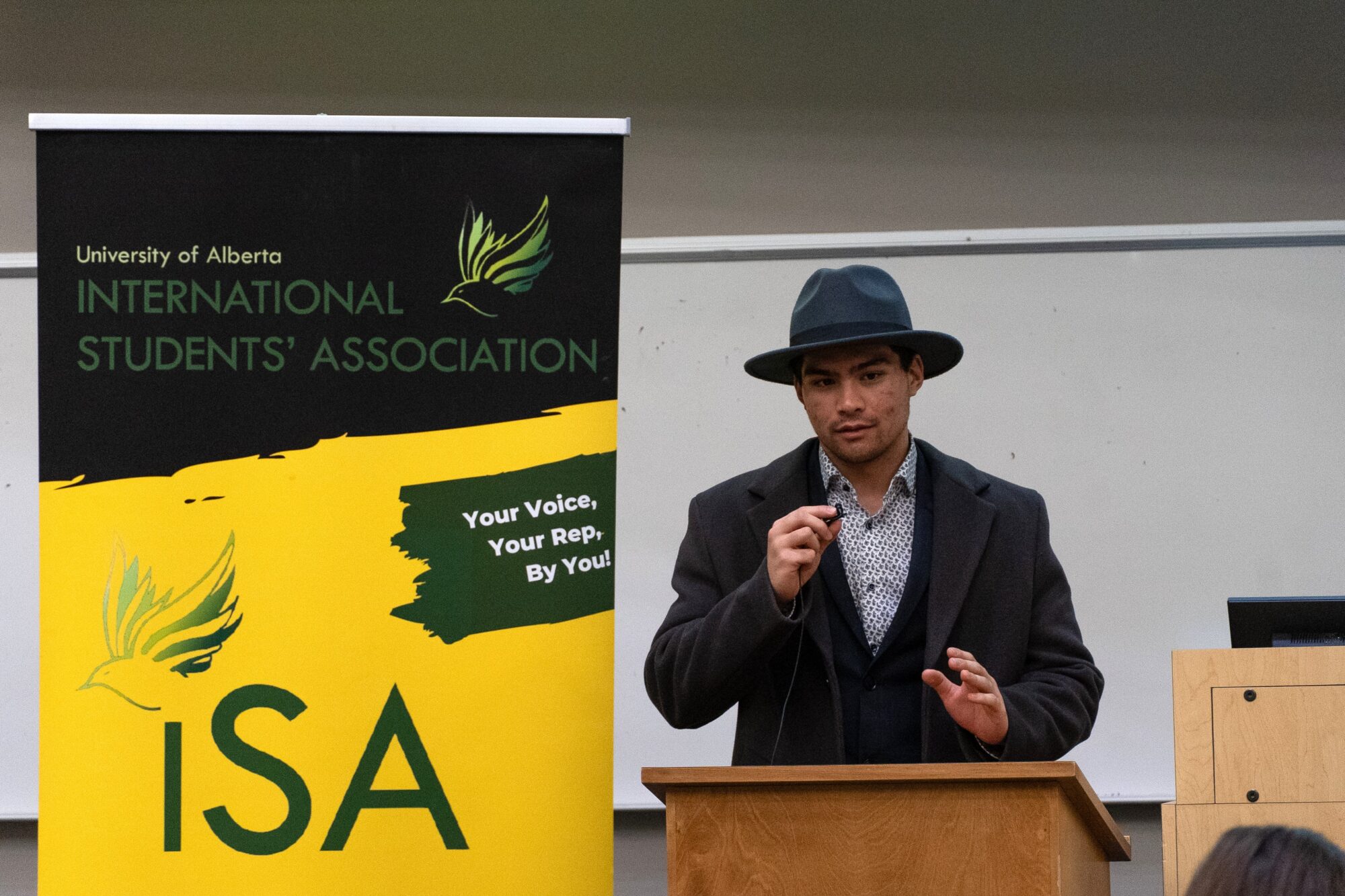
Rodenbush agreed with the other VPX candidates on working with CASA to increase the 24 hour cap to “alleviate the financial burden of international students.”
During audience questions, the ISA’s VPA asked the VPX candidates what specific initiatives or policy changes they plan on implementing to make scholarships more accessible and equitable.
Raina addressed this by stating that, if elected, she will advocate for more bursaries and grants so students don’t have to pay loans back. She will also advocate to make sure the funding for Francophone students come through. Raina would also continue to advocate for “Canada’s student grant petition … to commit to funding on that front as well.”
Chauhan agreed with Raina and stated that she will “explore ways to collaborate with alumni, or exploring other avenues to create these bursaries.”
Rodenbush followed by reiterating his plan to increase entry level jobs with organizations and businesses. He will also fight against the student grant cuts “to make sure students don’t fall into debt, and have a safety net.”
In Chauhan’s closing statement, she advocated that she will be a consistent partner who communicates and collaborates, whether that is with a double Express Entry point or predictable tuition models.
Raina, in her closing statement, committed to making sure the city is safer for international students, “advocating that they’re housed … and for mental health resources.”
Following Raina, Rodenbush asked the ISA to get in contact with him and that “contact is king.”
—Trystyn Rayko
VPOF candidates discuss accountability, financial issues, and safety
VPOF candidate Armaan Singh opened again by talking about transparency around how students’ roughly $700 annual fees are spent.
Singh restated his platform pillars of financial transparency, generating more non-student revenue, and anonymous sexual assault reporting.
Current SU VPSL and VPOF candidate Logan West mentioned their experience and track record delivering on safety concerns raised by international students.
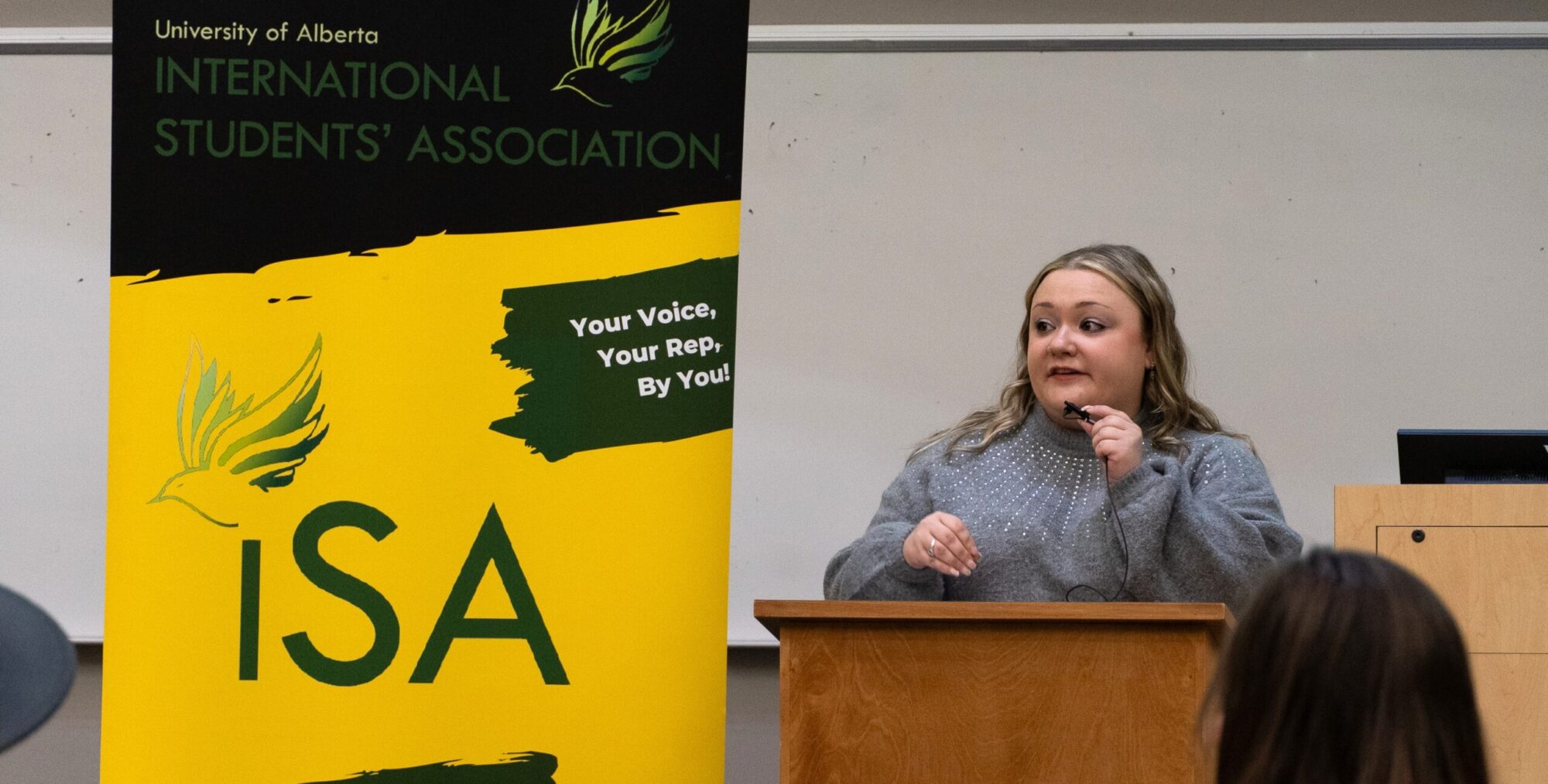
West highlighted getting the ISA a seat on the Sexual and Gender-Based Violence (SGBV) task force, expanding ONEcard access, and working with the City of Edmonton to provide educational materials about exploitative rental situations.
Additionally, she stated that she had built strong relationships with university administrators.
Anik asked the VPOF candidates if international students facing visa-related financial shocks should receive priority emergency funding.
Singh didn’t promise direct action, stating that the SU lacks authority to directly control university financial decisions.
He then emphasized advocacy to BoG, and promised to be realistic rather than making false promises.
West agreed with Singh, but said that they had the opportunity to build close and positive relationships with Ravina Sanghera, the vice-provost and dean of students, as well as Carrie Smith, the vice-provost of access, community, and belonging.
West stated these relationships could help students facing these issues and they could be directed to those she built relationships with.
West also said that the SU should be looking beyond that and making sure that every dollar students spend in fees is valuable.
Anik then asked if the SU should push for a cap on residence rent increases tied to inflation.
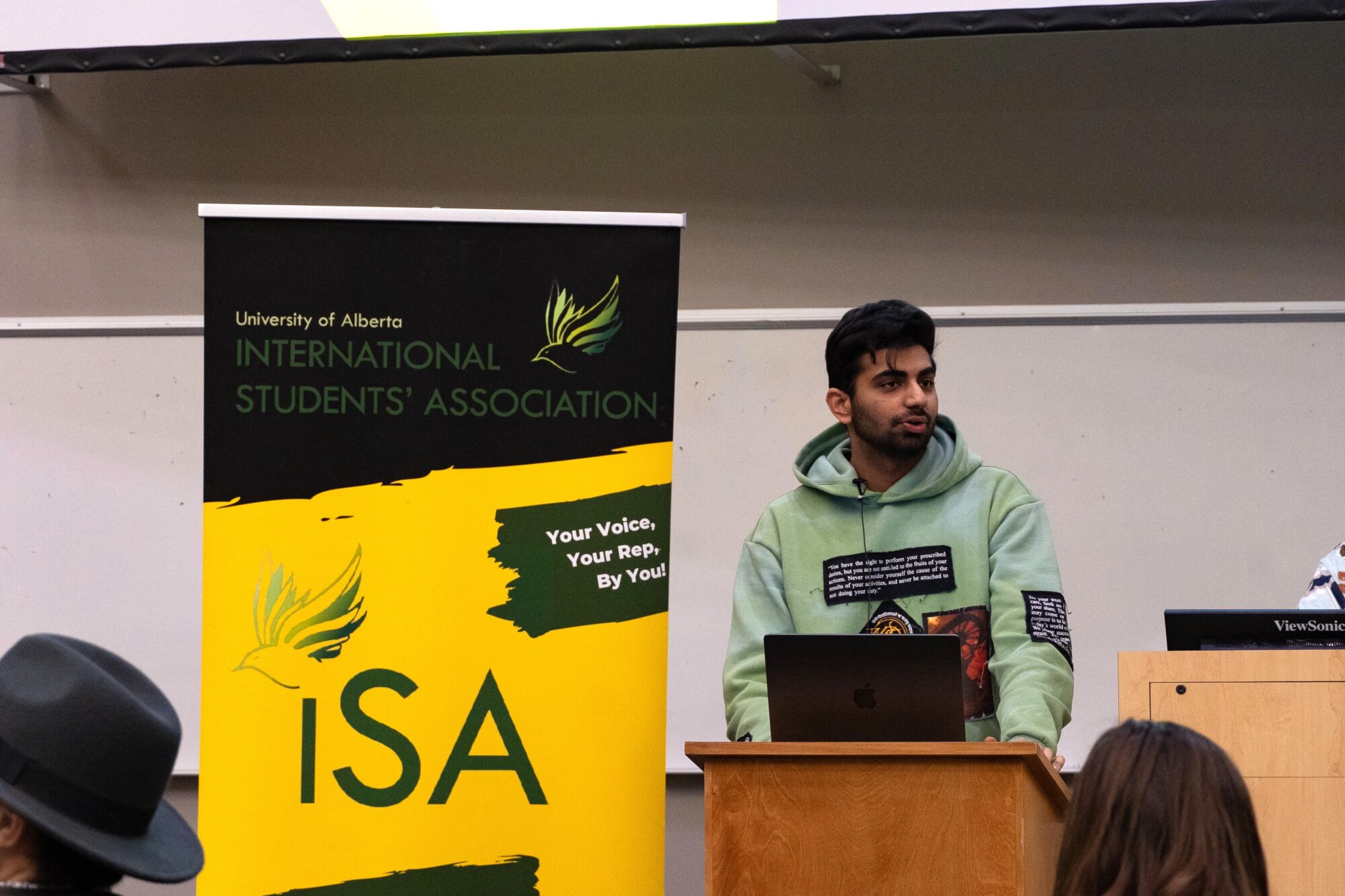
Singh suggested the SU having a website listing rent-controlled apartments around the university area that are safe and secure for students.
Singh also went on to talk about affordability, and that not everyone can afford the cost of residence and meal plans.
West said she supports rent control, but that it doesn’t necessarily fall into the VPOF portfolio.
West disagreed with Singh’s website idea, stating that it could make the SU legally liable for any issues that arise from it. Additionally, there are existing sites that service a similar purpose, according to West.
She mentioned the student talent hub, stating it could be a source of money for students and allow them to show their skills.
Ramish Raza, former ISA co-president, mentioned the ISA fee from 2024, which failed because it did not meet the 15 per cent turnout required for the referendum to pass. He asked if the VPOF candidates would review or amend the quorum requirement, and what steps they would take to engage international students.
Singh said that he completely understood the challenges, as the ISA’s budget had decreased in the last few years.
He argued many international students are disengaged due to financial pressures, and wanted to focus on education and mobilization to improve referendum turnout.
West emphasized strengthening ISA leadership and long-term planning. They also suggested engagement may grow through stronger student group partnerships.
Armaan questioned West by stating that West failed to follow through on collaboration promises, citing delays in communication that postponed iDay. He asked why her public commitments to interact with students did not result in meaningful action and support.
West said “I’d probably recommend not having your grandfather end up in the hospital dying in the middle of your term, because it will take you away for periods that are longer than you’d like.”
West then said that she took accountability, and publicly apologized for her lack of communication at that time.
West went on to say “we moved on, we moved forward and we put on iDay in SUB, which was incredibly successful and saw a really good turnout.”
West also noted that the ISA had failed to properly communicate as well, citing delays in responses and emails being sent to her personal email, rather than the VPSL email.
West then asked Singh whether his platform aligns with the operational and strategic responsibilities of the VPOF role, stating that his platform more aligns with that of VPSL.
Singh responded that he does want to implement the strategic plan, but his platform can’t just be repeating it. Singh argued operational responsibilities include maintaining functional websites like for an anonymous sexual assault reporting.
Singh also reiterated a point he brought up at previous forums, that the sustainability fund was being misused.
“Sustainability fund was allocated $90,000 and only $20,000 were used … those $70,000 went to waste. It could have been reallocated towards the campus food bank,” Singh said.
When given the opportunity to make closing statements, Singh brought up earlier points regarding West’s responsibilities.
“What happened was unfortunate and I hope your grandfather is a lot better. But at the same time that does not give you leeway that you can ignore your responsibilities,” Singh said.
Singh went on to talk about struggles he has faced this year, and that he did not let them affect his work.
Before West made her closing statements, Anik interjected.
“Just a kind and gentle warning before talking about any personal situation, for any candidates, never talk like that. I’m not going to warn you again,” Anik said.
West then closed by stating she has delivered on her commitments to safety, as well as issues of SGBV, giving the ISA a seat on the SGBV task force.
“I’ve endured adversity and overcome through strong resilience to learn and grow,” West said.
West said that her platform is reasonable, feasible, and addresses key issues that the SU will be facing.
—Evan Cruickshank
VPA candidate hopes to make academic advising practical and reliable for students and establish more multicultural resources in courses
In VPA candidate Susan Huseynova’s opening statement, she stated that her “focus is on making academic supports better for [students] in a practical way; faster [and] with more reliable advising, clear information, … and stronger advocacy” when barriers from policies or processes are created.
Anik asked Huseynova if “academic probation policies [should] account for immigration risk” when immigration status is tied to full-time enrolment.
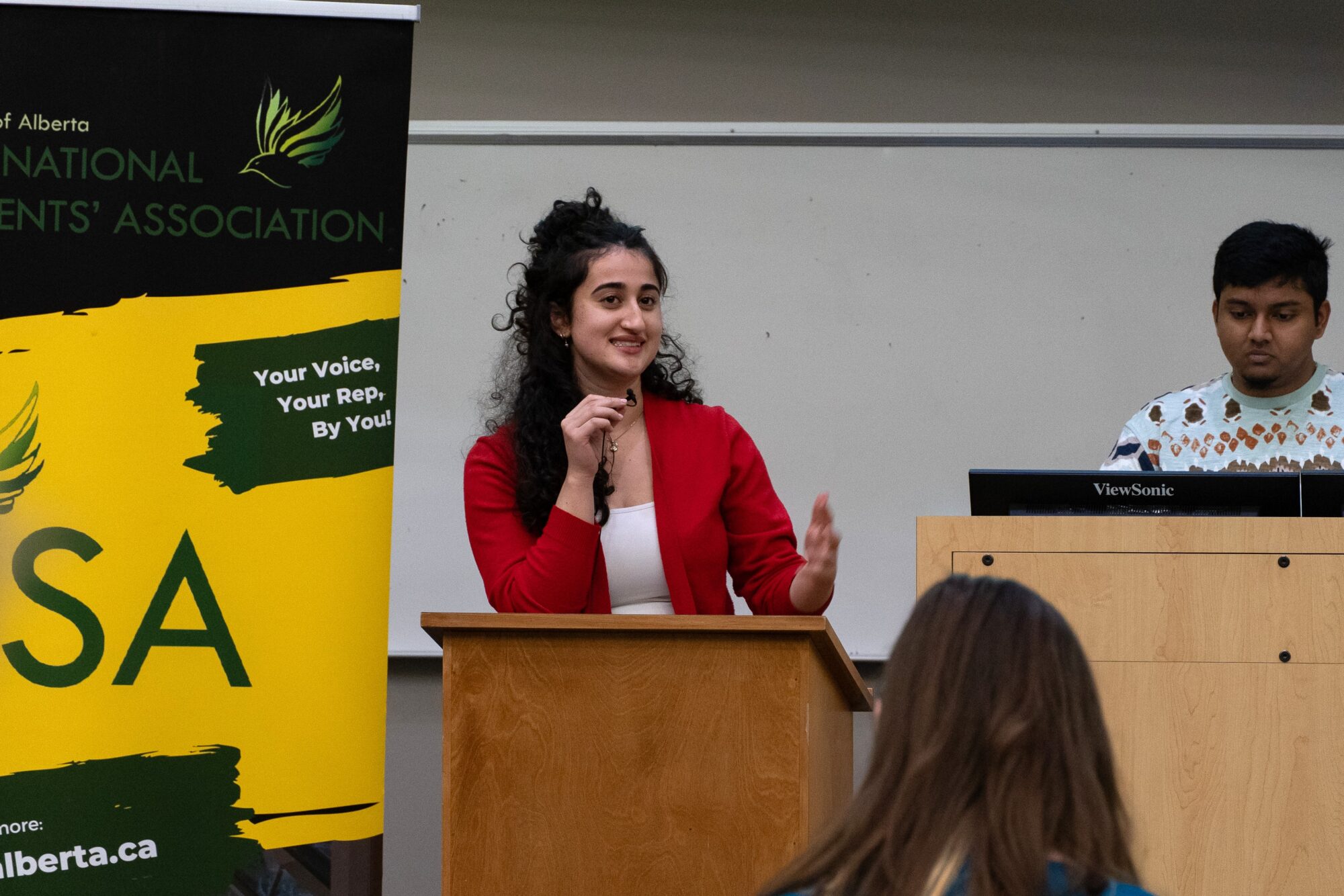
Huseynova responded by reiterating her action plan of restructuring and increasing advocacy efforts in hope of recognizing these issues and flagging them “before it gets to the point of academic probation.” She aims to implement a “system where students are flagged, whether on academic warning or [are] required to withdraw” before students are risking their visas and their time at the university.
Additionally, Anik asked Huseynova how she plans on implementing global perspectives in course curricula, instead of just primarily Western opinions.
Huseynova stated that she hopes to “co-create and co-design Indigenous studies courses with Indigenous leaders to ensure the most credible and reliable resources.” Through this model she aims to be able to establish the same with multicultural courses.
—Trystyn Rayko
VPSL candidates
In his opening statement, VPSL candidate Brish Goorimoorthee stated that he will advocate for “better residence support and de-rationalization of rent.” He followed by saying that he will push for proper maintenance, adequately affordable housing, and clear communication.
“One way to meet this goal is to push for a long overdue overhaul of The Vault at the community space at HUB, as students deserve their own … space,” Goorimoorthee said.
Following Goorimoorthee, VPSL candidate Nolan Greenwood commented on the challenges faced by international students at U of A’s residence, including the rationalization program.
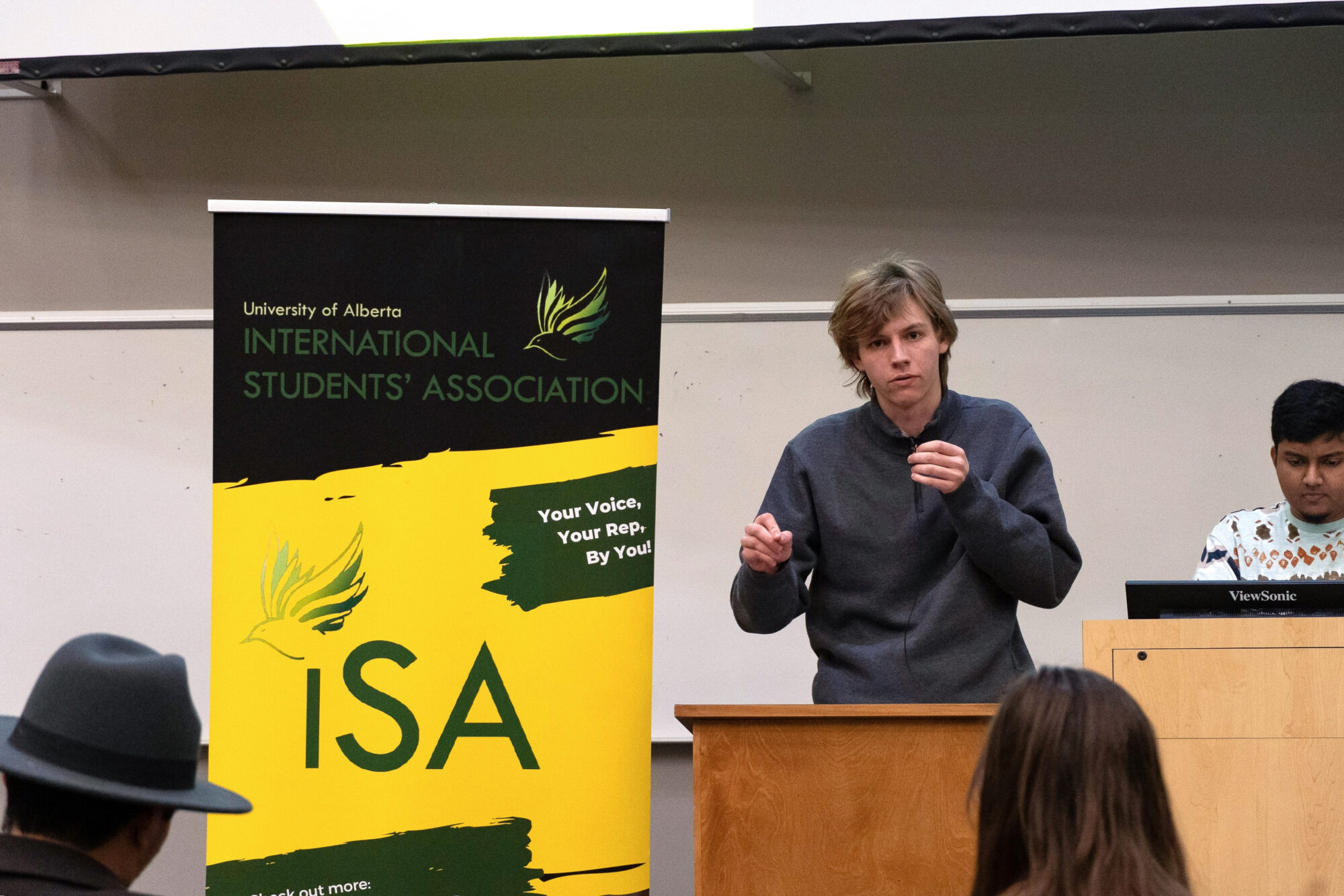
“This program raised rent significantly, as well as reduced affordable, safe options on campus,” Greenwood said.
He followed by saying that he will advocate for the implementation of the SGBV task force recommendations. He highlighted recommendation nine, “which calls for an immediate co-ordinated response from the university for sex-for-rent — an issue disproportionately affecting international students.”
Manyu Rathour, current co-vice president (communications) for the ISA, stated his three platform principles — advocacy, social impact, and community building.
“This means fighting food insecurity, advocating to de-standardize residence rent, and stopping tuition hikes. [As well as], raising campus spirit, expanding mental health support, promoting access to student-friendly jobs on campus, [and] hosting a free SU prom open to all U of A undergrads,” Rathour said.
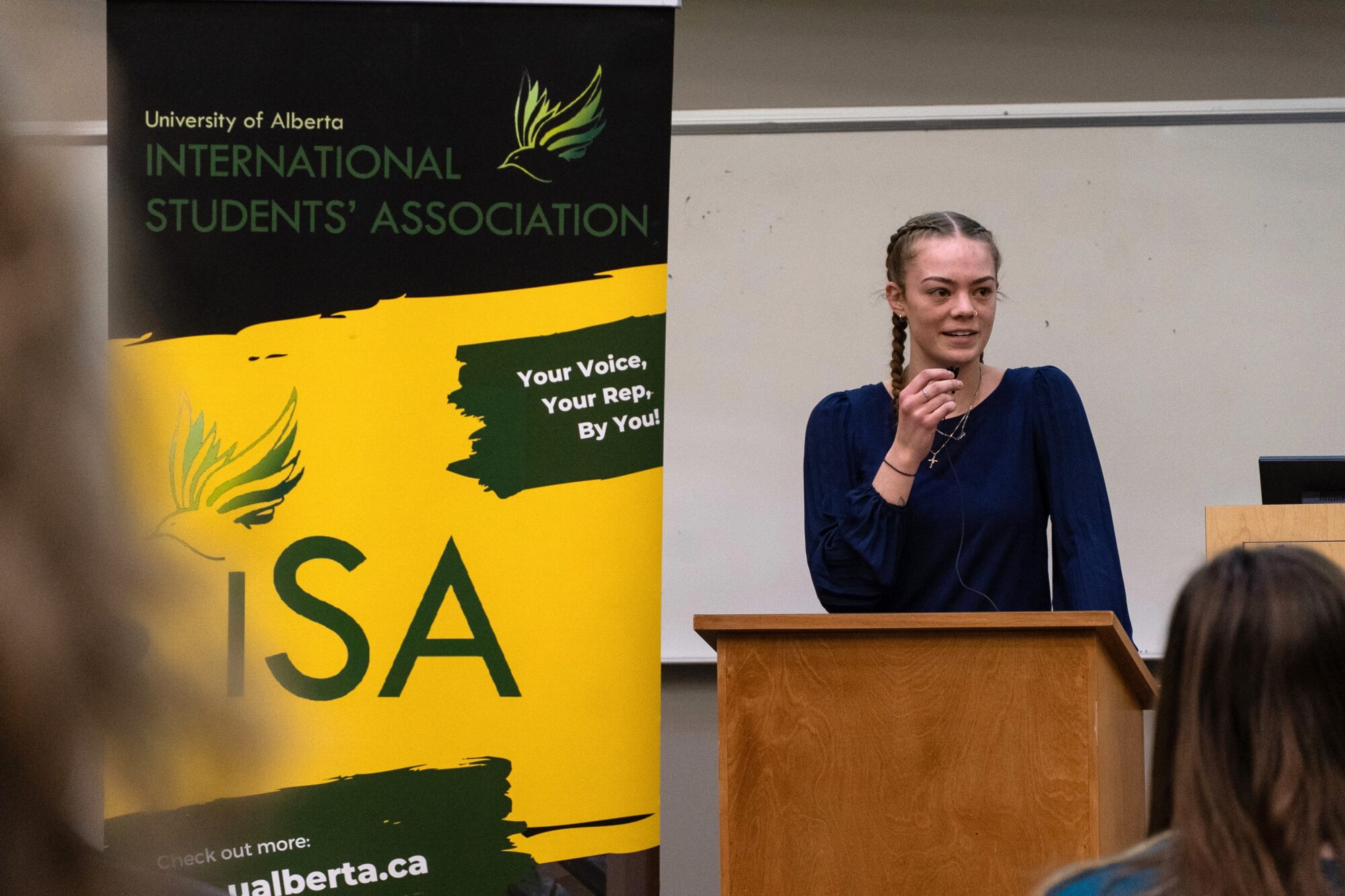
VPSL candidate Paige Wall stated that international students “contribute enormously to this campus academically, culturally, and socially.” She followed by saying that these students feel a unique set of pressure that domestic students do not feel.
“Within the VPSL role, I see three priorities — affordability, service navigation, and safety. That includes strengthening collaboration with the Campus Food Bank (CFB), reviewing whether student-led programming creates financial barriers, and ensuring international students have clear, accessible information,” Wall said.
Anik asked candidates what culturally competent reforms could be implemented to improve international students’ life on campus.
In his response, Goorimoorthee stated that he will support the PSC.
Greenwood stated that the cultural content reforms would be structured around the ISA. He followed by saying that “traditional spaces are not necessarily spaces that international students engage in.”
Following Greenwood, Rathour stated that “[he] would propose that the One-At-A-Time Therapy (OAATT), they have drop-in hours, and so does PSC. [He] would be ensuring that all the [student representative associations and faculty associations] can get OAATT and PSC to sometimes have drop-in services available right at their office, in their office hours.”
Wall stated that she will advocate for clear communication around all available services, multilingual accessibility, and structured collaboration between VPSL, ISA, and counselling services to identify gaps.
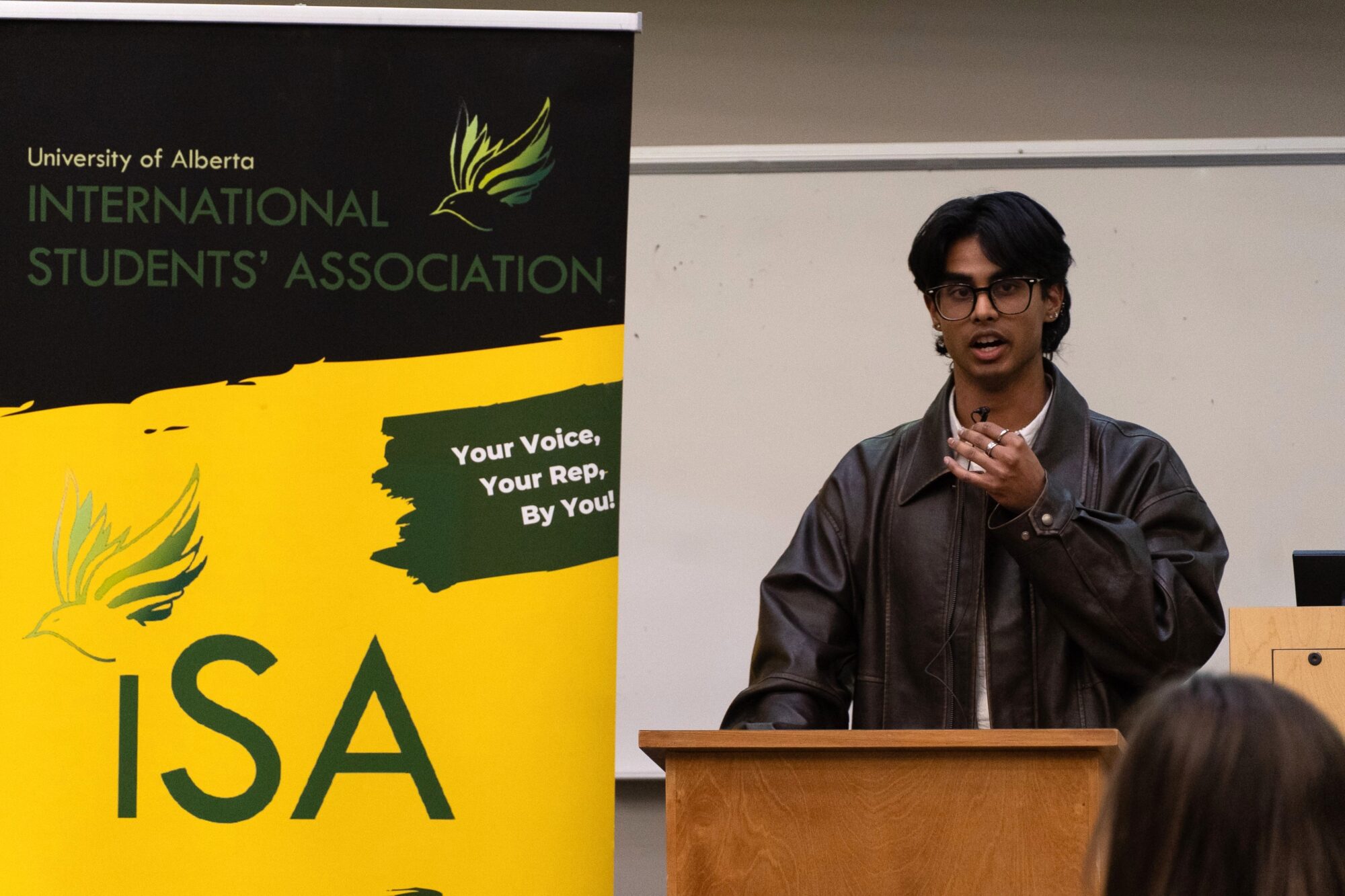
Anik asked candidates what structural programs, not just events, would they introduce to reduce international student feelings of isolation after their first year on campus.
In response, Goorimoorthee stated that he wants to incorporate programs into the Week of Welcome and New Student Orientation.
Following Goorimoorthee, Greenwood said he will “continue to work with the ISA to ensure consistent advocacy, as well as … offering support and resources [that are not necessarily done] by the ISA.”
Rathour began his response by saying that his “opponents have it quite wrong as [they] talk about international students making lifelong friendships.” He followed by stating that the Winter Orientation should be improved, ensuring that all students feel welcome on campus.
In her response, Wall stated that culturally-oriented events are extremely important to international students, especially for those who want to stay involved and find friends on campus.
The Gateway asked candidates how they would move beyond consultations and events to ensure the needs of international students are being met.
In his response, Goorimoorthee stated that he cares and shows up for students.
Greenwood mentioned the importance of consultation, which ensures that student groups, such as the ISA, have their voice heard.
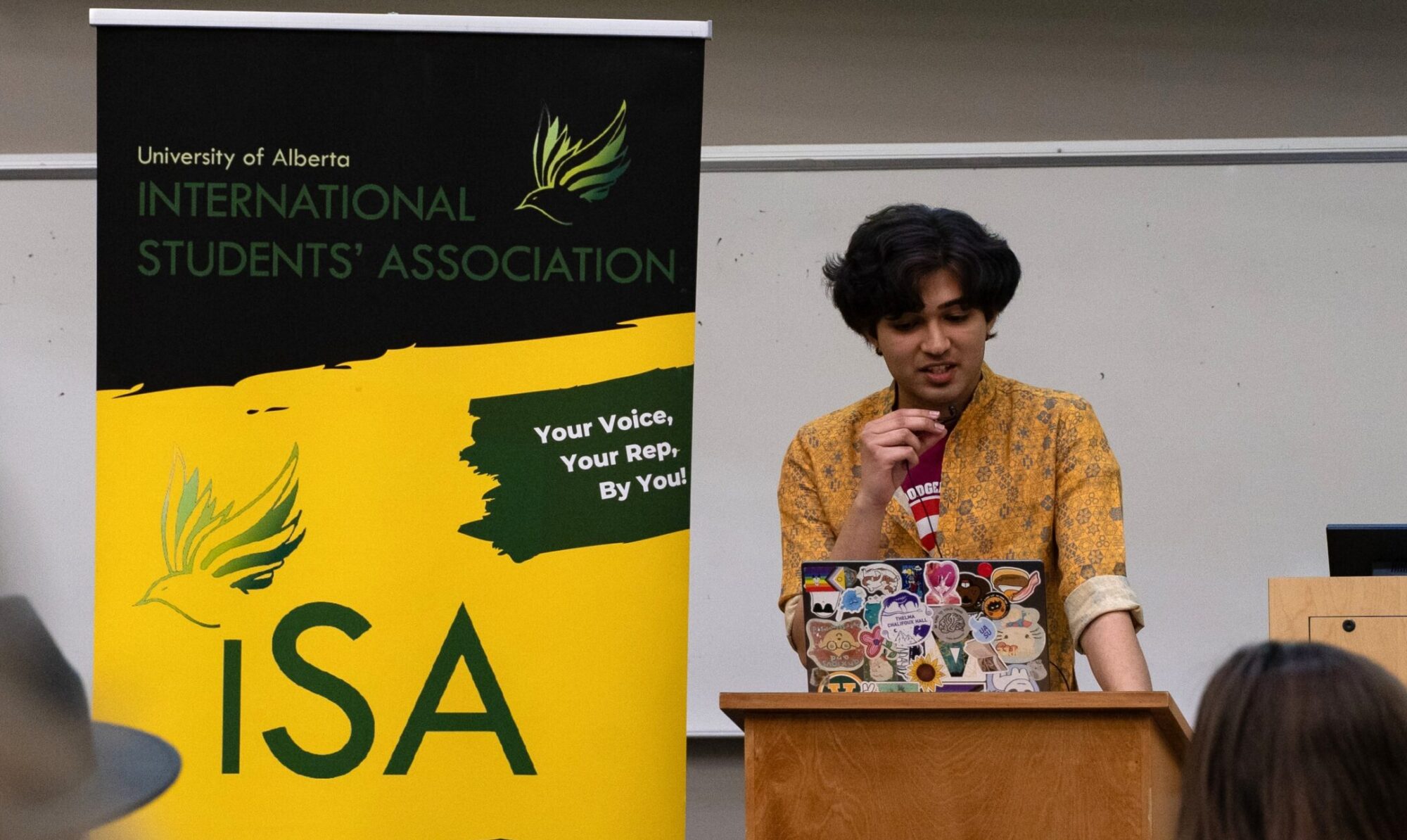
Following Greenwood, Rathour said that candidates “keep talking about consultation when there [are] things like food insecurity, standardization of rent, [and] tuition hikes.”
“I’ve proven to you that this is more than just a consultation, that I can put my money where my mouth is. I think that you deserve a VPSL who actually understands you, because to be loved is to be seen, and I see you guys, and I doubt that my opponents do,” Rathour said.
Wall stated that as VPSL she would embed affordability considerations into SU programming, ensuring that events, conferences, and initiatives are financially accessible. According to Wall, she will try to “strengthen the coordination with the CFB and the ISA.”
Greenwood said to Rathour that throughout the forums he has made countless promises about events for students, such as the U of A and Campus Saint-Jean prom, U of A Got Talent, as well as events with the ISU. He asked what SU expense would Rathour propose to reduce to ensure that all other campus events are properly funded.
In response, Rathour stated that Greenwood is not “listening to [his] speeches at all.” He followed by saying that U of A prom would be a long-term plan, and that SU has a lot of money that is just being wasted.
In his closing statement, Goorimoorthee also addressed financial events, stating that he “had the biggest event on campus last semester, the Performative Contest.” He followed by stating that he will continue to do that again.
—Fernanda Campana Omori
BoG representative candidates
In BoG representative candidate Amaan Khan’s opening statement, he said as an international student from the state of Kuwait, he wants to build on the work of the previous work of the BoG representative. He said he will advocate for student experience and housing affordability. He also said that he plans to bring travel statistics to BoG and advocate for transit safety. He ended his opening statement saying “we are international, but we are still U of A students.”
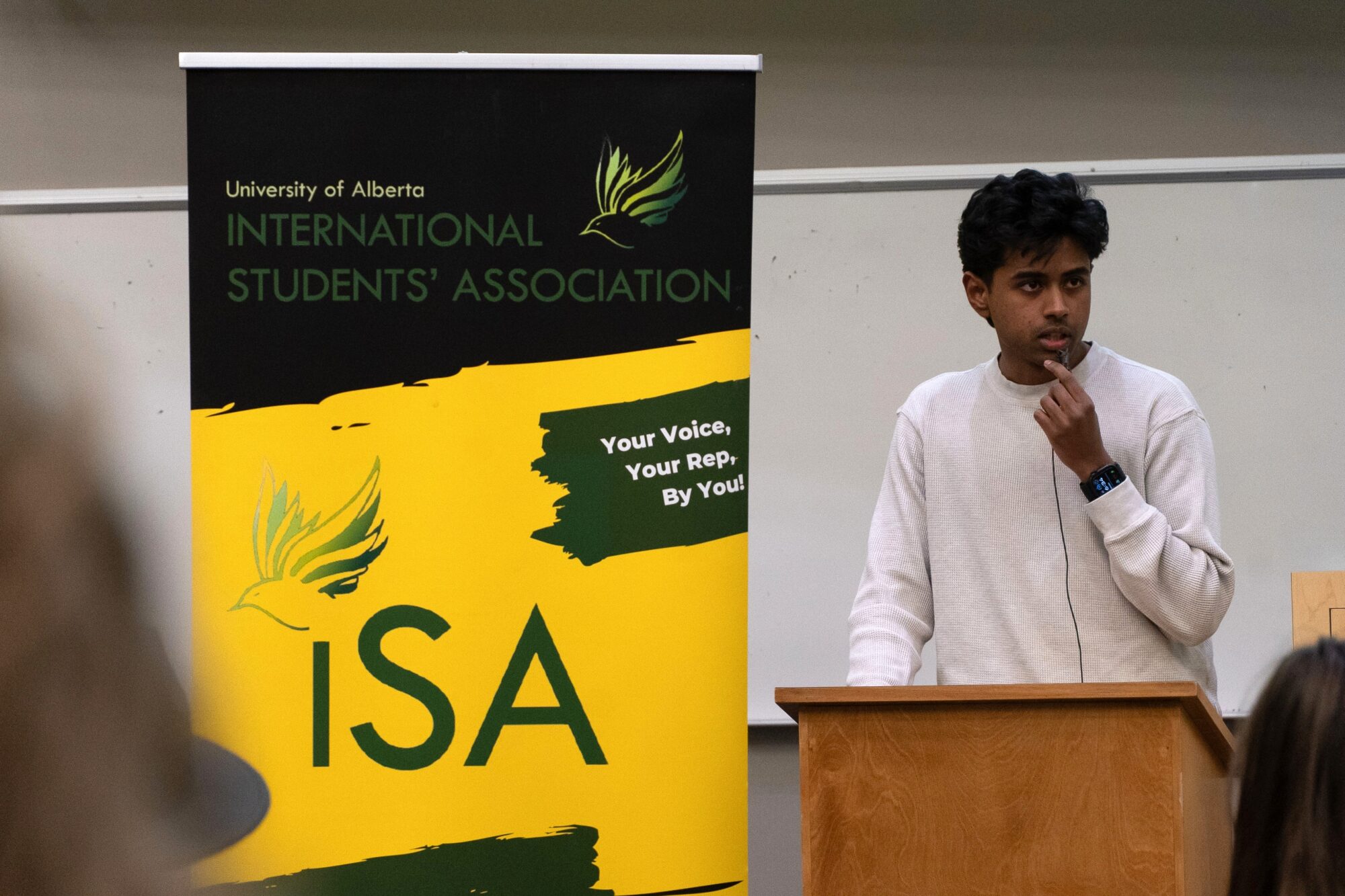
In BoG representative candidate Janardhun Alagarsamy Vignesh’s opening statement, he mentioned his experience as a first generation immigrant. He acknowledged the further 5.5 per cent approved increase of tuition for international students, the delays of visas and work permits, and residence concerns that are impacting students. He called these issues “worrisome exploitation.” He reiterated his three platform pillars — oversight, sustainability, and advocacy.
In Mojarrad’s opening statement, she mentioned that she is an international student, and that “no one understands international students like us.” She said that her platform will ensure that international students understand how to access their needs.
Anik asked the candidates if they believed that the university planned adequately for federal immigration caps and, if not, what would they change.
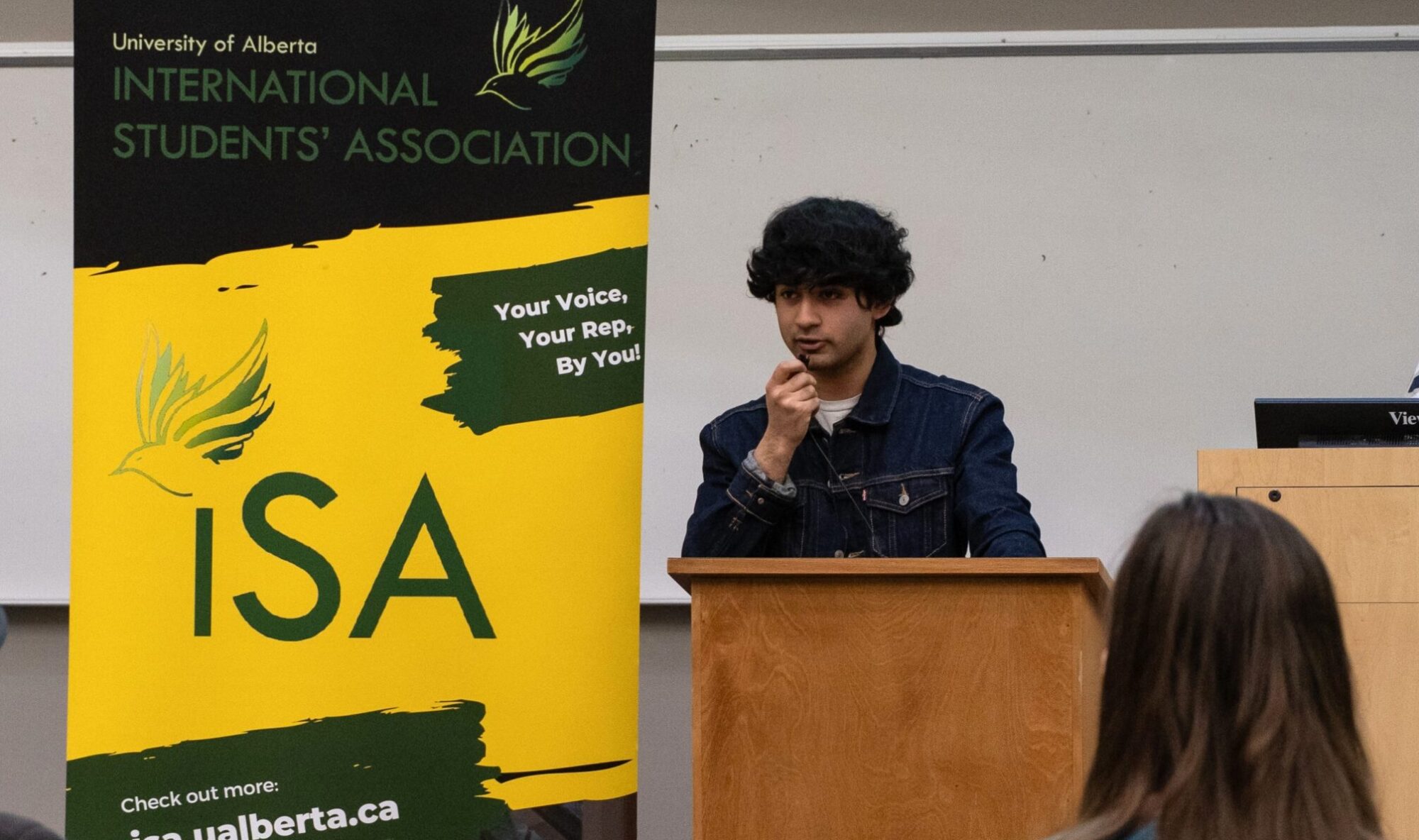
Khan said that he believed the university did not plan adequately for immigration caps. He acknowledged that study permit extension timelines have been increased, post-graduation work permits (PGWP) are taking a year to go through, and students are now paying an “exorbitant” amount of tuition. He said he will lobby for better immigration priority at the provincial level.
Alagarsamy Vignesh also said that he believed the university did not plan adequately as there are new policies being implemented quickly as an improvement. He suggested a more proactive approach at looking into a contingency plan, allowing for other alternatives and programs that can intake international students.
Mojarrad also agreed with her opponents that the university did not plan adequately, saying that the government’s response was that “[international] students need to leave” after their studies.
She said that lots of international students are here to change their future. She plans to incorporate rules to make it easier for students to get permanent residency and better work conditions.
Anik then asked the candidates how they will ensure that international students understand what is happening in closed-door board meetings that directly impact them.
Khan said that he plans to utilize effective and consistent consultations with SRAs, satellite campuses, and student groups. He said he will create a detailed and structured board report after every meeting, along with using social media and formal documentation.
Alagarsamy Vignesh said that he values transparency. He said that he “cannot always promise full transparency” and that there is a non-disclosure agreement (NDA) that is signed for the BoG representative. He added that he would like to incorporate information in a more engaging and “bite-sized” way so students are better able to understand how they are being impacted.
Mojarrad said that she wants to utilize social media as it is a more accessible platform for students. She said she plans to use accessible language to make things easier to interact with and understand.
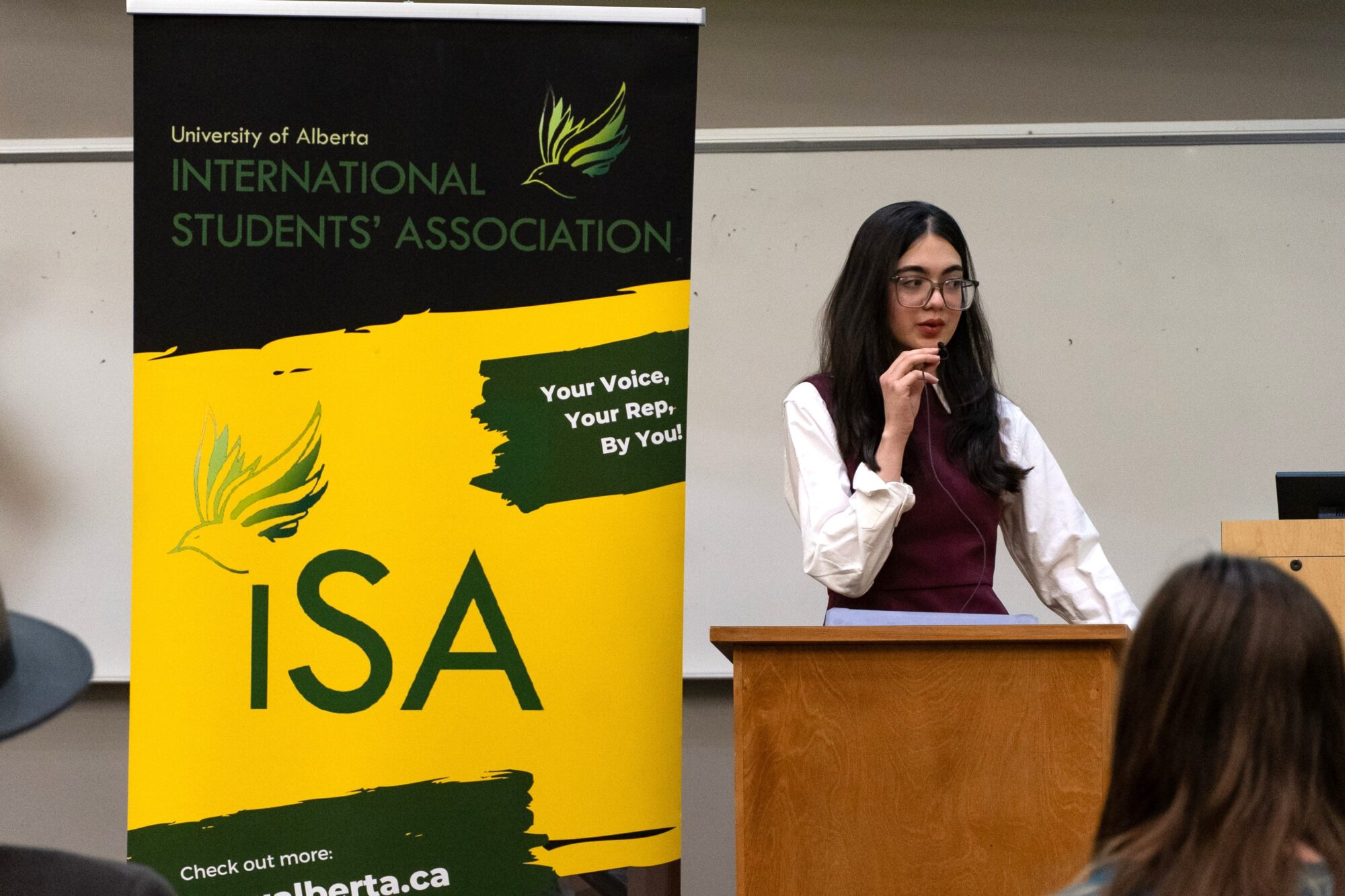
The Gateway how the BoG candidates will convince other members of the board and the university to not further rollback EDI policies or efforts if the board removes EDI from recruitment policies.
Khan said that effective consultation will be the key to protecting marginalized students and including them in the decision making process.
Alagarsamy Vignesh said “we must understand that equity and EDI principles are essential to the integrity of the university. Additionally, he said he will “always advocate for EDI principles to remain integral to hiring policies.”
Mojarrad said that her “platform will create opportunities.” She said that if EDI is rolled back, she will “definitely make a platform to make sure these opportunities are not rolled back again.”
—Erin Widmark-Pickle
Golden Bears and Pandas Legacy Fund
After the candidates opening statements, Molly Stetson, a member of pandas rugby and the Legacy Fund Committee, spoke on behalf of the Golden Bears and Pandas Legacy Fund. The fund is a student-led initiative founded in 1991 to save varsity programs. Currently, it represents student ownership over campus culture.
The fund is overseen by undergraduate students. It supports scholarships, assistant coaches, and study halls for athletes, while also driving equity initiatives like the women in coaching program.
“On March 4 and 5 vote yes to protect athletics jobs and to keep the student voice active,” Stetson said.
—Evan Cruickshank
CORRECTION: A correction was issued at 9:12 on February 28, 2025 to correct that Sesek has promised to cut his own salary.