BREAKING: Budget 2026 sees some cuts to student aid
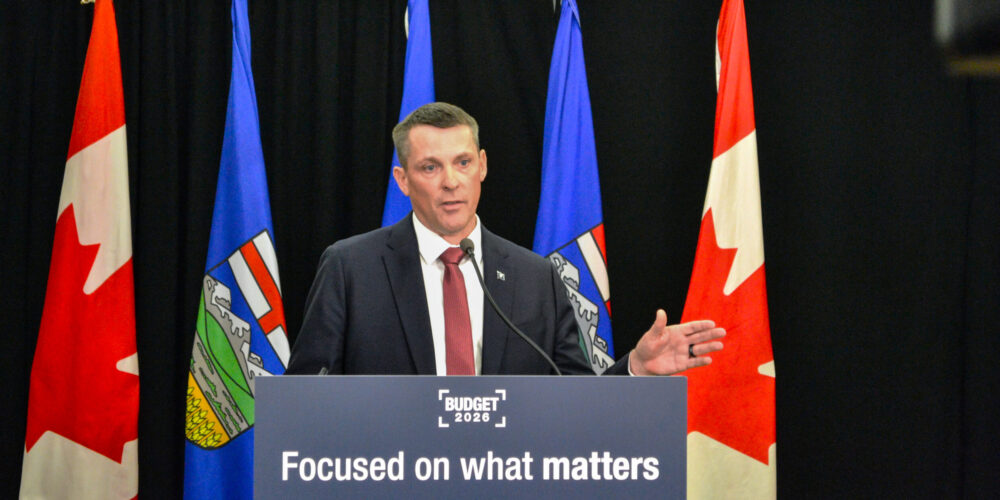
"Advanced education did quite well in this budget, all things considered," Finance Minister Nate Horner says.



 Evan Cruickshank
Budget 2026 features small cuts to student loans, capital maintenance and renewal for post-secondary institutions (PSI), and no new capital project funding for the University of Alberta.
The title of this year’s budget is “Focused on what matters.” Budget 2026’s total expenses are estimated to be $83.9 billion before contingency, which is an increase of 3.1 per cent from the 2025 forecast. Budget 2026 estimates a $9.4 billion deficit.
Revenue for the province is down from a forecasted $75.3 billion in 2025 to $74.6 billion. That is a 0.93 per cent decrease.
“2026 will not be easy,” President of Treasury Board and Minister of Finance, Nate Horner, said at the Budget 2026 press conference. “I recognize this is a tough pill to swallow, but this deficit reflects our commitment to providing top quality services, like education, health care, and social supports.”
The deficit is largely due to a drop in the price of oil. Other cost pressures like increased wages due to public sector bargaining and population growth contributed as well.
U of A operating grant still being decided
Minister of Advanced Education, Myles McDougall, said in a news release that “a strong economy starts with a strong post-secondary system. Budget 2026 invests in the programs, training spaces and campus infrastructure needed to prepare Alberta’s students for the jobs of today and tomorrow.”
Estimated total operating expenses for all PSIs are $7.1 billion, up $55 million from 2025–26. The increase is due to factors like demand for more seats in apprenticeships and high demand occupation and inflationary pressures.
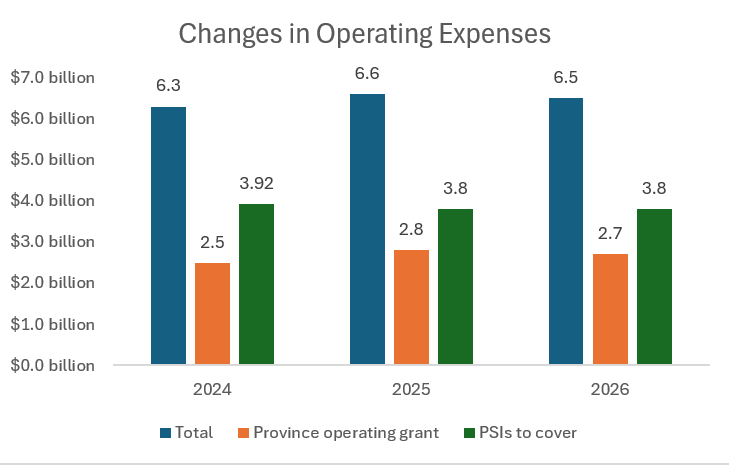
Operating expenses managed directly by PSIs is estimated to be $6.5 billion in Budget 2026, down from $6.6 billion last year.
Advanced Education will provide $2.7 billion in operating grants to PSIs. This means PSIs will have to cover 58 per cent of operating costs, or $3.8 billion, through other sources of funding. Other sources can include tuition, research funding, and federal funding.
The operating funding also includes $7.5 million for Indigenous education.
The government is still working to finalize the funding agreements for individual PSIs.
U of A expecting another flat operating grant
Last year, the budget allocated $436.6 million to the U of A’s operating grant. The operating grant has remained at the same level for four years.
Since 2019, the Government of Alberta has cut the U of A’s operating grant by $222 million.
The Alberta Students’ Executive Council (ASEC) has advocated for the restoration of pre-2019 operating grant funding.
“We argue that a restoration of adequate funding to support institutions and students, as confirmed by the Mintz panel’s recommendations, is a foundational step towards a clear, unified vision for exceptional post-secondary education in this province,” ASEC states on their website.
At the December 12, 2025 meeting of the U of A Board of Governors (BoG) Todd Gilchrist, vice-president (university services, operations, and finance), said the university was anticipating another flat operating grant.
President and Vice-chancellor Bill Flanagan said the previous four years of flat funding has meant “continued significant financial pressure on the U of A.”
Budget 2026 stated that part of the operating expenses increase for Advanced Education was due to an increase in compensation expenses. Several unions of PSI employees have renegotiated their collective agreement since the last budget. That includes the Association of Academic Staff of the University of Alberta (AASUA) and the Non-Academic Staff Association.
“Advanced education did quite well in this budget, all things considered,” Horner says
At the Budget 2026 press conference, The Gateway asked Horner how, if at all, this budget considered the Mintz panel recommendations to reform PSI funding.
Horner said he wasn’t sure of the specific recommendations, but that “advanced education did quite well in this budget, all things considered, especially on the capital side.”
The U of A received no new funding for its requested capital projects. The Government of Alberta is continuing to fund the renovation of the Biological Sciences Building and Campus Saint-Jean, as outlined in Budget 2025. There is also a continuation of funding for the U of A Hospital Brain Centre Neurosciences Intensive Care Unit.
The U of A’s capital plan outlined two projects it was seeking provincial funding for. The first was an Integrated Health Sciences Innovation Complex, or a Dianne and Irving Kipnes Health Research Academy 2.0. The U of A was requesting $30 million for the demolition of the existing Research Transition Facility and for functional programming of a Kipnes Academy 2.0.
The U of A said this project comes from a need to relocate research labs, teaching labs, and lecture halls from the Clinical Sciences Building as part of an effort to free up bed space in Walter C. Mackenzie Health Sciences Centre.
For the second project, the U of A is seeking $5 million for planning and landscape preparation for a data centre. The U of A has committed $250,000 and is seeking other partners to fund the project.
Slight cut to student aid, less students receiving loans and grants
Budget 2026 outlines that Alberta PSIs’ tuition fees are estimated to be $2.2 billion in 2026–27. This is an increase of $169 million from last year’s forecast, however revenue is “not as strong as previously forecast due to international student tuition revenue decreases” related the Government of Canada’s cuts to the number of new study permits.
Budget 2026 has allocated $148 million over three years to increase seats in high demand post-secondary programs through Targeted Enrolment Expansion programs. The funding will target graduate and undergraduate engineering programs.
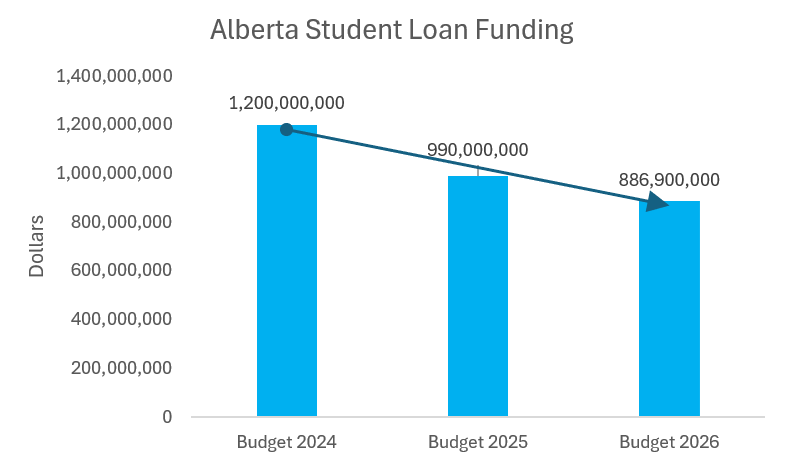
Budget 2026 allocates $886.9 million for student loan disbursements. This is down by about 10.4 per cent from Budget 2025.
The budget allocated another $182 million for scholarships, grants, and awards. Budget 2025 a total of $183 million for scholarships, grants, and awards.
The number of students receiving financial aid has decreased. In 2023–24, 123,200 students were receiving student loans, compared to 108,100 in 2024–25. The number of students receiving provincial grants has also decreased, from 21,200 in 2023–24 to 18,000 in 2024–25.
CORRECTION: A correction was issued on February 27, 2026 to remove a sentence stating that the amount of operating costs PSIs have to cover increased this year. It has stayed the same.