SU Elections 2026: Myer Horowitz forum recap
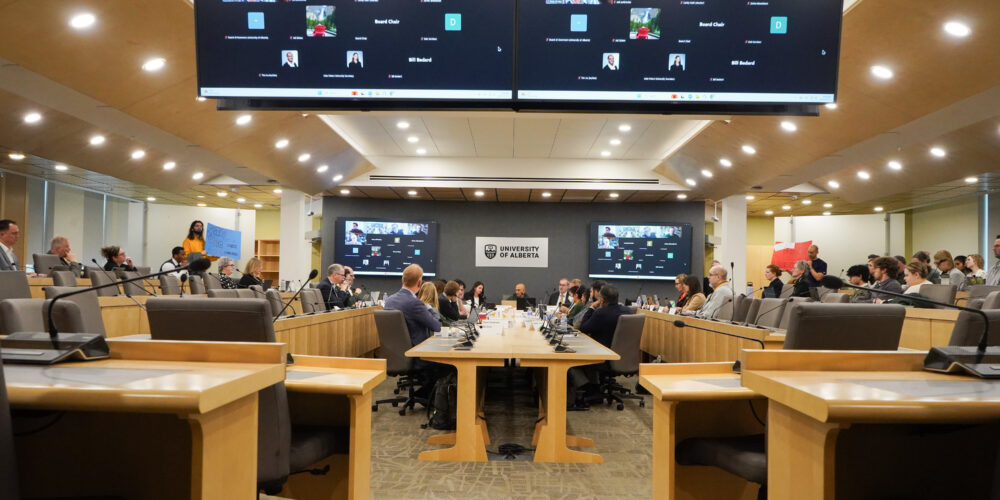
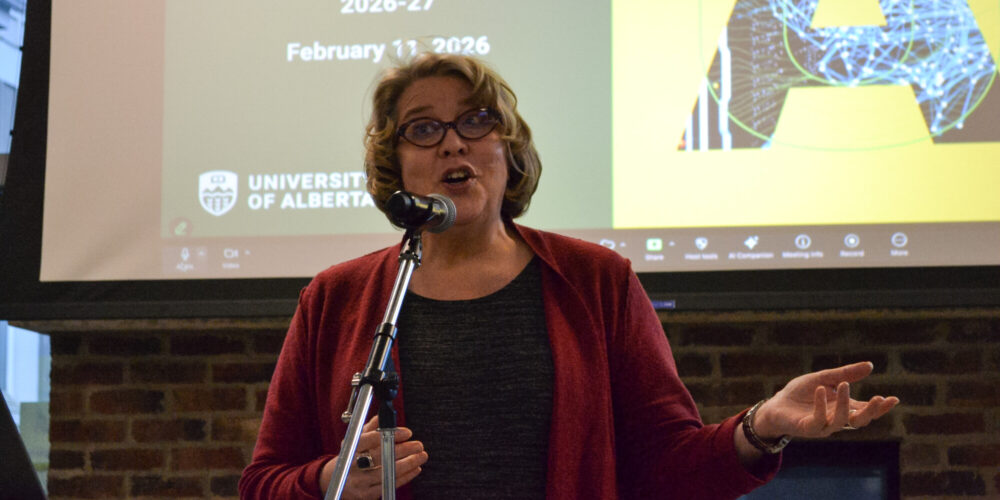
The sixth University of Alberta Students' Union 2026 elections forum was held at the Myer Horowtiz Theatre.





 Leah Hennig
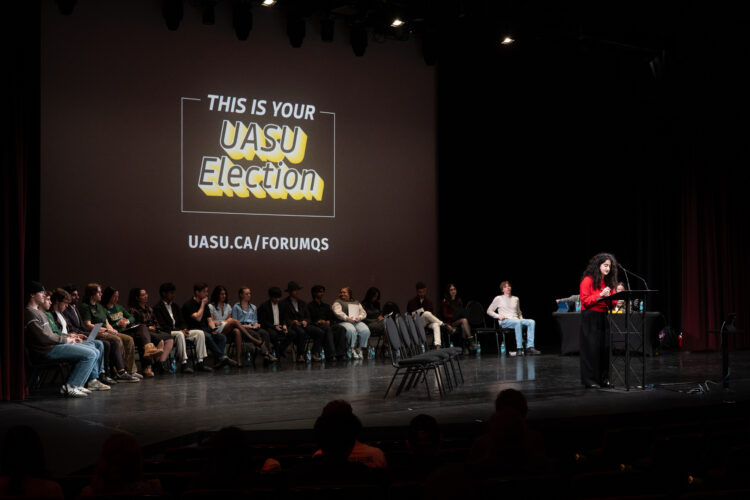
The sixth forum of the University of Alberta Students’ Union (SU) 2026 elections was held at the Myer Horowitz Theatre in the Students’ Union Building (SUB) on March 2. The event was offered in-person and online.
Chief Returning Officer, Megan Garbutt, moderated the forum. Candidates and referendums and plebiscites were given 90 seconds for their opening statements. Garbutt then asked each race or campaign a prepared question, which candidates had 60 seconds to answer. Candidates then had 60 seconds to answer audience questions. Finally, candidates and campaigns had 30 seconds to give their closing statements.
Here is the TL;DR version of this forum:
- President: candidates discuss their goals and key priorities.
- Vice-president (external) (VPX): discuss funding for student supports and external partnership ideas.
- Vice-president (operations and finance) (VPOF): transparency, increasing sustainability, restructuring SU finances, and internal reform.
- Vice-president (academic) (VPA): candidate addresses student concerns around the Course Material Access (CMA) plans and academic advising system.
- Vice-president (student life) (VPSL): candidates advocated for de-rationalization of rent and implementation of the 11 recommendations from the sexual and gender-based violence (SGBV) task force.
- Board of Governors (BoG) representative: candidates discuss consultation website and tuition increases.
- Plebiscites and referendums: Golden Bears and Pandas Legacy Fund, Interdepartmental Science Students’ Society (ISSS), and East Campus Students’ Association (ECSA) discuss the purpose of their proposed fees
Presidential candidates offer overview of their priorities and goals
In his opening statement, presidential candidate Abdul Abbasi emphasized his efforts over his last two years as VPX to represent students at all levels of government and advocate for issues facing students including safety, affordability, employment, and housing.
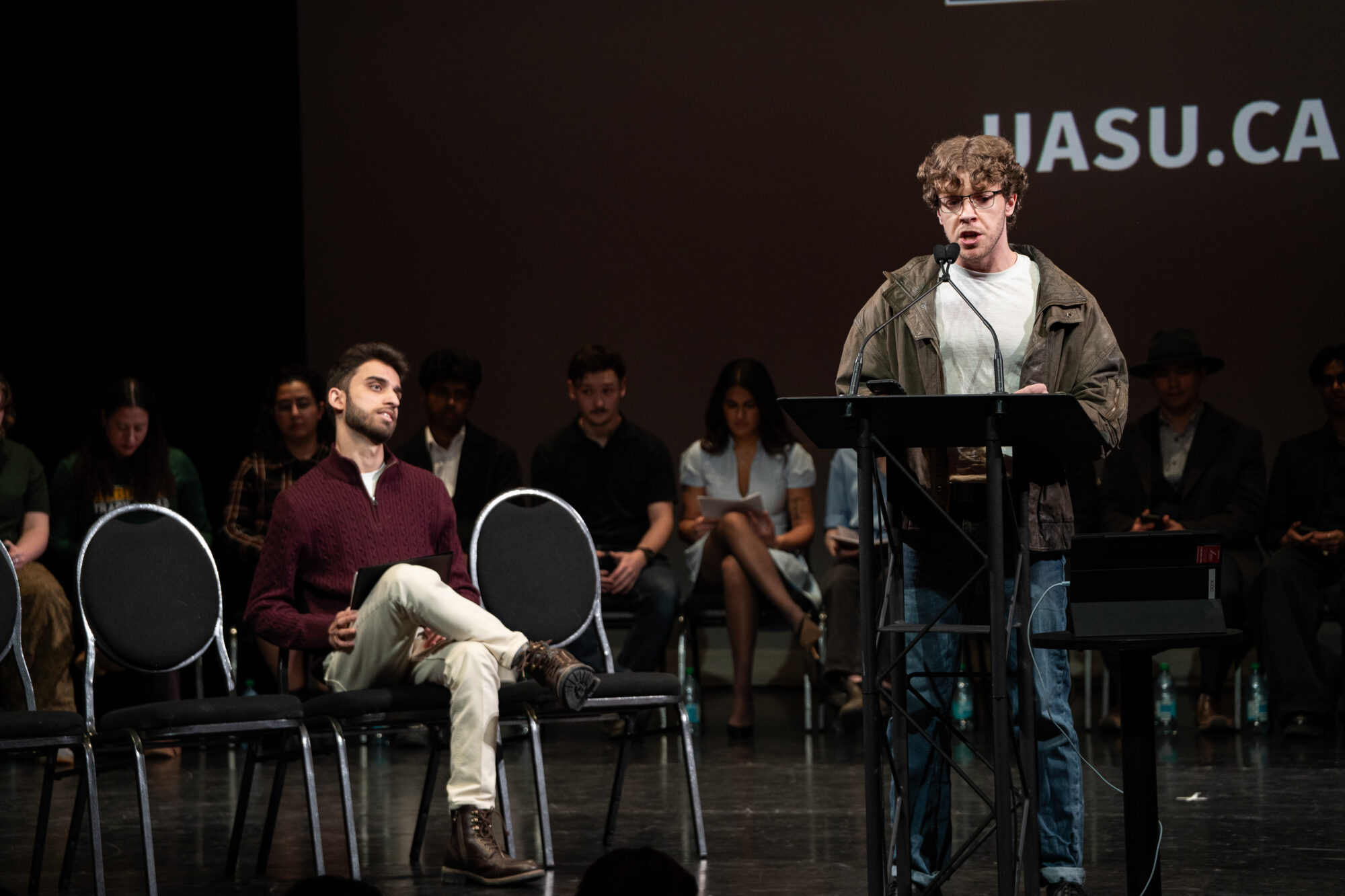
“These experiences have shown me that change does not only happen by luck or accident. It happens when you understand the system, how the system works, and how to move it,” he said.
In his opening statement, presidential candidate Joseph Sesek described himself as “a candidate for change.” He reiterated his goals to add additional lighting and CCTV cameras, expand ONEcard access, and give international and Indigenous students a permanent seat on Students’ Council.
Additionally, Sesek criticized Abbasi’s efforts during his two terms, saying that he has “collected over $100,000 in salary and benefits while playing footsies with the university administration and provincial government.”
Garbutt asked the presidential candidates what their top priority would be as president and what steps they would take to achieve it.
Abbasi emphasized that the SU needs to ensure that the work it does is not abstract to students. His goal is to build an SU that focuses on large issues, including affordability and transit safety transit, but also smaller things like accessible microwaves, working water fountains, and portable chargers.
Abbasi also emphasized that his role allowed him “to represent students to all levels of governments, not to the university administration.”
Sesek said that he is focused on “affordable solutions to everyday issues, issues that all students face,” including increasing library hours, increasing safety on campus, and addressing residence issues.
The Gateway asked the presidential candidates what new initiatives they want to pursue and how they plan on pursuing them.
For Sesek, this includes increasing library hours, giving students course syllabi while they are enrolling in classes, and a two-week turnaround on exam marking.
When it comes to new initiatives, Abbasi emphasized the importance of ensuring that the SU is “pragmatic in the things [it does]” and focused on the large issues as well as the small ones.
Josh from the U of A Hide and Seek Club mentioned that there was an attempt to organize a world record game of hide and seek for AntiFreeze, but it was voted down. Josh asked the presidential candidates if they would promise to add more whimsy to campus.
Sesek committed to “as much whimsy as possible,” saying he would be “die hard for any type of fun events like that.”
Abbasi emphasized the importance of working with the SU events team early on to ensure that events like these can happen. He also mentioned that he wants to modernize the SU’s student group regulations and work on event approval so student groups can hold more events.
Braiden Janes, an executive member of ABBEDAM Productions, asked the presidential candidates how they would work to foster a united campus community for all students, considering that there are limited opportunities for off-campus students to engage with peers outside of their home faculties and programs.
Sesek reiterated his commitment to hosting a party at Campus Saint-Jean (CSJ) to “let people embrace the CSJ culture.”
Abbasi highlighted the importance of student groups and mentioned that he has been working with Student Group Services (SGS) to see how the SU can modernize student group regulations and better support student groups “so that we can have more of those collaborative events.”
—Kathryn Johnson
VPX candidates discuss funding and external partnership goals
In her opening statement, VPX candidate Arman Chauhan said she intends to expand “open educational resources with dedicated provincial investment” to reduce financial strains on students. Chauhan plans to advocate for “appropriate federal investments into student housing” and partner with municipal leaders to improve transit safety and affordable access to Edmonton recreational facilities.
VPX candidate Angel Raina began her opening statement by restating her experiences as an SU arts councillor and current speaker of Students’ Council. She said she understands how the SU functions, allowing her “to hit the ground running when [starting her] term,” if elected. Additionally, Raina said her experience in City of Edmonton governance spaces has allowed her to begin building relationships that serve U of A students.
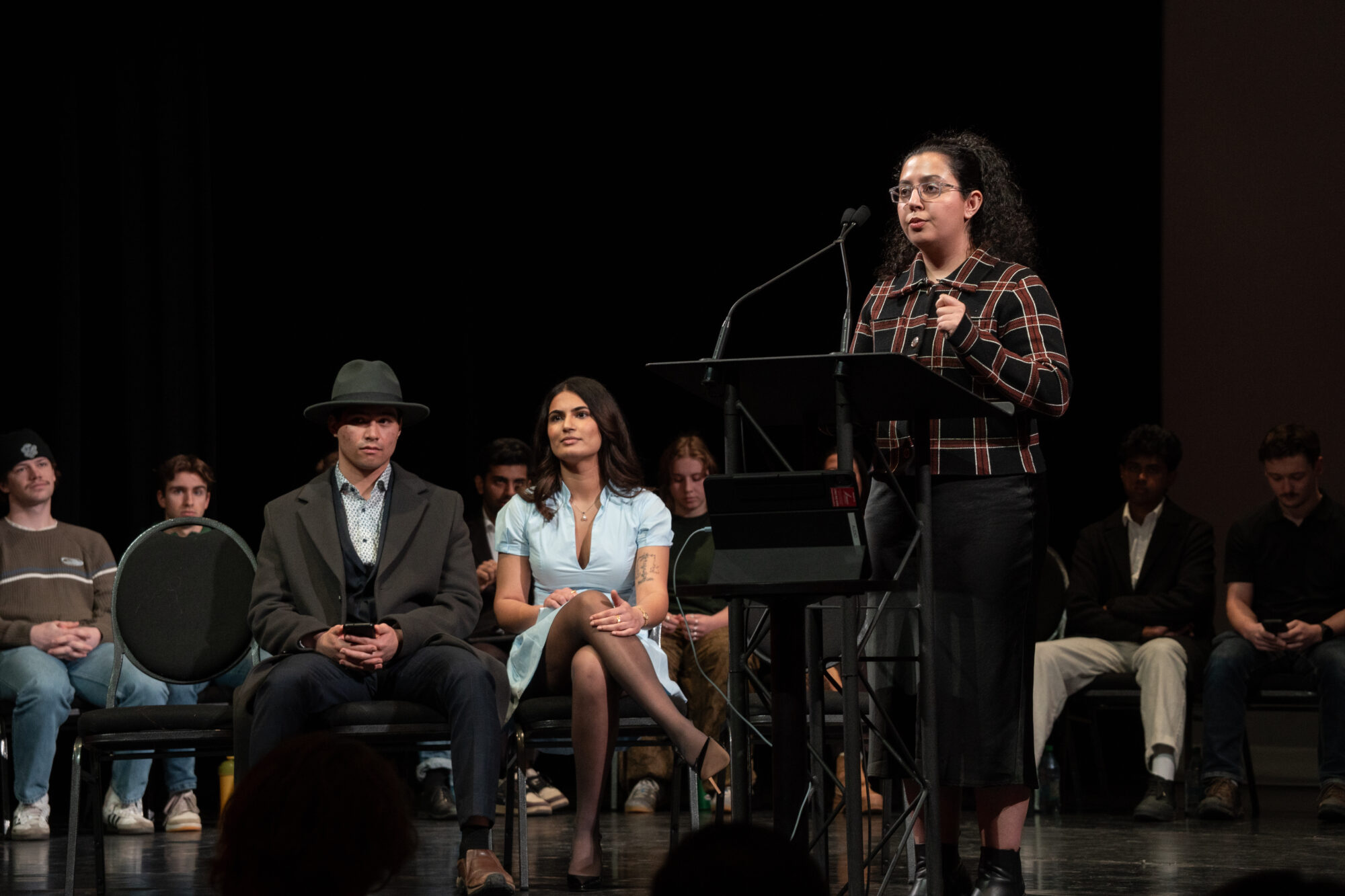
Raina said the SU would “need to work to make sure the federal grant of $1 billion for student housing makes its way to Edmonton, which requires working with the federal and municipal governments on the provincial level.” She would also like to focus on “providing more grants and bursaries,” instead of student loans.
She reiterated her intention to “advocate for peace officers on transit to be partnered with social workers to aid distressed individuals and de-escalate situations.” She would also advocate for the expansion of the Leisure Access Program.
In his opening statement, the third VPX candidate Dustin Rodenbush stated his intention to “expand university scholarships, internships, co-op programs, and research opportunities by meeting with organizations and businesses to expand these programs for aspiring students.”
Rodenbush’s goal is to ease the transition from university to the workplace, specifically helping students get jobs relating to their field of study. Additionally, he plans to work with CASA to “push back on any possible student grant cuts that may appear in the federal budget 2026.”
Rodenbush said he agrees with the interior and exterior Butterdome renovations, however he views the “full exterior redesign” as “entirely unnecessary.” He wishes to “advocate to have future government funding allocated to other areas [to] improve campus life and classroom experience.”
Garbutt asked the VPX candidates how they intend to “advocate to improve transit safety for students.”
Chauhan said she will push for the Transit Safety Coalition, which she explained, “means pairing peace officers and social workers together to de-escalate issues.” Her second approach is using the city Vibrancy Fund. She said this fund can be used “to allow student-led grants to create safer, cleaner, and better spaces around transit.”
Raina also expressed her intention to “pair peace officers with social workers on transit.”
She said, if elected, it will be important for her “to advocate to the municipal government to have infrastructure to improve or add cell access and underground stations for emergency situations that will come up because Wi-Fi isn’t always reliable.”
Raina also wishes to improve the cleanliness of transit spaces. Additionally, she would like to “advocate to improve co-ordination through more funding” of the city’s existing crisis diversion teams.
Rodenbush also plans to “increase social workers as well as peace officers” for transit safety. Additionally, he intends to “co-operate with the city to fix and upgrade escalators.” Furthermore, Rodenbush plans for “cleanliness efforts in and around the university.”
The Environmental and Conservation Science Students’ Association asked the VPX candidates whether or not they will push back against budget cuts to university-affiliated daycares.
Rodenbush said he will push back against budget cuts to daycares.
Raina agreed and explained that “there is also a certain degree of grants and funding with the provincial government” with which she intends to work with the VPSL, “particularly to get information out to students.”
Chauhan intends to build off of this work of the current VPOF and work with the next VPSL to “implement the Mintz Panel recommendations that push for further funding … whether that be sharing resources with other institutions or pushing for a grants-first model.”
The Gateway highlighted the recently proposed list of referenda from Danielle Smith that could impact accessibility to social services for international students, as well as their ability to remain in Alberta after graduation. The candidates were asked how this would impact their advocacy and whether or not they plan to work with Smith’s government.
Rodenbush said he “cannot save everything, but what [he] can do is salvage.” He plans to “keep the money within the university system and [hopes] to reallocate it to other areas.”
Raina said “a lot of things are determined by the government, but we also need to rely on community, and that is a big part of being an international student [at the U of A].”
She shared her intention to “push to externally partner with organizations such as NGOs and other youth groups in the city to take care of some of the needs that we’re not seeing possible with the government.” In addition, she wishes to continue to “push to support international students on the provincial and federal levels.”
Chauhan said that the U of A provides services “to make sure [the university’s] international student population is supported.” Additionally, Chauhan said ASEC could be involved in “taking in approaches that are backed by research as to why [the university’s] international student population is vital for institutions and why it increases profits for institutions.”
In addition, Chauhan is “pushing for a double-point Express Entry system for students,” which is at the federal level. She said we need to “maintain ways to keep our international student population here and provide incentives for them.”
—Lucy Stuckey
VPOF candidates discuss financial restructuring, internal reform, and sustainability
VPOF candidate Armaan Singh opened again by talking about transparency around how students’ roughly $700 annual fees are spent.
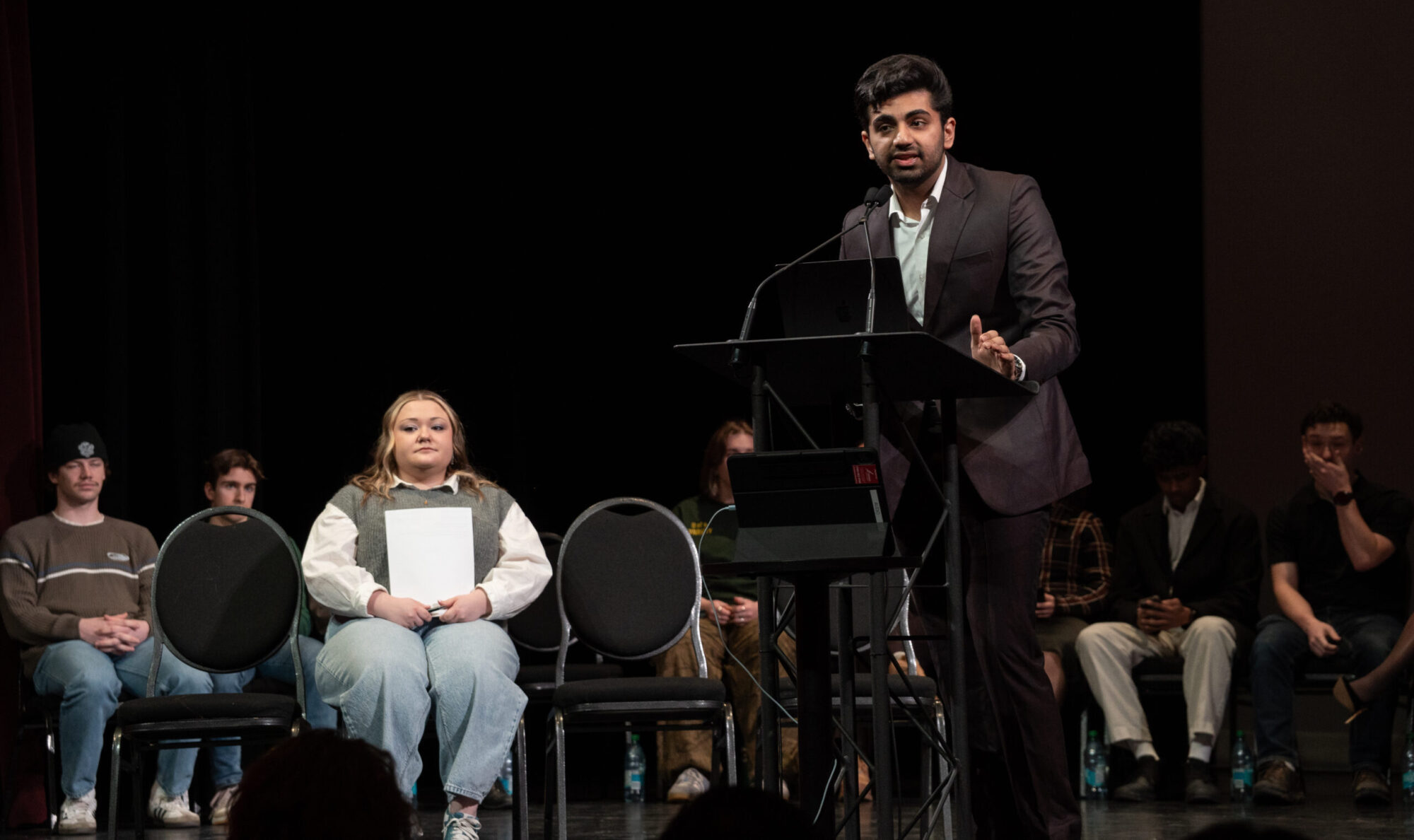
One of his major points was operational efficiency. He also argued for more efficient use of the spaces we have on campus, like the Myer Horowitz Theatre, stating they could bring in more revenue.
Singh also mentioned that even a three per cent reduction to operational costs could generate large savings for the SU.
Current SU VPSL and VPOF candidate Logan West highlighted their experience and track record as VPSL.
They stated that they have delivered in their current role, and are ready to move into focusing on internal operations.
West mentioned several priorities, including student-friendly pricing, marketing transparency, reform of student group regulations, and modernizing the Perks system to make it more relevant to students.
The CRO asked how candidates would collaborate with other executives to support their initiatives while maintaining a responsible budget.
Singh focused on specific initiatives, like collaborating with the VPSL to create anonymous sexual assault reporting, as well as supporting municipal and provincial advocacy.
He also mentioned financial transparency for students.
West talked about early strategic planning for long-term projects.
They also talked about co-ordinating event programming to prevent reactive spending.
They also emphasized ensuring advocacy work is communicated effectively through official platforms.
Juliana, a student, asked if candidates support the divestment of SU funds from fossil fuel and weapon infrastructure, as well as banks that fund these projects, and how they would do so.
Singh didn’t talk about fossil fuel or weapons infrastructure, and instead shifted the conversation towards investment returns.
Singh argued that the SU is earning low interest on their savings, and proposed that funds could potentially follow university investment strategies for higher returns.
West talked about ethical investment decisions involving Students’ Council and sustainability groups on campus.
She stated that the SU should uphold ethical principles.
West also said that divestment is up to the students, and shouldn’t be entirely up to the executive council.
Avery, a student, asked the candidates what their plan is to increase and support sustainability on campus.
Singh focused on decreasing food waste and selling surplus food at reduced prices.
He stated that the SU already does lots for sustainability, citing the Daily Grind’s use of recyclable materials.
West emphasized supporting student-led initiatives, as well as promoting the Seed Fund.
West also stated that they didn’t want to step on the toes of any student groups that are already running sustainability initiatives.
Mia, the vice-president (finance) of Organization for Arts and Interdisciplinary Studies (OASIS) and vice-president (internal) of the U of A Debate Society, asked candidates how they will reform student group processes and regulations to make the financial operation of groups easier.
Singh spoke on his past experience in an student representative association (SRA), criticizing the current approval and reimbursement systems.
He claimed that SU staff are overworked, and are unable to efficiently process requests in a timely manner.
Singh proposed reworking the current rubric system used for granting, and using funds more efficiently.
West proposed a large-scale, holistic review of the student group regulations and approval systems.
She also wants to explore non–cheque-based reimbursements to prevent students from being out of large amounts of money.
West also suggested making rubric granting and feedback systems easier for students.
In closing, Singh emphasized his desire to fix what isn’t working, and make operations more transparent.
“We have gone West long enough, it’s time to move forward,” Singh said.
West closed by highlighting doing more with less, and that they will deliver tangible and feasible reforms to the SU.
“Vote for a SU with a vision,” West said.
—Evan Cruickshank
VPA candidate expands on her plans for structural changes to resources for students
During VPA candidate Susan Huseynova’s opening statement, she acknowledged the stress that students face from the uncertainty of academic standards and the expectations surrounding artificial intelligence (AI) use and academic integrity. Huseynova aims to increase “transparency and accountability on big affordability files like CMA.”
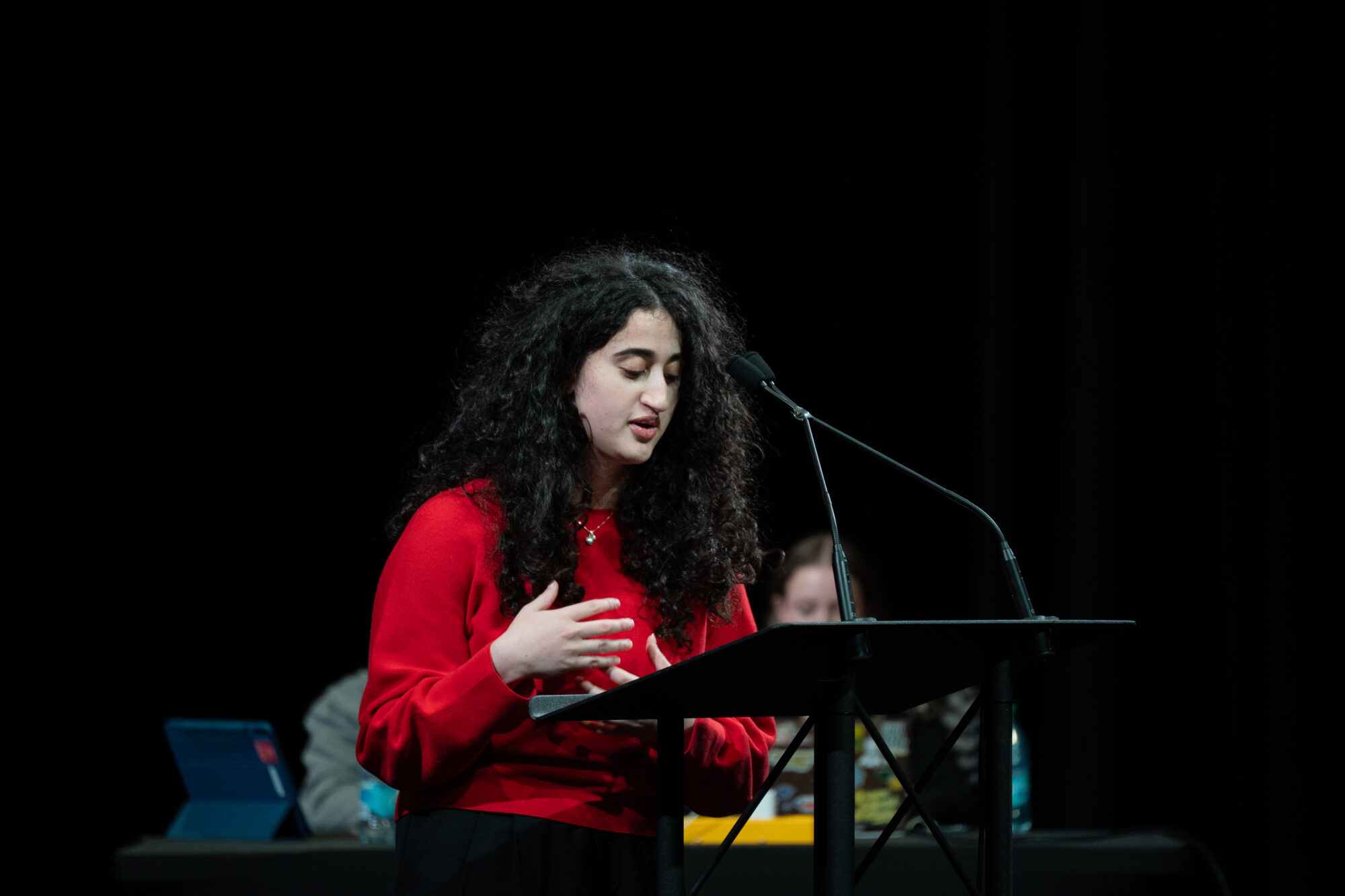
Garbutt asked Huseynova what plans she has to “improve textbook and course material affordability for students.”
Huseynova stated that “the risk of CMA is that the data underneath isn’t fully reliable,” and that the SU has identified a gap in course material reporting with “many courses already hav[ing] no cost or low cost materials.”
Huseynova said that if elected, she will push for a transparent and auditable report before rollout which will include “a consistent term by term reporting process.”
During audience questions, SGS asked whether Huseynova plans on “making new changes or supporting solutions that have worked in the past that aren’t up to date” in regards to the many free resources that have not been updated, such as the exam registry.
Huseynova responded by saying that she plans on building off of the ideas and systems implemented by previous SU members. She also reiterated her plans for “enhancing [the] academic advising [system] project and escalating academic concerns project.”
The Gateway asked how Huseynova plans on making concrete changes to the academic advising system to better support students as “multiple candidates in the past have spoken on wanting to improve the … system with little to no improvement.”
Huseynova plans on implementing a centralized model which means that it will be “one co-ordinated advising system that keeps faculty expertise where it’s needed.”
This is a project that she will be continuing from a previous advising project. She stated that a co-ordinated model will “provide better [and consistent] advising” for students on all campuses.
—Trystyn Rayko
VPSL candidates advocate for de-rationalization of rent, implementation of the SGBV task force recommendations, and increase consultation
In his opening statement, VPSL candidate Brish Goorimoorthee began with a land acknowledgement. He followed by stating that he is committed to listening, learning, and working towards meaningful action.
“My platform is rooted in the belief that student life thrives [when] barriers are reduced, communication is transparent, and opportunities for connections are intentionally created,” Goorimoorthee said.
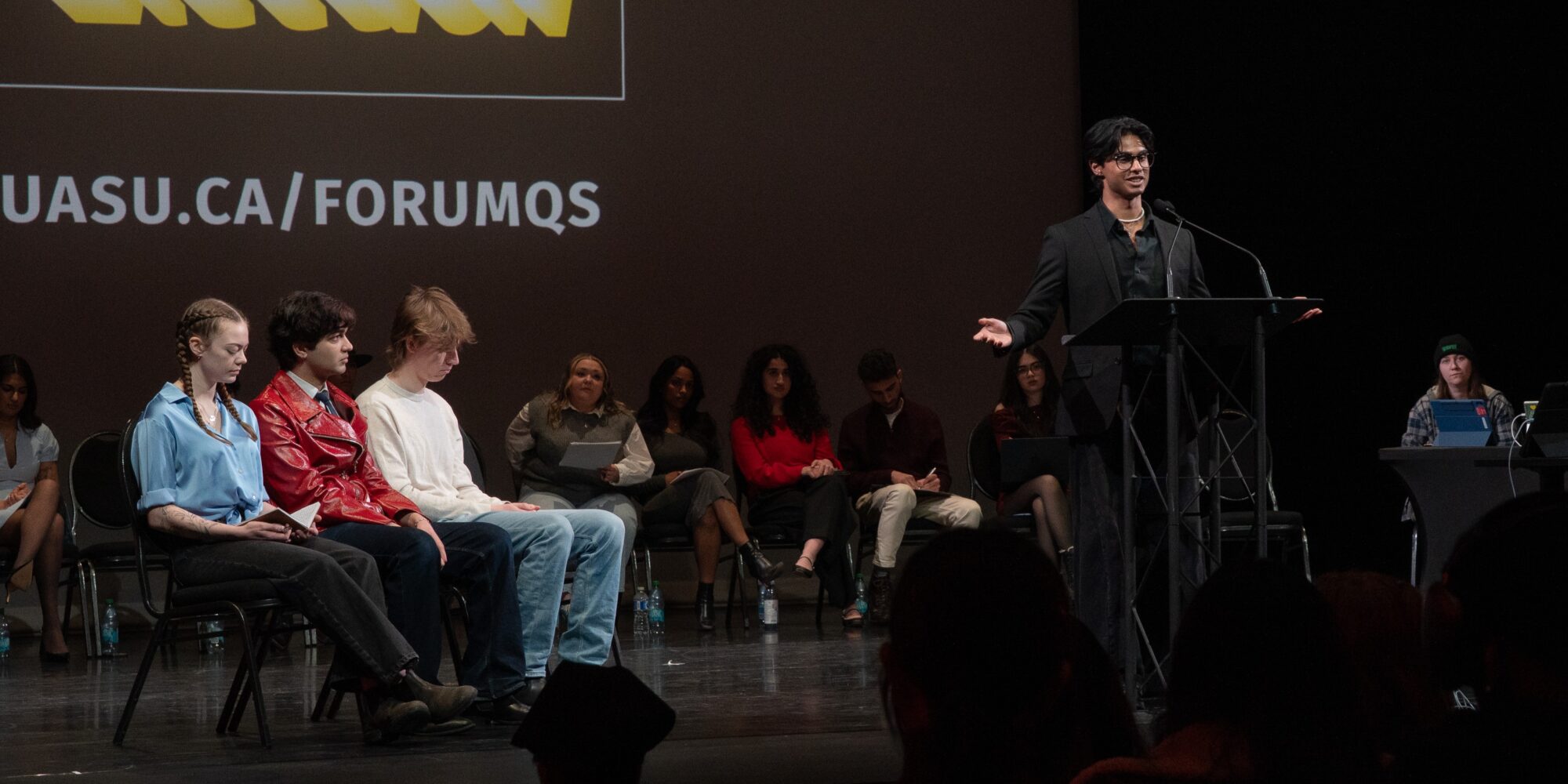
Nolan Greenwood, VPSL candidate, restated his three main platform pillars of improving life in residence, implementing the 11 recommendations from the SGBV task force, and strengthening advocacy through events and campus outreach.
“Students face rising costs with the rollout of the rent rationalization program without an improvement … I would call for a review of the program, [which] unfairly targets living in [International] House, as well as HUB Mall,” Greenwood said.
Following Greenwood, Manyu Rathour also stated his three platform pillars of advocacy, social impact, and community building — all grounded in student wellness. He followed by saying that he will advocate for the de-standardization of rent and the reimplantation of a five-day meal plan for student residents.
“I will advocate to increase counseling access, expand trauma-informed training for Safewalk Volunteers, and push for safer, more inclusive recreation spaces,” Rathour said.
Additionally, “I will advocate for a free SU Prom and rotating U of A’s Got Talent to unify our campuses,” Rathour said.
VPSL candidate Paige Wall stated that through consultation she was able to understand the underlying issues faced by students. According to Wall, she will “focus on strengthening existing structures, embedding affordability considerations into programming decisions, and advocating for improved mental health capacities where gaps exist.”
She followed by saying that she will support the implementation of the SGBV task force recommendations and formalize a structured collaboration with student associations across campus.
Garbutt asked candidates how they would advocate for mental health resources for students.
In his response, Goorimoorthee stated that mental health can be supported through community building. He followed up by saying that he will advocate for more online access to the Peer Support Centre (PSC), so students have resources when they are not on campus.
Goorimoorthee also proposed an “aura farming contest” event.
Following Goorimoorthee, Greenwood stated that he will ensure mental health resources are properly shared with students early on. He highlighted the SGBV task force modules, which educate students prior to their arrival on campus, saying that he will use the same technology to make the mental health resources known.
“By strengthening outreach and advocacy with student groups on campus, the SU is able to understand the gap students face in the mental health support they need,” Greenwood said.
Rathour stated that he will “make sure that the app Empower Me is better supported through ALUMO on the SU’s health and dental committee.” He followed by saying that SUB only offers a maximum of 16 therapy sessions, which he believes “is just not enough.”
“I want to advocate with the university and with the Counselling and Clinical Services to ensure that [the] number of total sessions is increased on a case by case basis,” Rathour said.
Wall began by stating that mental health is “a capacity issue just as much as it is an awareness issue.” According to Wall, she will advocate for a need-based review to understand where gaps exist, particularly across different U of A campuses.
“I would also ensure [the] PSC’s and clinical services are well co-ordinated,” Wall said.
Emily, an audience member, asked the candidates how they would make campus more accessible.
In his response, Goorimoorthee said he will push for the full implementation of the ONEcard access program, which will provide extended access to libraries, buildings, and facilities.
Following Goorimoorthee, Greenwood stated that he will ensure the SU is consistently working and meeting with student groups and leaders on campus. According to him, this will ensure that mental health issues are being shared to the greater university scale.
Rathour stated that he will ensure “elevators … [and] accessibility doors on campus are frequently checked and renewed if they are non-functional.
In her response, Wall mentioned that accessibility is “followed by affordability, and affordability extends beyond tuition.” For her, this includes the residence costs, food insecurity, event accessibility, and financial pressure that student groups face.
Yanella, an audience member, stated that the number of student groups on campus has returned to pre-pandemic levels. However, according to many students, the quality of the groups and performance of executives has decreased. Yanella followed by asking how the candidates plan to address this issue.
In his response, Goorimoorthee said he wants to push for student groups and leadership to have training and education that is more accessible and available.
Greenwood also mentioned the importance of training given to student groups by the SU.
“I think, as [the] SU moves to take over full event approval through the coming years, ensuring that the modules [and] feedback we give on events, [will] help better student leaders,” Greenwood said.
Following Greenwood, Rathour stated that he “think[s] that 40,000 students is a population, not a community. It’s these student groups that build a community at the grassroot level, and [he] think[s] that it is very important for them to receive the proper support they require to act as proper functioning execs.”
According to Rathour, he wants to ensure that the university is giving the power to the SU for the event approval format.
Wall stated that she will try to include herself in conversation with different student groups and understand where improvements can be made. She followed by saying that she will try to formalize structured collaboration with the International Students’ Association (ISA), the Indigenous Students’ Union (ISU), and different faculty associations and campus groups.
Serena, an audience member, asked candidates what the first act of change students can expect to see once a VPSL is elected.
In his response, Goorimoorthee restated that he will push for the implementation of the ONEcard access program not only on North Campus, but also on Campus Saint-Jean and Augustana.
Following Goorimoorthee, Greenwood stated that his first action would be to call for the review of the rent rationalization program, ensuring that there is clarity and transparency from the review so that students and student leaders are informed in the decisions made.
Rathour began by saying that “[he] know[s] that not every hill is the hill to die on, but every hill is [his] favourite, so [he] will be there.” He followed by stating that he wants to work with the City of Edmonton to run a fair market evaluation to “rent de-standardize each of the residences we have on U of A campuses.”
Additionally, Rathour stated that he will work with the city to ensure that they understand what jobs are student friendly.
Following Rathour, Wall said that she would like to establish structured consultation with key student groups, review grant accessibility processes, and initiate conversations around mental health — such as capacity gaps.
—Fernanda Campana Omori
BoG candidates discuss tuition and consultation website
In his opening statement, BoG representative candidate Amaan Khan asked the question “Do we students deserve to be left in the dark for decisions regarding us?” In response, he said that “we deserve the light.”
He said that his platform is based on a combination of consultation with student groups, statistics, and student stories. He said that he has been and will continue to work with the Dean of Students, Ravina Sanghera, to bridge the gap between current student experience and the board.
Khan also wants to bring back the anonymous survey website and work with the vice-provost (access, community, and belonging) “to enhance the student experience and bring a focus to transparency and inclusion in governance.”
In Janardhun Alagarsamy Vignesh’s opening statement, he reinforced his three platform pillars: oversight, sustainability, and advocacy. He said he wants to push for summaries of explanations for financial and strategic decisions; protect academic integrity, degree value, and long-term accessibility on campus; and build structured feedback pathways so students see progress. He said “governance is serious work that requires patience, listening, and consistency.”
In Tala Mojarrad’s opening statement, she said she has always been an advocate for leadership. She acknowledged that the university has great resources and infrastructures, but they can be hard to access.
She said she plans to implement a documentation platform to ensure that unprofessional, racist, and discriminatory behaviour can be recorded and reflected upon. Mojarrad also said she wants to bridge the gap between students and the Board “to make your voice and opinions integrated in the decisions that are made for you.”
Garbutt asked the candidates if tuition increases are approved, what the candidates expect the university to deliver in return.
Khan said that he would make sure that he works with the BoG and university administration to make sure that tuition is used to bring student experience back to students by working with the Deputy Provost (students and enrolment), Melissa Padfield. He also said he plans to work with other provosts, such as Verna Yiu, provost and vice-president (academic), to ensure that student experience is the focus in regards to transit safety, campus safety, and affordability.
Alagarsamy Vignesh said a lot of what he will do is “definitely advocate for pushing back against tuition hikes.”
He said that if there is a tuition increase, he will make sure the money goes back into students’ pockets and their experiences. This would be through residence issues, working with VPSL, and implementing mental health resources.
“The fact of the matter comes down to improving our safety and improving our overall university experience,” Alagarsamy Vignesh said.
Mojarrad acknowledged that tuition increases are unavoidable, however she plans to make sure that she will “advocate for your voices to make sure that this does not happen.”
She said that if tuition increases, she will sit down with the Financial Registrar Office to break down what is making tuition expensive and convey that to students. She said that she will advocate for education affordability and food safety. She also mentioned that she wants to make sure the new operating grant is also being attributed to current students as well as new students.
The Gateway asked what a specific change the candidates hope to make or influence at the Board level and how students would know if this has been effective.
Khan acknowledged that students are unaware of what role BoG actually plays, and past BoG representatives have done a “wonderful job at addressing that,” but there is still work to be done.
He said he will work with the Learning, Research, and Student Experience committee on the BoG to make sure transparency and governance are a huge focus. He said he will make structured reports to students, and that there is a focus on social media and consultation, so students know how to get involved.
Alagarsamy Vignesh said that his main priority is to implement an escalation and triage system where student concerns can get an institutional response. He wants to have a centralized and accessible feedback form where students can register complaints and he can categorize and follow up with them, create periodic updates, and summarize themes.
Mojarrad said that one of her priorities is to make sure students are accessing resources and can access them properly by using social media to explain how to access them. She mentioned that food banks are available but many students still struggle to access those services.
She said she wants to see changes to these infrastructures. It is important to note, however, that the BoG does not oversee food banks, instead an independent board of directors does.
Karina Banerji, current BoG representative, mentioned that the BoG representative candidates have all stated an intention to revive Adrien Lam’s website to collect anonymous feedback, which was not continued in that form for this term due to financial constraints. Banerji asked the candidates how they would implement this initiative, given that the BoG representative has no allocated funding.
Mojarrad mentioned that the university has a “great IT and IT team” and students who work at the U of A. She also pointed to the possibility of applying for grants or funding from the province or university.
Khan said, in preparing to run for BoG representative, he consulted Lam and she agreed to pass the website down to the next BoG representative, regardless of who it is.
“It needs to be internalized, and it is a very, very good resource,” he said. He also pointed to his experience as a computing science student, which will allow him to run the site without funding.
Alagarsamy Vignesh said that Lam paid $26 per month to keep the site running, but he would pivot to co-operate with the VPOF “early on so that it can get implemented into the SU website. It’s not about having the website up, it’s about accessibility and where the students can reach it.”
—Erin Widmark-Pickle
Plebiscites and referendums representatives discuss the goals of their fees
Matthew Naruzny from the East Campus Students’ Association (ECSA) represented the ECSA referendum. If passed, the referendum would create a student representative association membership fee (SRAMF). The proposed SRAMF is $10 per semester and students would have the option to opt out.
The purpose of the fee is “to ensure [ESCA has] ongoing funding to continue organizing residence events and to help fund [their] residence improvement projects.”
Garbutt asked Naruzny how this membership fee will improve the student experience for ESCA residents.
Naruzny emphasized that the fee will be “the only ongoing funding that ECSA has.” The fee will be put towards funding ESCA’s projects and ensuring they can continue this in future years.
Barrett Groves and Molly represented the Golden Bears and Pandas Legacy Fund plebiscite. The fund charges undergraduate students $5.11 each semester.
“Since 1991, the Legacy Fund has saved and stabilized our varsity programs through resources such as preseason travel, assistant and weight room coaches, and mental health supports for athletes,” Molly said.
The fund has created work and practicum placements for students and has funded jobs for A-team members like GUBA and Patches, both of whom are paid employees, Molly said.
Garbutt asked the Legacy Fund team how they will communicate to students what this dedicated fee pays for and what they receive from it.
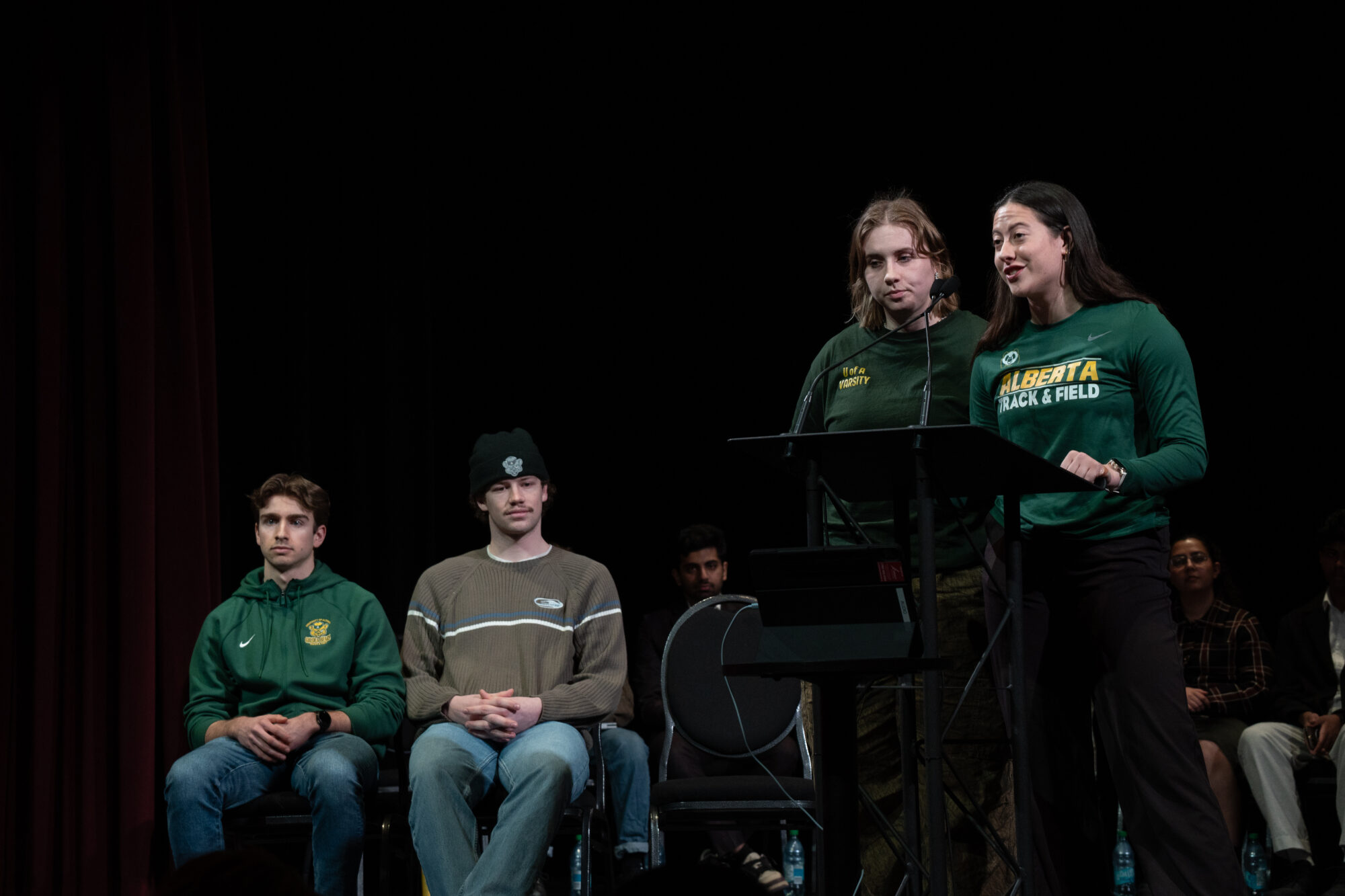
Daniel Gutierrez said that they have been communicating this information on Instagram.
Gutierrez said that the fund goes back to students through initiatives like student nights, giveaways, and free pre-season tickets. Additionally, Gutierrez emphasized that student athletes help to “bring in more donations, more sponsorship to the university as a whole … therefore bettering the campus experience for all students.”
A student athlete asked the Legacy Fund team what will happen to athletics if the Legacy Fund does not get approved.
Molly said that one of the main things that this would affect for student athletes is their mental health supports.
“By having the Legacy Fund funding mental health supports for athletes, it actually takes away from these athletes having to use the campus mental health support, so it frees up a lot of room for other students to be available to use these support services.”
Groves added that the Legacy Fund is integral to student athletes’ study halls.
Christene Saji represented the Interdepartmental Science Students’ Society (ISSS) plebiscite. The plebiscite involves a faculty association membership fee (FAMF) renewal for the faculty of science. The FAMF is a $7 per semester opt-out fee that applies to all faculty of science students.
Saji said that much of the work ISSS does is made possible through their FAMF.
“This fee has allowed ISSS to provide consistent services and opportunities students rely on from scholarships and mentorship programs to COSA group funding as well as academic initiatives and large scale faculty events that build community,” Saji said.
Saji said that increasing the fee from $5 to $7 is about “preserving and strengthening what science students already benefit from.”
Garbutt asked Saji what changes to the student experience should science students expect with this membership fee.
Saji said that an increase to the fee will allow ISSS to better support their COSA groups and expand their scholarships. Additionally, Saji mentioned that an increase to the fee will mean an increase in ISSS’ academic conference fund.
The Education Students’ Association, Lister Hall Students’ Association, and Nursing Undergraduate Association were unable to attend. The Course Materials Access program plebiscite does not have a yes or no side campaign.
—Kathryn Johnson