Review: ‘The Great Gatsby’ brings Jazz Age glamour to the Citadel
A new adaption of the American classic is a shiny, lively production with great performances and design. Check it out, old sport!

 Nanc Price
This month, the Citadel Theatre‘s season continued with a new production of F. Scott Fitzgerald‘s The Great Gatsby. The Jazz Age classic was adapted for the stage by Canadian playwright Erin Shields. Directed by Daryl Cloran, the production stays quite true to its original source material. The affable Nick Carraway (Richard Lee Hsi) navigates a summer of wealth, parties, and yearning as he finds himself entangled in the lives of his rich neighbours, the Buchanans, and the mysterious Jay Gatsby (Duncan Cox).
The entire cast brought a shimmering energy to the stage, effortlessly bringing Fitzgerald’s timeless characters to life. The ensemble perfectly captured the indulgent, laissez-faire attitude of the post-war ultra-wealthy as they flitted across the stage, stumbling from too much champagne or drunkenly dancing their cares away. Lee Hsi’s performance as Nick Carraway served as a great anchor for the show. Although the frequent, fourth-wall-breaking narration was sometimes a bit heavy-handed, he used it to his advantage, charming the audience with an easy smile and familiar demeanour.
Another standout was Timothy Dowler-Coltman as the pompous Tom Buchanan. As the pace of the first act sagged, he helped it along with snappy comedic timing, his oafish character bringing levity to the quiet tension simmering between the other characters. Once the play picked up in the second act, Dowler-Coltman maintained his strength, turning from oblivious to aggravated. The play reaches a fever pitch in a confrontation between Buchanan, Daisy, and Gatsby. The scene was beautifully portrayed by the three actors. I could feel the heat emanating from the stuffy hotel room and their biting remarks as they exploded with passion.
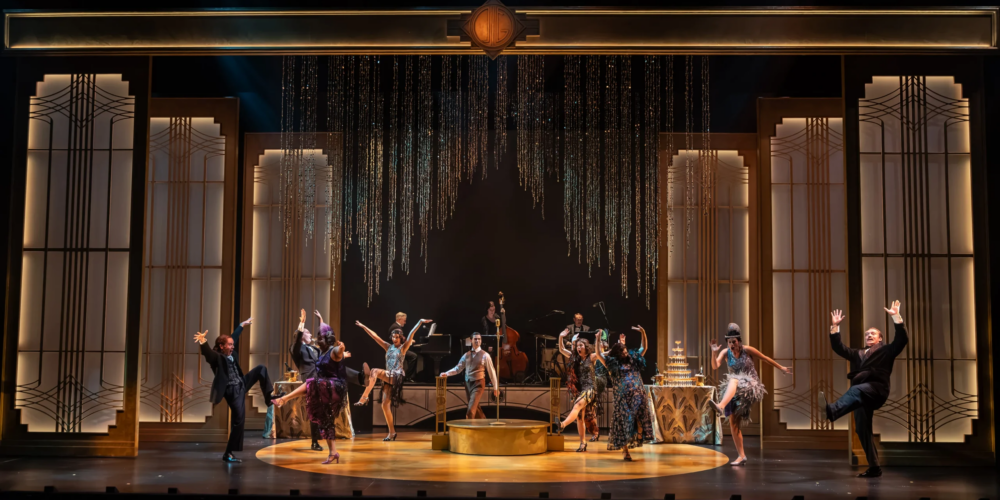
The design of the show was what really brought the production together. Lorenzo Savoini‘s sparse set created the illusion of huge, decadent mansions and extravagant hotel rooms with hardly any furniture. The negative space on stage allowed for the emotional stakes to take up space, leaving room for pain, lust, and everything in between as the characters navigated the glittering stage. The lighting design, by Hugh Conacher, paired beautifully with the set. The use of pure light to create vehicular movement was incredible. Relying on lights to convey the more complex aspects of the plot added to the gorgeous simplicity of the set.
A welcome addition to the production was the inclusion of a live jazz band. Featuring drums, bass, and a piano, the trio added a layer of atmosphere that rounded out the environment created by the show’s design. When the party was hopping, it felt as though the audience was in Gatsby’s mansion with everyone, trading stories and secrets alongside Hollywood elite. When the fun was over and tensions rose, the band added a sinister sound to the din of tension.
The Great Gatsby is a novel greatly influenced by the modernist movement, meaning most of its narration is internal, and not leaving much space for tangible action. It can be a struggle to adapt a story like this for the stage. Despite a bit of a sluggish pace in the beginning, the Citadel quickly picked it up and delivered a dazzling new production of a classic story. Filled with jazz music, a stunning set, and great performances, the production is an excellent addition to the theatre’s season.
The Great Gatsby runs until November 22.