U of A and EPL partner to tackle health misinformation
“More information doesn’t necessarily mean better or accurate information,” Dr. Narnan Hussam said.

 Supplied
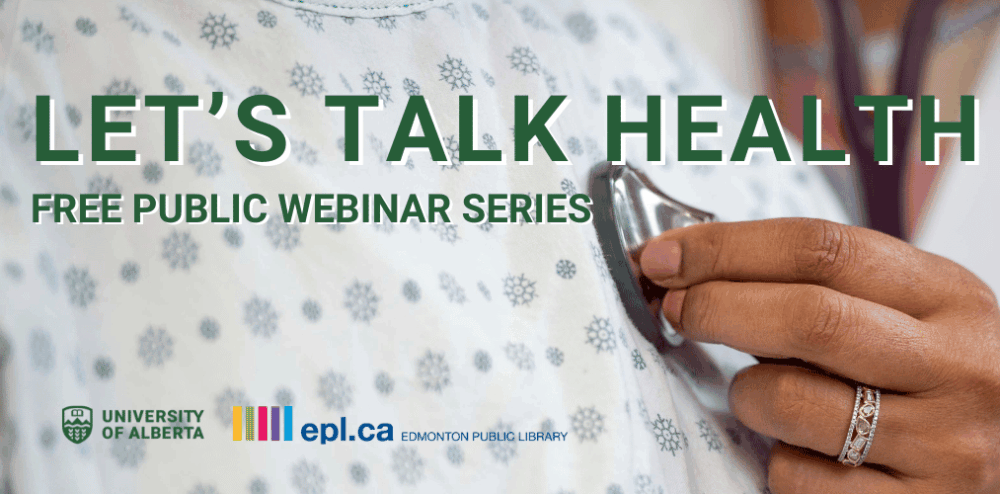
The University of Alberta’s department of medicine has partnered with the Edmonton Public Library (EPL) to launch Let’s Talk Health, a public education series that brings medical expertise to the community. Through nine sessions, specialists aim to help Albertans better understand health issues and make informed decisions alongside their health-care providers.
Dr. Narmin Kassam, chair of the department of medicine at the U of A, said the series intends to share the department’s expertise beyond the university.
“We wanted to use this as an opportunity to connect with the external community and share that expertise,” Dr. Kassam said. “Rather than keeping that expertise within the walls of the university, we wanted to bring it to the public.”
She said partnering with EPL was a natural choice because libraries provide accessible, trusted spaces for learning. The initiative aims to offer information that is “evidence-informed, practical, and easy to understand,” particularly as people encounter competing health claims online.
Making complex medical information accessible
The series addresses health topics that can be difficult to understand without a medical background. Dr. Kassam said information can be misleading even when it is not entirely false, particularly when claims are oversimplified or presented without sufficient context.
“What we would like to do is bring that reliable evidence and informed information, and give some context in terms of where it’s applicable,” she added. Rather than offering individual medical advice, the sessions aim to help people recognize misconceptions and ask better questions during medical appointments.
“If someone comes away from these sessions understanding a health issue either more clearly or recognizing a misconception, I think we will have gotten so far ahead, and we will have accomplished our goals,” Dr. Kassam said.
The department selected topics by considering common questions from families and communities, issues receiving media attention, and areas where specialists believe greater public awareness would help.
The initial series includes topics such as GLP-1 medications and vaccines. Its opening session on GLP-1 receptor agonists attracted more than 500 registrants, with over half attending live, according to Dr. Kassam.
The department hopes to use audience feedback to shape future sessions. “By no means is this an exhaustive list of what we’ve planned for this year,” she said, adding that organizers want the community to suggest topics they would like to explore.
Public response and community engagement
Dr. Kassam said the response to the first session exceeded expectations, particularly during the live question-and-answer period.
“We couldn’t keep up with the questions,” she said. “There was just so much dialogue and gratitude, and just really, really good questions that we wouldn’t have even thought of to address.”
The strong participation suggests an appetite for opportunities to discuss health concerns directly with specialists. Live sessions allow attendees to seek clarification and engage with experts rather than simply consume information online.
Dr. Kassam said organizers will continue evaluating attendance and participant feedback to determine what works and where improvements are needed. Surveys also invite the public to recommend future topics.
Building trust amid online health misinformation
With health claims circulating widely on social media, Dr. Kassam said the series encourages people to evaluate information critically rather than accept confident-sounding opinions as scientific fact.
“I don’t think it’s a matter of forcing people to change their opinions,” she said. Instead, the goal is to offer perspectives grounded in evidence and allow people to make decisions with their health-care providers.
For those overwhelmed by conflicting claims, Dr. Kassam recommended partnering with health-care providers and seeking sources that rely on scientific evidence. She also warned against social media algorithms that reinforce existing beliefs.
“Just thinking outside the echo chamber and going to different sources,” she said, can help people access a wider range of information.
The department hopes Let’s Talk Health will continue beyond its initial nine sessions, with topics already planned for 2026–27. Dr. Kassam said future programming will depend on attendance, evaluations and community feedback.
Ultimately, Dr. Kassam wants people to approach health care as a partnership rather than a one-way exchange of information.
“I would just say that this should not be a paternalistic relationship,” she said. “I think the relationship with your health-care providers is a partnership.”
She encouraged people to ask questions, consult trusted sources, and look beyond familiar perspectives when navigating health decisions. Through its collaboration with EPL, the department hopes to make reliable medical information more accessible and help Albertans feel better equipped to understand the health issues affecting their lives.