Film Review: ‘Tony’
This spectacular Anthony Bourdain memoir adaptation will make you want to take a solo trip to find yourself.

 Supplied
For a college student, “we need to get away” has never left the group chat. Doing it alone, though, just for the plot, has become a lost art. Not for a resumé, or for any reason, just going somewhere new and staying in the discomfort of it, because you wanted to. That used to be a natural process of growth: stepping into the unknown and coming out with what you needed. We exist now inside this expectation that everything needs to have a purpose. Watching this biographical coming-of-age film was a reminder of what it felt like before that, when you could just commit to something because you wanted to see what happened.
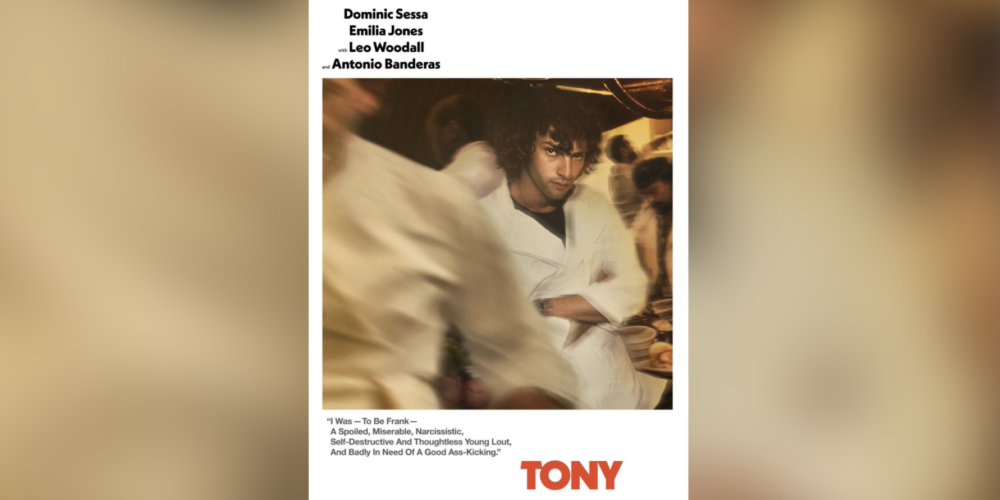
Written by Todd Bartels and Lou Howe and directed by Canadian filmmaker Matt Johnson, Tony follows Dominic Sessa as a young Anthony Bourdain. Set in the 1970s, Anthony runs away from home to Provincetown, Massachusetts, for the summer after losing a literary scholarship.
He’s motivated by his chase for Nancy (Emilia Jones), his rekindled crush from high school, who told him about her summer job in Provincetown. He hopes to win her heart, but he’s crushed almost as soon as he arrives, when he finds that she’s seeing someone. Broke within days, he starts lying to her about being a writer to save face, all while working the line at a fast food joint in exchange for a hammock in the back to sleep in.
Watching him spiral into his own web of lies is genuinely stressful. I started this movie cringing at his choices and how easy it was to tell they were all horrible ideas. It was a weird feeling to be disturbed by a main character. But my opinion of him changed many times as I watched him navigate toxic connections in the kitchen and find the sort of community I hoped he’d hold onto forever. I ended up hoping the whole mess somehow worked out.
Sessa’s performance captures Tony’s conceit and arrogance perfectly, and we watch him grow out of it throughout the film. In moments when we expect him to make the wrong choice, he seems to listen to us, the crowd, and back down. Sessa’s performance shows that Tony is shocked by his own restraint.
I came in with zero prior knowledge of Bourdain or his memoir Kitchen Confidential. This was my first introduction to his world, and the film not leaning on his fame actually worked in its favour. It explored emotions as timeless and complex as it needed to: mentorship that’s not applied for and community you grow into rather than seek out. Even the dialogue and the way the characters communicated never felt locked into an era. It felt like a story that could belong to anyone who’s ever run off somewhere just because. It was easy to forget I was watching something set 50 years in the past.
The film also finds its soul in the head chef, played by Antonio Banderas. He’s wise, chaotic, and deeply religious. He uses the heat and noise of the kitchen as a kind of personal confessional, a place to drown out whatever he’s carrying. Banderas’ delivery has this old-soul quality that makes the shack feel less like a workplace and more like a found-family, with him at the head of it, chaos and all.
Just like the found-family dynamic, the film’s comedy sneaks up on you. After the first shock, it becomes predictable on purpose, because that’s the routine of the kitchen. It’s what happens when you put people in a cramped kitchen together for a summer, powered by the lies Tony tells everyone and himself.
By the end, Tony is still Tony, but pointed somewhere different. What he’s chasing shifts from something superficial into something that actually feels like him. And that’s what brought me back to where I started, rooting for him. This film is proof that doing something just because, with no plot required to justify it, is still a timeless way to learn about identity. Watching it left me wanting to take a solo trip of my own, not to find anything in particular, maybe to reaffirm or redirect, or just build community in a whole new way.