Tyra Delver brings love, connection, and bannock to TIFF
The Edmonton filmmaker discusses her short documentary, 'pahkwêsikan sâkihitowin: Bannock is Love,' and food as a labour of love.

 National Film Board of Canada
The Toronto International Film Festival (TIFF) ran earlier this month, from September 10–20. Filmmakers from Canada and around the world gathered in Southern Ontario to celebrate the new, weird, and groundbreaking in contemporary cinema. Amidst those artists was Tyra Delver, a MacEwan design student and burgeoning filmmaker from Saddle Lake Cree Nation.
Delver was selected for TIFF’s {RE}DEFINED initiative, a program aimed to amplify the voices of young Canadian artists. {RE}DEFINED selects five filmmakers from across the country and gives them the opportunity to produce and share their work in collaboration with TIFF. Delver’s short documentary, pahkwêsikan sâkihitowin: Bannock is Love, premiered at the festival on September 16.
Delver first conceived of the concept for the film a couple of years ago, when she was making bannock from a kit that only required her to add water. “I was like, wow … if people knew stuff … like this [existed], I think they would have an easier time with … connecting to how to make bannock, because I know that sometimes it can be very difficult,” she said, emphasizing that it can be hard to replicate the bannock your parents or grandparents made for you when growing up. “Bannock as … a storytelling tool has always been … prevalent in my life and I’ve always been surrounded by it,” she continued.
“Bannock is so easy to make, and it’s so easy to share,” Delver says
pahkwêsikan sâkihitowin: Bannock is Love features interviews that explore why bannock is not only an important symbol of tradition, but also of food sovereignty. “I think food sovereignty is so important … I wanted to touch on [it] because it’s still very, very true in Indigenous communities, that food sovereignty is … a big theme. And people struggle with it,” Delver said.
She views bannock as a relatively universal food that is easily accessible for everyone: “bannock is so easy to make, and it’s so easy to share.” Within that accessibility, there is a reclamation of autonomy that shines throughout the film.
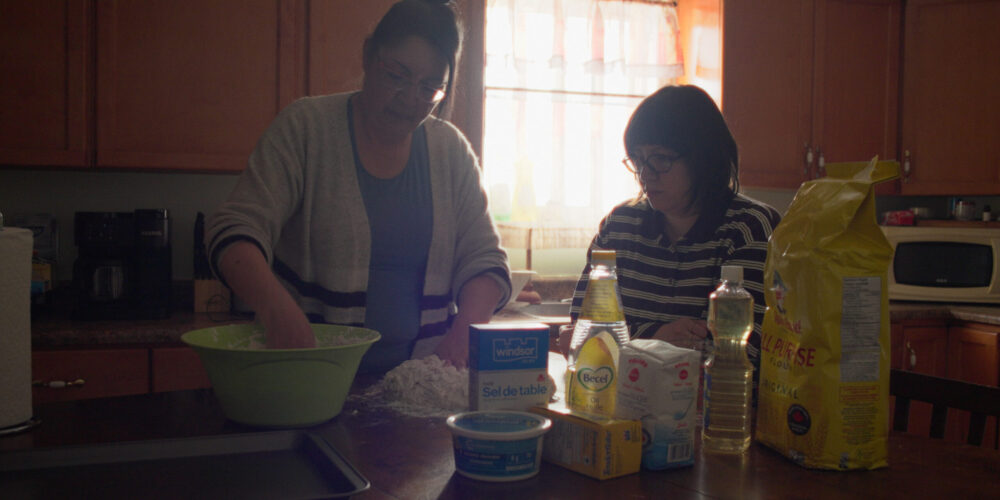
One of the people Delver interviews for the film is her mother, Miranda. The documentary opens with the two of them in Miranda’s kitchen, preparing a batch of bannock together. Her mom walks her through the steps while telling Delver about when her own mother taught her how to make bannock, around the age of seven.
The scene is homey and familiar, but it was hard for Delver to balance being both daughter and documentarian. It was “kind of the most difficult thing, because I wanted to ask questions that, you know, I wouldn’t otherwise ask my mom on … a daily basis,” she said.
Their conversation was “eye-opening in a lot of ways,” Delver got to learn more about her mother’s childhood and how her love of bannock has evolved over the years. Interviewing Miranda gave Delver the opportunity to have an intimate conversation with her mother from a different perspective, embedding her personal relationships into the narrative of the film.
Making this film was also the first time Delver got to create something “of this calibre.” The {RE}DEFINED initiative provides their selected filmmakers with all of the resources they need to complete their desired film.
“It definitely taught me a lot,” she said, “as an emerging filmmaker … it’s super weird to be celebrated this early on and to have this opportunity, and I think that sometimes I don’t believe that it’s real still.”
Delver also got meet with the other participants of the initiative, and they were able to listen and learn from each other in a collaborative, filmmaking environment.
Before the premiere of Bannock is Love, Delver expressed that she hoped the audiences at the festival would take away a feeling of connection from her film. “I’ve been talking to many people that have seen the film and, you know, they connect to the brand of flour that we use in the film, or they connect to just the way my mother and I talk,” she said, “and I think that’s just beautiful.”