Film Review: ‘The Odyssey’
Visually astonishing, but lacking in character depth, Christopher Nolan's adaptation of 'The Odyssey' both stuns and disappoints.

 Supplied
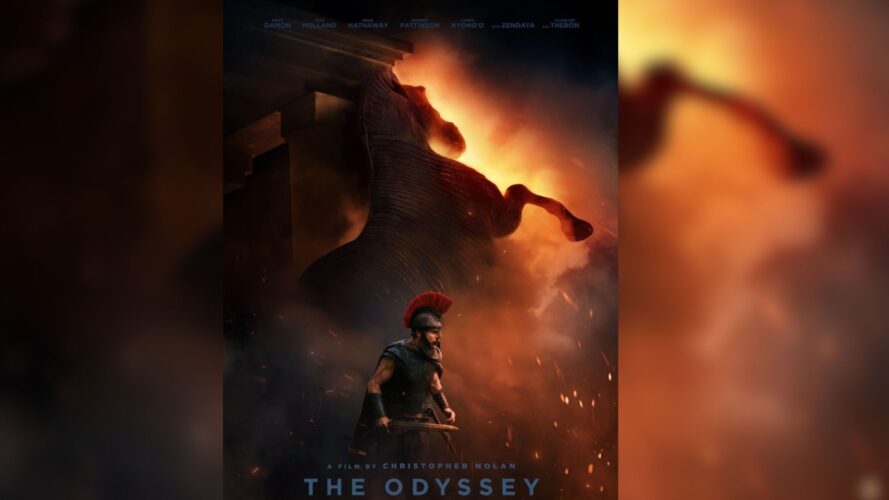
I recently had the privilege of seeing Christopher Nolan’s The Odyssey in IMAX 70mm. The movie is an adaptation of the ancient Greek epic poem of the same name by Homer. As with all of Nolan’s movies, The Odyssey is a visual spectacle and indescribable in its sheer scale and awe. There aren’t any words that could particularly describe the experience of watching the movie in theatres. The score and the breathtaking mise en scène work together to create an unforgettable experience. However, The Odyssey lacks the depth of the original poem, turning a morally nuanced cast of characters into simple beings with simple goals. The script was clunky, and the adaptation falls short in many ways.
The visual aspect of the film is absolutely its strongest. Nolan’s attention to detail and massive practical spectacle create what can only be described as awe. His decision to shoot the entire movie on IMAX 70mm film cameras was a risk, but it ultimately paid off. It should be noted that this was the first feature film to be shot entirely on IMAX 70mm, and I honestly don’t think the movie would be the same without it. I find it challenging to write about the visual aspect of the film because it cannot be truly described; it is something you must see for yourself. From a visual standpoint, every scene is perfect.
As per usual, Nolan opted to use as little CGI as possible. While I was worried that parts of the movie, like the Cyclops, Circe’s transformation of the men, or the Laestrygonians, would fall short, Nolan managed to nail every scene. The depiction of the cyclops was particularly striking to me. The way Nolan used light, or a lack thereof, to amplify the fear of the soldiers, is not something I could forget any time soon.
There isn’t much to say about the movie’s score other than that it was spectacular. Ludwig Göransson is an incredibly talented composer, and you could hear his passion throughout the film. Göransson utilized a lyre and an aulos, as well as a range of gongs and even scrap metal, to create a recognizable and authentic score befitting the Homeric tale.
The script is where The Odyssey starts to fall short. Nolan cited Emily Wilson’s translation of the poem as an inspiration for the movie. The first line of her translation is “Tell me about a complicated man.” Unfortunately, The Odyssey does not tell the story of a complex, morally nuanced character. Nolan reduced Odysseus to a flat, brooding man trying to get home. We do not get to see the charming, witty, and cunning Odysseus that Homer wrote about, and the same goes for the majority of the other characters in the movie. It’s hard to root for the characters when they are portrayed in a superficial, confused manner. Nolan’s affinity for grandiose scale and awe, rather than developed characters, is clear throughout the film. Nolan attempts to portray Odysseus as a product of the guilt of his actions, but doesn’t have anything interesting to say about war, time, or memory. No one in the movie has a convincing motivation for their actions.
Despite the lack of depth, the movie is still heavy with dialogue. Some of which make up for the simplicity of the writing. A scene that stood out to me was Odysseus’s monologue about the sirens. Odysseus describes the impossible and haunting nature of the sirens’ call impecably, and creates one of the most striking moments of the movie for me.
Overall, the cast was comprised of heavy hitters who delivered outstanding performances. When I found out the cast, I was a little worried about Matt Damon as Odysseus, but he delivered an incredibly strong performance all around. The two performances that stood out the most were Anne Hathaway as Penelope and Samantha Morton as Circe. Hathaway brought the character of Penelope to life in such a unique way that emphasized the strength and intelligence of Penelope. The character was not reduced to a wife who misses her husband, but an independent queen who held on to her love. Morton, on the other hand, delivered a haunting performance as Circe the witch. Morton was the perfect choice for the role, playing a powerful sorceress with a penchant for turning men into animals. The scene of her physically twisting and shaping the soldiers into pigs was gruesome and hard to forget. Lastly, Robert Pattinson played an amazing Antinous, and it was hard to imagine that he was the same guy from Twilight.
I would be remiss not to mention the use of stunt doubles in The Odyssey. One of the most notable examples comes during the soldiers’ confrontation with the Laestrygonians. Rather than relying on CGI, Nolan opted to use exceptionally tall actors to portray the giants and shorter actors to double as the soldiers, creating the illusion of scale through forced perspective. Matt Damon’s stunt double, Devyn Dalton, is a Canadian actress and stuntwoman!
Overall, there wasn’t a single performance in The Odyssey that I felt struggled. Even smaller roles, like Jon Bernthal as Menelaus or John Leguizamo as Eumaeus, felt authentic and passionate.
The best way to sum up my issues with The Odyssey is that I don’t think it trusts you. This movie ranges from excellent to ‘just okay,’ and I think that is because Nolan refused to, or didn’t know how to, create complex characters.
Ultimately, The Odyssey is a film that must be experienced in IMAX 70mm. However, its spectacle cannot fully compensate for its lack of character and thematic depth. Nolan has created an astonishing cinematic adventure, but not a complex and compelling epic that Homer’s Odyssey deserves.