 Glynnis Hood
For the past 18 years, Glynnis Hood, professor emerita, has monitored beaver populations in Beaver Hills, particularly within Miquelon Lake Provincial Park. Through this long-term research, Hood and her team have documented increasing temperatures in the summer and winter months.
Each year, students from the University of Alberta’s Augustana and North Campus have assisted with winter beaver lodge surveys. Together, they have documented every single pond and beaver lodge within the park.
Importance of beavers in climate change research
Hood emphasized the importance of including non-hibernating mammals in climate change research. She explained that “semi-aquatic mammals are highly dependent on water all-year round, including muskrats, river otters, and beavers.” Despite this, relatively little research has focused on how these animals are responding to a warming climate.
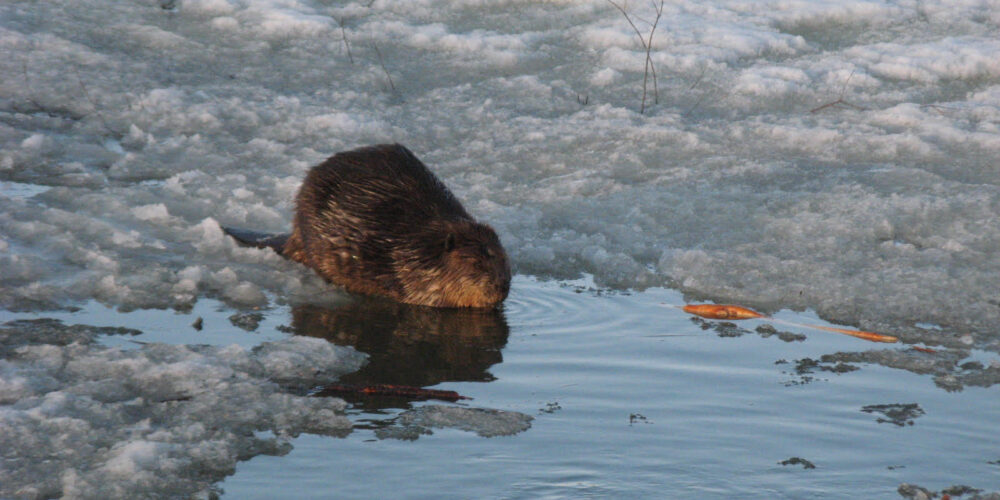
Unlike many mammals that hibernate and remain inactive during the winter, beavers stay active year-round. Although they spend the winter beneath the ice, they continue carrying out important activities, including breeding inside lodges. Hood described beavers as “seasonally confined, non-hibernating animals.”
As beavers are unable to leave their ponds during the winter, they have to rely on food caches stored before freeze-up. However, warmer temperatures and longer ice-free periods have allowed them to forage for extended periods in the fall and early winter.
While longer open-water seasons have provided more opportunities to gather food, declining water levels have reduced the availability of emergent vegetation. As Glynnis Hood explained, “because the water levels are going down, they don’t get a lot of that nice emergent vegetation, they actually keep cutting trees throughout the summer and into the fall.” The longer they remain active outside of their lodges, the greater the likelihood of interactions and conflicts with humans.
A link between beaver behaviour and warming temperatures
One of Hood’s major findings demonstrated a clear link between climate warming and beaver behaviour. According to her, “for every one-degree Celsius increase in temperature that we get, the date the beavers come onto the ice is six days earlier.” The finding highlighted a direct relationship between rising temperatures and earlier seasonal emergence.
Climate warming has also contributed to the northward expansion of beaver populations. Hood noted that beavers are moving further into the Arctic, entering regions where local communities have never encountered them before. “They’re coming into areas of the Arctic where people have never seen beavers before,” she explained.
As beavers become active earlier in the spring and remain active later into the fall, Hood emphasized that wildlife managers would need to adapt their management strategies to account for these changing patterns.
Looking ahead, Hood and her team plan to continue monitoring the Beaver Hills study area and expanding their long-term dataset. In addition, she has research starting up in the Arctic, in the Inuvialuit settlement region, where her team is hoping to apply knowledge from Alberta’s beaver population to better understand how northern ecosystems are responding to climate change.
As Hood explained, “with the warming climate, beavers are moving further and further into the Arctic,” and her team’s work “can help inform what we can expect with northern expansion, because as temperatures in the Arctic start to warm up, we can expect that beavers might have a better chance of surviving through the winter and then colonizing further and further north.”