Play Review: ‘Rat Academy’ at the Roxy Theatre
Niche Albertan history serves as the basis for this hilariously fearless show.

 Supplied
Upon entering The Roxy Theatre for Rat Academy, I expected a quirky storyline with a sort of understated comedy. What I saw instead was a tightly crafted, humorously physical, and surprisingly heartfelt piece of theatre. It was a show that felt deeply rooted in Alberta’s own obscure cultural history. Presented by Theatre Network, this 90-minute production carries the scrappy energy of its Fringe origins while showcasing a level of improvisational polish that proves how far it has evolved.
The creative team reads like a tight-knit collective rather than a traditional hierarchy. Co-creators and performers Dayna Lea Hoffmann and Katie Yoner developed the show through Batrabbit Collective. The pair built it from a small experimental piece into a touring hit with multiple sold-out runs and festival accolades. Their work has clearly been shaped by mentorship from established Canadian clown artists. This lineage shows in the production’s commitment to physical storytelling. Director Joseph McManus wears multiple hats and is also credited with stage management. His influence is evident in the show’s precision. The comedic jolts landed in sequentially genius timing without feeling over-rehearsed. There’s a strong sense of dynamism in execution. The performers constantly engage with the audience in a way that makes the story feel shaped in real time, yet the plot is pre-set.
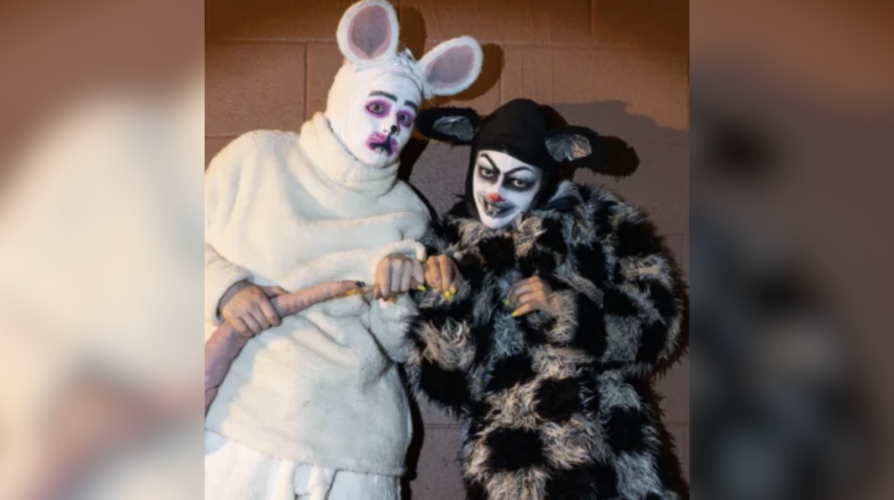
The premise is deceptively simple. Fingers, a hardened street rat, believes himself to be the last rat in Alberta. Until he encounters Shrimp, an escaped lab rat with a childlike optimism. Together, they establish the titular “academy” to teach the necessary survival skills for an apocalyptic rat-free Alberta to each other and the audience. This setup enables the show to unfold as a series of comedic “lessons,” from mock lectures on scavenging to elaborate physical demonstrations of essential rat behaviour. But, beneath the silliness lies a surprisingly poignant thread about fear versus love, friendship, the need for connection, and biases. The show draws inspiration from Alberta’s real 1950s anti-rat campaigns, turning a very unique piece of provincial history into a simultaneous satire and emotional backdrop.
Comedically, Rat Academy thrives on physical theatre. Hoffmann’s Fingers is all hunched shoulders, sharp gestures, and gruff vocal work, portraying a true creature shaped by scrappy survival. In contrast, Yoner’s Shrimp is wide-eyed, sweet in nature, but extremely naive (to Fingers’ discontent). Their chemistry is clearly genuine, built on a classic but fluid dynamic that seems especially brilliantly catered to Gen X in the realms of parenthood and pet ownership, with fleeting comedic moments of mutual authority between the two. The audience interaction is certainly frequent but is not forced. The audience was enthusiastic to the point of my surprise. This interactive element had the theatre feeling more like a shared playground than a passive or one-sided viewing space.
What stood out most was how fearless the comedy was. The show embraced clown logic through extended bits, exaggerated movement, and moments of deliberate absurdity. When laughter peaks, it pivots down into something more thematically reflective — but it never feels too heavy for a comedy. That balance is where I thought Rat Academy excelled. Technically speaking, the production is quite minimalist. The set and lighting (credited to Claire Sonmor in the program) created a flexible, almost cartoon-like environment. The costume design leaned into visible exaggeration. It seemed as if each set element was maximized in supporting the performers.
By the final moments, Rat Academy becomes more than a comedy and concludes as a uniquely touching meditation on survival and companionship. Leaving the theatre, the audience buzzed with a particular post-show collective lightheartedness. In short, Rat Academy is weird, funny, and sneakily profound. Niche, Albertan history acting as the basis for such a production was new, but definitely not regrettable.