U of A hosts second annual Alberta Social Psychology Symposium
Researchers gathered for lectures, poster sessions, and roundtables about a variety of topics with social psychology.

 Leah Hennig
 From April 30 to May 1, the University of Alberta hosted the second annual Alberta Social Psychology Symposium (ASPS). Researchers gathered from across the province to share research posters, attend talks, and roundtable discussions.
The research shared at ASPS ranged from topics around language learning to identity to self-forgiveness.
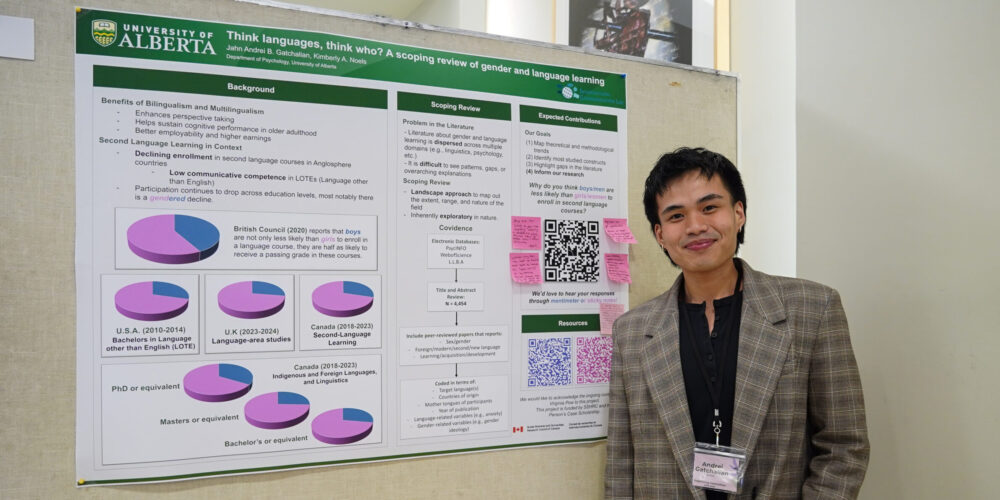
Andrei Gatchalian shared his first–year Master’s project during the first poster session as well. He’s also part of the organizing committee for ASPS.
His project focuses on the gender split in who is learning languages other than English (LOTEs). Gatchalian is conducting a scoping review of gender and language learning.
Gatchalian said that language and gender have been a big part of his identity as a student and as a person. He’s part of the 2SLGBTQIA+ community and Tagala is his first language. He moved to Canada when he was 12 years old and has grown to be proud of speaking more than one language.
“Learning another language has been linked to various benefits, including social benefits, [and] economic benefits,” he explained. “However, there has been a decline in second language courses in anglosphere countries, so that includes Canada, the [United Kingdom], and the [United States].”
He explained that individuals in these countries often perform poorly in cognitive competence in LOTEs. As participation in LOTEs education declines, there’s also gender decline. More women than men tend to learn LOTEs.
There is a lot of research on this across different disciplines; however, that presents a challenge in recognizing patterns in the gaps to explain them.
“Our main goal is to map out the extent of the range in the nature of the field, and really explore what’s out there in the literature,” he said.
They are currently only in the preliminary stages of the review, which has found over 4,000 relevant papers and studies. Next, they’ll start to code for targeted languages, countries of origin, and gender-related variables.
Carving out space for more identities in research
Jordan Caudron was another one of the student researchers sharing their research at the first poster session. Their research looked at how maternal or paternal age and effects of siblings appear in bisexual, asexual, homosexual, and heterosexual populations.
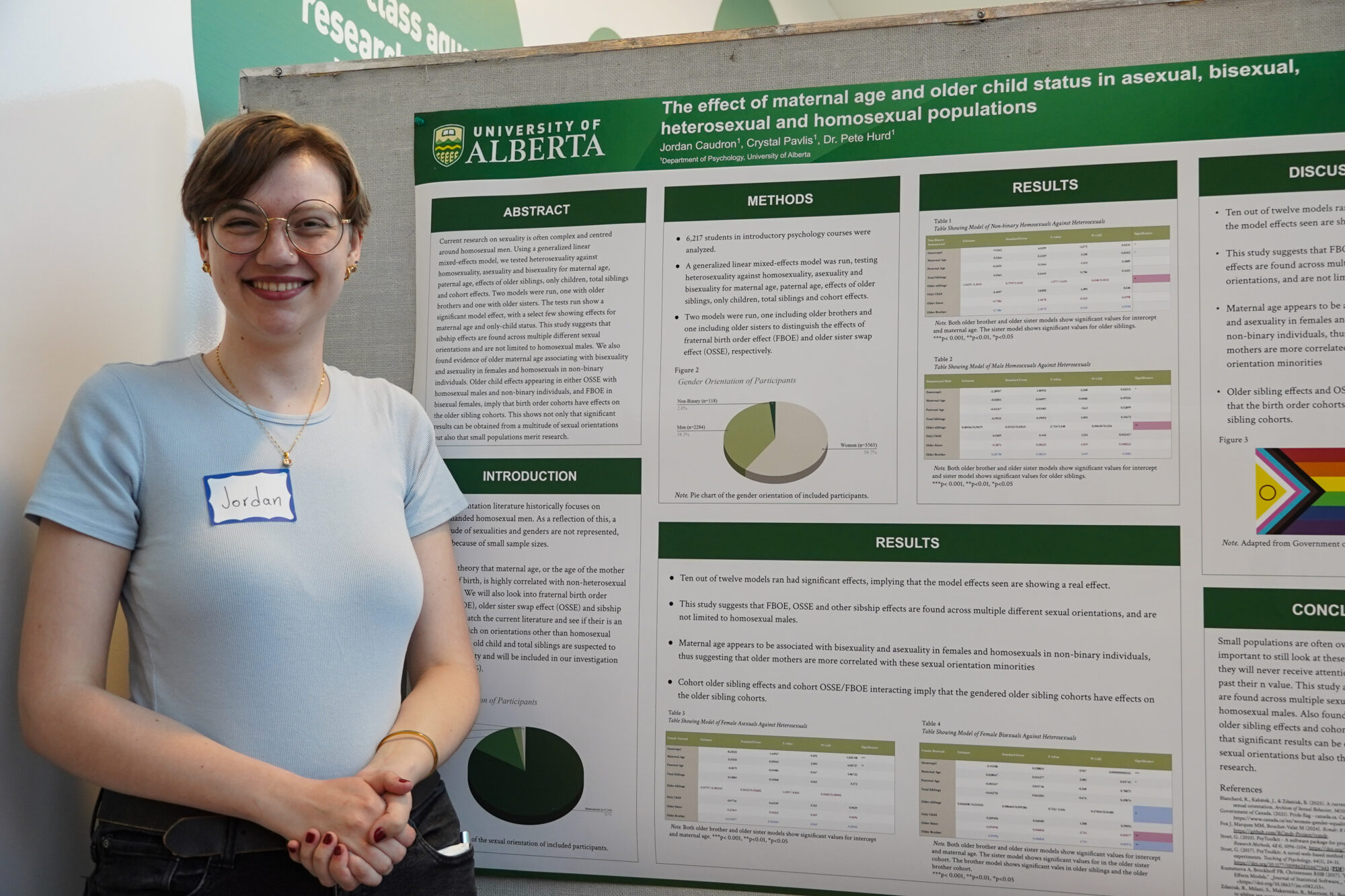
Caudron is part of the psychology honours program and did her research under Pete Hurd, a professor of psychology science.
“Current research on sexuality is homosexual right-handed men, and I have a personal belief that we should include smaller end values in our research,” Caudron explained. “These are your asexuals, your non-binary folk, your females. These populations [are] rarely talked about in research, and they’re still very deserving of a voice.”
Her research analyzed 6,000 students and ran them through a generalized mixed model. First they ran homosexuality, asexuality, and bisexuality against heterosexuality, and then ran a female and male model. They found that 10 out of 12 models had significant effects.
“When I separated those two models, they showed different effect sizes, which I found was pretty cool,” Caudron said.
“My favourite finding out of all of them is that maternal age is associated with bisexuality and asexuality in females and homosexuality in non-binary individuals,” Caudron said.
This showed an association between older mothers and bisexual and asexual females. The study also found effects of sibling relationships, such as fraternal birth order, older sister swap effect, and sibship, across multiple sexualities.
“I think it’s important to make room for clear research inside humanities and social sciences,” she said. “If we don’t carve out a place for them in the sciences and humanities now, they will never find a place.”