BoG representative candidates highlight representation, but lack specifics
Candidates addressed how to elevate a campus that often feels overlooked — with varying levels of specificity.

 Leah Hennig
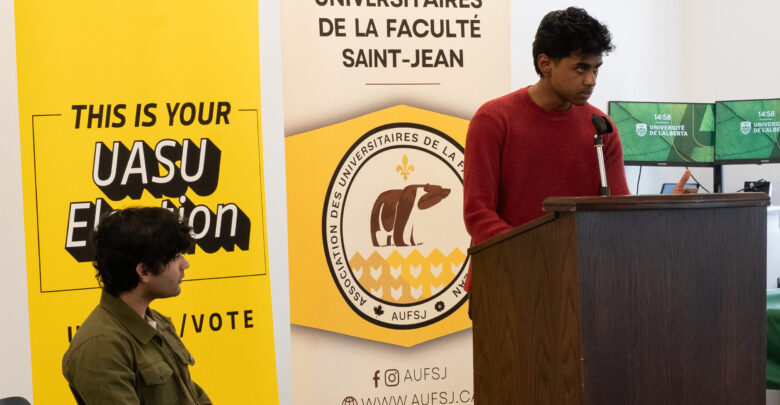
 At the Campus Saint-Jean (CSJ) forum on February 25, two of the Board of Governors (BoG Rep) candidates returned to themes that are quickly becoming staples of this election cycle: communication, consultation, and the promise that students will be “heard.”
The central question from the l’Association des Universitaires de la Faculté Saint- Jean (AUFSJ) was straightforward: how would candidates ensure a campus that often feels overlooked is treated as an institutional asset at the university’s highest decision-making table?
Amaan Khan’s approach leaned heavily on the same framework he carried at the previous forum — communication as governance strategy. Opening in French and acknowledging the limits of his fluency, Khan positioned himself first as a listener, presenting consistency in communication as a core pillar of his platform.
His most concrete commitment was procedural. Khan proposed advocating for CSJ representatives to present directly to BoG whenever campus-specific issues arise. This would create what he describes as a one-to-one connection between CSJ and decision-makers.
The response addressed the central question in principle by emphasizing access and visibility. However, questions remain about implementation. Khan’s emphasis on listening signals responsiveness, but he provided fewer details about the mechanisms that would ensure concerns translate into policy influence rather than just ongoing consultation.
Consistency promises reliability, but voters are still waiting to see the specifics.
Janardhun Alagarsamy Vignesh again delivered the most explicitly critical framing of governance, this time grounding it in the material realities of CSJ.
His opening statement named residence maintenance issues, rising rents, food insecurity, and the difficulty of accessing university services in French. He framed all of these within structural neglect, signalling a willingness to treat CSJ inequalities as systemic rather than logistical.
Alagarsamy Vignesh’s three principles — oversight, sustainability, and advocacy with purpose — translate well into the CSJ context. Oversight by questioning whether budgets and restructuring plans meaningfully include CSJ input. Sustainability meant long-term investment in francophone education. Advocacy when it comes to shifting consultation from end-stage feedback to early decision-making.
Tala Mojarrd was unable to attend due to a scheduling conflict, leaving this context-specific conversation without her perspective. This absence carries particular weight given how much of Mojarrad’s platform is rooted in her experience as an international student. CSJ is a campus with a large international student population and students navigating language, bureaucracy, and institutional distance simultaneously. This would have been a natural extension of her argument. Forums are not the entirety of a campaign, and scheduling conflicts happen. But her absence unintentionally illustrates the challenge her platform seeks to address: representation gaps are still gaps, even when the intention to listen is clear.
What is becoming clear across forums is that this race is less about whether candidates value marginalized student communities and more about how they interpret the limits of the role itself.