SU Elections 2026 Q&A: President
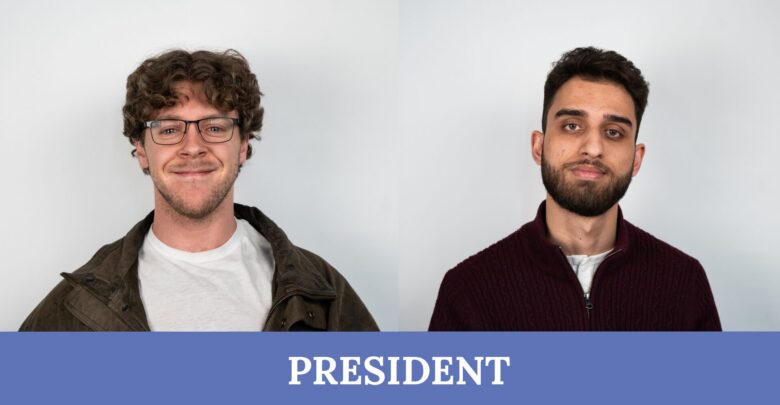
There are two candidates in the 2026 Students' Union presidential race: Abdul Abbasi and Joseph Sesek.

 Leah Hennig
 The Students’ Union (SU) president is the chief representative of the SU and all University of Alberta undergraduate students. The SU president sits on the Board of Governors (BoG) and General Faculties Council (GFC), acting as an advocate to university administration and all levels of government.
There are two candidates in the 2026 SU presidential race:
- Abdul Abbasi, a fifth-year criminology student, current SU vice-president (external) (VPX), and the 2024 –25 VPX
- Joseph Sesek, a third-year psychology student
The following interviews have been edited for brevity and clarity. Candidates were given 1 minute and 30 seconds to answer each question.
Why have you decided to run for president?
Abdul Abbasi: Over the past two years as VPX, I have represented students at each level of government and have worked to turn the student priorities into real outcomes. That experience has taught me not only how decisions get made, but how to navigate systems effectively so students can actually see the results. I first got involved in the SU because, coming from Augustana, I felt that the smaller campuses were often overlooked, and I stepped up because I wanted to make sure that every student, no matter where they study, what they study, feels represented and prioritized, and that’s the motivation that still drives me today.
During my two terms as an executive, I have also seen firsthand how much leadership matters. When a president understands the role and supports their team well, the entire SU is stronger and effective, and I want to bring that kind of leadership, and want to support the executive team so they can succeed, collaborate well, and deliver meaningful progress for students. Also, over the past two years, I have listened to students and have seen where the SU can do better, and that is why I’m running. One of the big philosophical changes I’m hoping to bring to the SU is that I want to lead a SU that delivers on both the big priorities and the everyday things that shape the students’ life.
Joseph Sesek: I came to the U of A because, first and foremost, it’s a top 100 university in the world, carries a lot of prestige, and there’s a lot of great things going for it. However, I fear with the $248 million shortfall that the U of A president Bill Flanagan outlined back in October 2025, I think with that shortfall, we may be in jeopardy of falling out of the top 100 universities in the world. Now that affects every one of us, international students and Canadian students alike. I am running because no one has stood up and made a massive effort to mobilize the U of A students to help the university get its fair funding, and thus end the need for annual tuition increases. Furthermore, I believe my campaign platforms will help the U of A remain a top 100 university in the world. During the election campaign, I will outline those specific commitments I have. They range from extending library hours to midnight, to greater safety for more lighting and monitored CCTV cameras on campus, and the expansion of the already great ONEcard access program to all buildings after 6:00 p.m. and on weekends.
What would you say are the three main takeaways from your platform?
Abbasi: I see the role of the president in three ways that the SU can better support students. That includes operationally, advocacy to the university, and advocacy to all level of governments. When it comes to internally to the SU, that includes realigning the UASU’s budget to ensure that every student dollar directly supports the today’s students priorities, while positioning the organization for long-term sustainability. With the upcoming years, we’re hoping to do [a] three-year operational plan and the first year of the strategic plan, that means looking into zero-based budgeting, which essentially means looking at every expense from the ground up to make sure that student dollars are being used effectively, also working with Student Group Services (SGS) to better support clubs, as SU is getting the authority to approve events and recognition and making sure that SGS and student group regulations are working for the student leaders, not against them.
When talking about advocacy to the university, pushing for a bookstore policy so we can have better, accurate data for Zero Textbook Cost (ZTC) that can better support students. A lot of concerns we have heard around rent rationalization, so making sure that there is a review of that as university moved from 60 different rates to five different rates. Focusing externally, something I’ve heard time and time again is a need for cheaper gym access and recreation centres, so pushing for Leisure Access Pass to make sure that students have free or cheaper access across the city, pushing for transit safety, and bus rapid transit. And as the Mintz panel recommendations have come out, implementation of that.
Sesek: My campaign challenges all of us students, alumni and current students alike, to strive to achieve great things together. I think we must, firstly, get the U of A the funding it needs to stay a top 100 university in the world. Two, we must protect the U of A experience by ensuring adequate housing and adequate safety. To me, it’s crazy that in 2026 we have to still address the two lowest pillars of Maslow’s hierarchy of needs, which is physiological and safety needs. There is an urgent need for the residence situation to be immediately addressed and corrected. There is also an urgent need for more lighting, CCTV cameras, and ONEcard access expansion to include all university buildings after 6:00 p.m. and on weekends. Three, now, these next three points I’m really adamant about getting done, and I think in good faith discussion with the U of A administration, they’re undeniably cheap, easy, and reasonable fixes that will massively improve the U of A student experience and help maintain and improve our already great reputation. These consist, again, of extending library hours back to midnight. One thing I really like is professors having to mark exams and papers within 14 days, and syllabus and material cost transparency in all course listings. Many more where that came from on josephforprez.com.
Many students are struggling to keep up with the cost of living and rising tuition. How would you address these concerns as president?
Abbasi: Affordability has been a big priority for me in my two years as VPX, and still remains my top priorities. And as I talked about, there are three different avenues where we can use them. When it comes to the university, pushing for open education resources and more zero textbook classes, so students don’t have to spend so much on textbooks and save costs there, while advocating for review of rent rationalization, as we know that housing is really expensive, so students can get the quality that they are paying for.
Internally, when we are talking about different things the SU can do, and that is where I believe that the SU can play a big role in making food more affordable for students and support students better because everyday costs on campus matter the same as much as the large policy issues. Externally we have to address the bigger drivers of affordability. So the biggest reason of the tuition increase has been the provincial operating grant cut, so if making sure that we’re getting towards the implementation of the Mintz panel so the university sees more funding, but at the same time, trying to find some of those opportunities, making sure that if students have access to free or substantially cheaper gym and recreation centre closer to where they live, that can help them to save money while maintaining their health and well-being, making sure that the transit is more safe for students, so that the students can even live further away but feel safer traveling.
Sesek: So to me, student mobilisation is key. And it’s not limited to students, it’s also the U of A administration, the staff, everybody who works here. We must achieve great things together and we must get adequate funding immediately, fair funding immediately for the U of A. Years of playing footsies with the Alberta government has resulted in an operating grant from the Alberta government being stuck at the same amount for the last four years. And that’s according to Bill Flanagan’s report as of last year. All the meanwhile, both inflation increased and the student headcount increased significantly. There’s no more playing footsies. It’s time for feet on the ground and in the Alberta legislature. To find out how I will tackle this exact issue, you could check out my righteous video at, again, josephforprez.com.
Students sometimes don’t feel heard by the university. How would you work to make students’ voices heard when you are working/meeting with the university?
Abbasi: I think the first step to do all of that is making sure that the SU is listening to students and what the student concerns are. The SU represents more than 39,000 undergrad students, but one of the most common things we hear is people don’t know what the SU is or what the SU does. That is one of the big ways I think we can, again, we need to start by pushing to hear what the student concerns are, and that includes the UASU has a really robust governance structure in the country, making sure we’re talking to a faculty association and departmental association to hear those concerns, making sure that the SU execs are more on the ground.
We have done great work on social media this year, but making sure SU execs are at new student orientation and different events. But these past two years, I have had the opportunity to push the things that students need externally, and have been able to achieve a lot of wins there. So making sure, bringing all of that learning there, while making sure that SU is listening to students, SU is acting on what the student concerns are, and while we’re talking to the university, let those big policy things matter, but while we’re focusing on those big things, also focusing on small things. As I talked about, water fountains across campus. That is something that sometimes feels small, but so many students get affected by that. So making sure we’re listening to students and prioritizing both the big things and the small things as well.
Sesek: I believe mobilizing the students in a fight for fair funding alongside the U of A administration, including the president, Bill Flanagan, will create a positive relationship between the SU and the president of the university and make it easier for us to implement all the issues and concerns that students have. The relationship between the president and the UASU is very important and it should be handled tenderly. Secondly, to figure out what issues need to be addressed, I want to immediately add an Indigenous student position and an international student position. I feel like their voices should be heard, they are a very significant portion of our student body. I want to make sure that me and my [vice-presidents] have weekly office hours at Augustana and Campus Saint-Jean. I think it’s very important that every campus of U of A has direct access to the SU, so their voices can be heard. And then lastly, I will try to fit a meeting in my schedule with faculty associations and student groups at least monthly, so we can create a constant dialogue between the SU and the associations that make this university so great.
As president, you would oversee the executive team’s work. How will you ensure that you stay true to your platform commitments while also supporting other executives’ initiatives?
Abbasi: I have seen how SU does when we have a president who is experienced and who provides that support to the team, versus when it does not, so making sure that I’m providing that support to the team. This year, I’ve had the opportunity to chair the Canadian Alliance of Student Associations (CASA), which represents half a million students from coast to coast. I have had a board of seven members and making sure that I’m bringing their priorities forward and making sure I’m supporting them in all the things that they want, but also, at the same time, that things that I have heard from the members, that they’re heard. And same goes in the presidential role. My biggest priority is making sure I’m supporting the vice-presidents (VPs), because once the VPs do that work, then the SU that is more effective for students. But while I’m running, there is that aspect of trying to make sure the things that I have heard from that students care about, and making sure [I’m] implementing those. It is a delicate balance in making sure [I’m] implementing those, but it is also working with the team. Five people are better than one person. So it doesn’t mean that if I have anything external, I would be working alone, or student life working alone. Making sure [I’m] working with the vice-president (student life), VPX, and respective executives to make sure they are also the one pushing, so, again, working as a team instead of alone.
Sesek: I’d like to start by saying I’ve put a lot of commitments on my website and my Instagram that I do intend to hold true, and I hope the students hold me accountable to. Well, not just the students, my peers and the university itself. Now, as president, you do have to oversee a lot of visions. My vision for the SU is the one I want to follow, but I will obviously work with my VP elects to also include what they think is right for the students. No opinions are going to be neglected, and I want to be friends with all of my VP elects and work hard diligently together to do what’s best for the students at the end of the day. I’ve had conversations with Pedro [Almeida], and this was one of the things he was adamant on, was making sure your relationships with the university and other VP elects was crisp, so you could all have worked together on a similar vision for what you think is right, and that is something I really aspire to do in my presidency.