UASU hosts Take Back the Night march, launches SGBV task force report
The January 22 Take Back the Night March marked the launch of the UASU’s Sexual and Gender-Based Violence Task Force Report.

 Leah Hennig
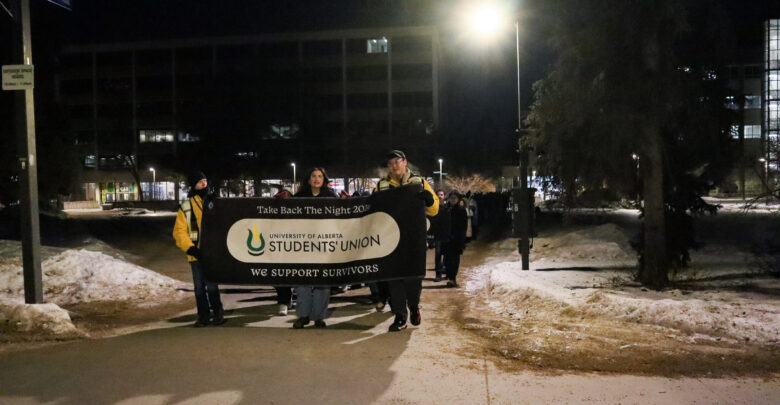
Despite the -26 C weather, students, faculty, and staff marched to Take Back the Night on January 22. The march was part of the University of Alberta Students’ Union’s (UASU) sexual and gender-based violence (SGBV) week.
Ahead of the march, Logan West, the UASU vice-president (student life), said that there were 21 campus groups present. The groups included the Association of Academic Staff at the U of A (AASUA), the Non-Academic Staff Association (NASA), the Indigenous Students’ Union (ISU), the International Students’ Association (ISA), Graduate Students’ Association (GSA), and more.
West explained that women who had experienced (SGBV) started Take Back the Night in the 1970s and sought to reclaim the night from those who sought to harm them.
“Women began to march through the night to reclaim it as their own, and to say that they were here and they were not afraid to make a stand and claim back equal space,” West said. “The movement has since expanded and grown to become incredibly intersectional.”
West said that the march is “a call to action to assert that [SGBV] has no place on our campus, and to demonstrate to the survivors of our community that we stand with them, that they are not alone, and that there is a community behind them willing to fight for them.”
UASU launches its SGBV Task Force Report and recommendations
The march also marked the official launch of the UASU’s SGBV Task Force’s report. The report includes 11 recommendations to address SGBV on the U of A’s campus.
“The task force brought together students from diverse communities across our campuses to offer their opinions and share their own experiences and their community’s experiences in these spaces,” West said. “It also brought together folks from the university community to speak to their experience working in these spaces.”
“It created a vision for a future where students are supported, where they receive the resources they need, where they receive education and the awareness and the support for their friends to be able to feel supported by them as well,” they said.
The Task Force directs most of the recommendations in the report at the U of A administration. The recommendations include mandatory consent education for incoming undergraduate students, making a SGBV in work-integrated learning toolkit, and building more sexual health awareness.
Other recommendations call for improvements to supports and accountability measures available to survivors of SGBV. One recommendation is to create bilingual resources, a plain language flowchart, and consistent semester-based programming.
Report calls for better accountability options and support for Indigenous students
Another recommendation asks the university to expand the Options Navigation Network (ONN). ONN is a group of university units meant to assist those who have experienced SGBV to understand the options available to them.
The report calls for the university to expand this “so every faculty has an identifiable, trained [ONN] unit that students can access without having to navigate the system on their own.”
The fourth recommendation is to expand non-disciplinary accountability options (NDAO) for SGBV available through the Student Success and Experience office. The report said that through consultations, it consistently heard concerns around limited visibility and availability of NDAOs.
“NDAOs for SGBV require specialized capacity and careful facilitation with survivor centred safeguards, which the university has not yet built the staffing model and expertise to support,” the report said.
The report also calls on the U of A to consistently offer culturally competent SGBV support and resources for Indigenous students. The task force identified capacity issues when it came to restorative justice options for Indigenous students.
Another recommendation is for the university to recognize October 4 as Sisters in Spirit Day. The report says “the Task Force identified a gap in the university’s recognition of missing and murdered Indigenous women and girls and 2SLGBTQI+ people [(MMIWG2S)].”
Call for response to sex-for-rent schemes
Recommendation seven calls on Residence Services to present to Students’ Council by fall 2026 about its current SGBV response practices and to develop a multi-year strategy to address SGBV in residence by winter 2027. The report identifies a lack of understanding by students around how Residence Services handles SGBV concerns and the options available to students in crisis.
“The Task Force heard that international students are a priority area of concern, as many can be especially isolated, reluctant to engage with formal reporting processes, and otherwise vulnerable,” the report said.
The task force also noted sex-for-rent schemes as a “rising form of sexual explotation that students face while searching for housing.”
Sex-for-rent refers to an offer of housing or reduced rent in exchange for sexual activity. According to the report, a survey found that 14 per cent of respondents reported knowing someone who had experienced sex-for-rent exploitation.
The report calls for the university to develop a co-ordinated response to sex-for-rent schemes in partnership with the UASU and the City of Edmonton.