 Ash Grover
Every year, The Gateway hosts a panel to discuss the University of Alberta Students’ Union (SU) election. This year’s panellists provided their insights on the candidates running, student politics, and who students should vote for in the 2026 SU election. The Gateway interviewed the panellists on Febraury 28.
Opinions expressed by the panellists do not reflect those of The Gateway.
The Panel
This year’s panel included:
- Angelina Botros: first-year pharmacy doctorate student, former General Faculties Council (GFC) and SU councillor from 2024–25
- Brooklyn Hollinger: The Gateway 2024–25 arts and culture editor, former deputy opinion editor
- Karene Kouadio: fourth-year English and political science student, social science councillor for the Organization for Arts Students and Interdisciplinary Studies (OASIS)
The Candidates
Abdul Abbasi, a fifth-year criminology student, current vice-president (external) (VPX), and the 2024–25 VPX.
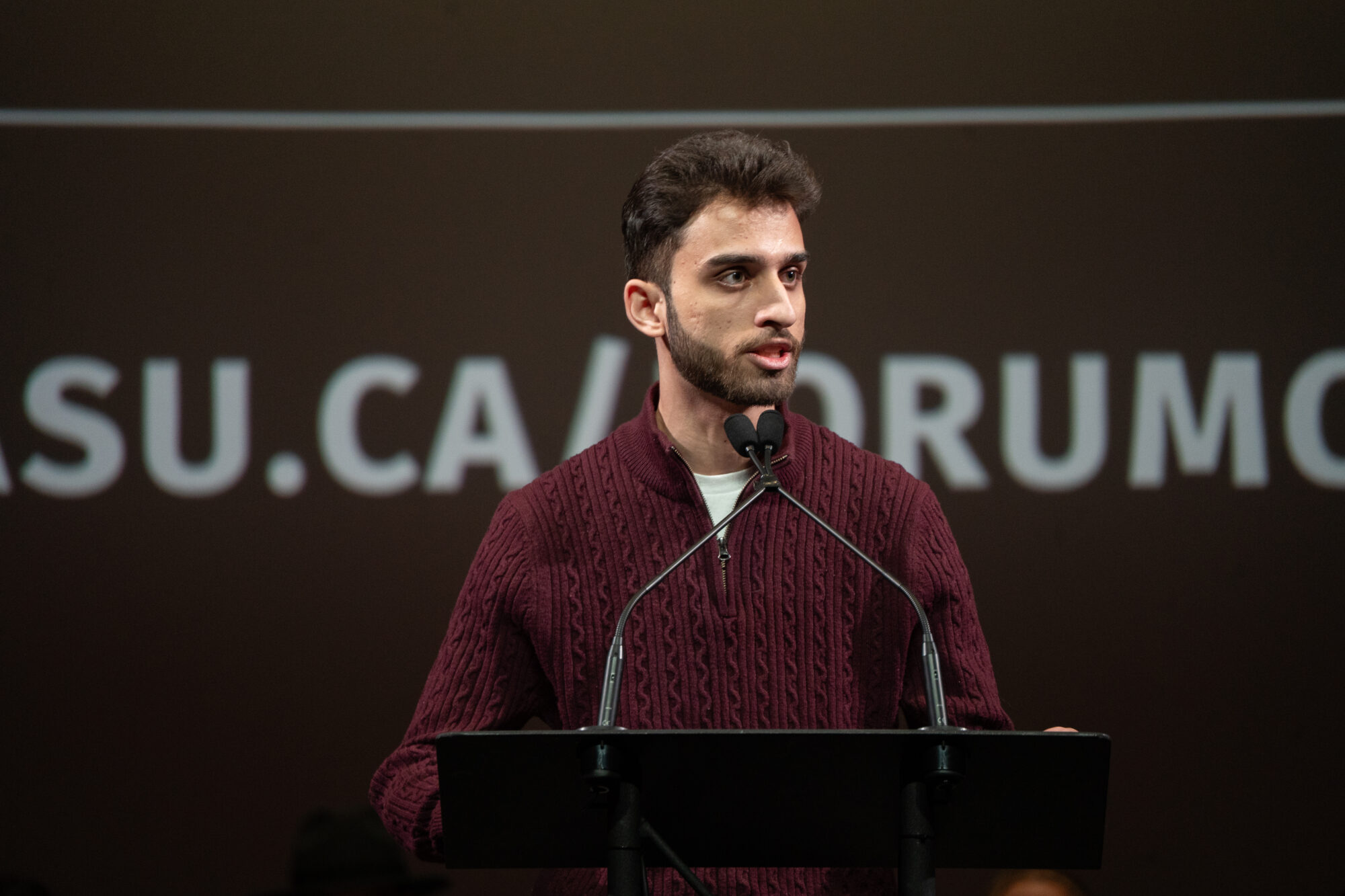
Joseph Sesek, a third-year psychology student.

All three panellists agreed that the presidential race is a matter of ambition versus experience.
“It’s a matter of someone who’s looking to do a lot of structural change and has very big ideas, versus someone who’s already ingrained within the system and has a more incremental approach because they have that experience and that idea of bureaucracy,” Botros said.
Hollinger said that Sesek does have a “solid, visible platform online and on social media … whereas maybe the same can’t quite be said for [Abbasi].”
She said that Abbasi is “leaning on his experience as VPX for two terms,” while Sesek is “trying to amp up his online and social media presence because of his lack of experience in any kind of governance roles.”
Kouadio agreed that Abbasi is relying on his previous experience as VPX, and also mentioned that Sesek’s platform is “more accessible” and “aesthetically pleasing.”
“I would say both candidates don’t know what exactly their role entails, and that’s fair enough because it’s too big of a role,” she said.
“It’s much easier to point [from] the outside because you have no experience within that position,” Kouadio says
In terms of forum performance, Botros said that Abbasi is someone who falls a lot on his experience as VPX, while Sesek is more ambitious and passionate with his delivery. However, she did not appreciate it when Sesek started pressuring and critiquing Abbasi.
Botros said that it is “a little bit immature to start shooting your shots at other candidates because, at the end of the day, the purpose of the forums is [communicating] how am I going to help you as a student?”
Hollinger said that she thinks that “Abbasi could benefit from bringing in new ideas for this year, but can also do so with bringing up stat[istics] and facts.”
Sesek, on the other hand, “has concrete, tangible ideas [that] he is bringing up, but I think they do need to [speak] a little bit more to the whole student body,” she said.
Kouadio said that she agrees with Sesek’s questioning of Abbasi’s platform. “It’s much easier to point [from] the outside because you have no experience within that position … but I think it’s imperative. I think that sometimes we get too complacent to not want to criticize certain people’s takes,” she said.
All three panellists agreed that previous experience is important for the presidential role.
“I would say it’s deeply imperative because being a president is having an understanding of your other [executive] roles, because not only are you furthering your own projects, but you’re also facilitating a lot of others’ projects,” Botros said.
Hollinger noted that experience isn’t as important for other SU vice-president positions, but experience in student governance is vital for the presidential role.
“If you become president having never been in an SU role or a student governance role, how can you support your vice-presidents if you don’t know what their experiences are like?” she said.
Kouadio mentioned that experience is an asset because it provides the candidate with background knowledge, as well as gives the student body something to base their vote on.
“Experience is a privilege in this race. Being able to work within two different presidential teams provides Abbasi with substantial evidence that he can actually do the work. But, personally, I’m skeptical of that route too because how much are we changing? How is this leadership going to be any different than the current one or the previous ones?” she said.
“I think anyone in politics should be critiqued. But, if anything, the person who now, if he becomes president will be in his third term in the SU, should be more prone to criticism. If he’s not chasing new ideas and making monumental change[s], maybe he should be more prone to criticism,” Hollinger said.
Kouadio also highlighted the importance of transparency within the presidential role. “I think whether you’re learning or whether you’ve been in the role for forever, the question now comes down to transparency because, at the end of the day, it’s a matter of having your student body be aware of your moves, understanding your intentions, and understanding what is happening,” she said.
“The real question is to what extent are you going to enable your fellow peers?” Botros says
Botros said that both candidates have highlighted important issues, but Sesek has highlighted more obvious issues for students.
“Both are addressing similar issues, and they’re both addressing issues that are needed on campus. Sesek [highlights] the first thing that [students] think needs to change on campus, whereas Abbasi is still addressing the issue, but it’s in a more [subtle] way,” she said.
Hollinger noted that Sesek’s platform could be more appealing to students that do not know much about student governance, as his platform highlights more changes for everyday student life.
Sesek’s platform is “I’ll support you but I’m going to do these things, whereas Abbasi’s [revolves] more around working with the groups and the system that make the campus such a vibrant place,” she said.
Kouadio said that both candidates have highlighted similar goals in different ways.
These candidates are “different sides of the same coin … and so my question is: how different are we going to be expecting the university to be?” she said.
“They’re both listing very similar platform points and very similar concerns. But the real question is to what extent are you going to enable your fellow peers?” Botros said.
Who will win: three votes for Abbasi
Who should win: three votes for Abbasi