Residence town hall brings students’ thoughts to the U of A
The Council of Residence Associations hosted a residence town hall for students to voice their concerns about residence to the university.

 Leah Hennig
On February 11, the Council of Residence Associations (CORA) held a residence town hall in East Campus Commons to give students an opportunity to share their experiences and concerns with residence to university administration.
The town hall included presentations from University of Alberta Campus Services administration and Residence Services. This was later followed by a question period where students could raise their concerns.
Many students from residences were present, including Lister Residence, Peter Lougheed Hall, East Campus, International House, Résidence Saint-Jean, and HUB.
The presenters were Katherine Huising, associate vice-president of campus services,
Geoffrey Rode, director of residence occupancy, and Melisa Garcia, manager of leasing and food services.
Rode spoke about the residence budget, as well as rent increases for the 2026–27 year.
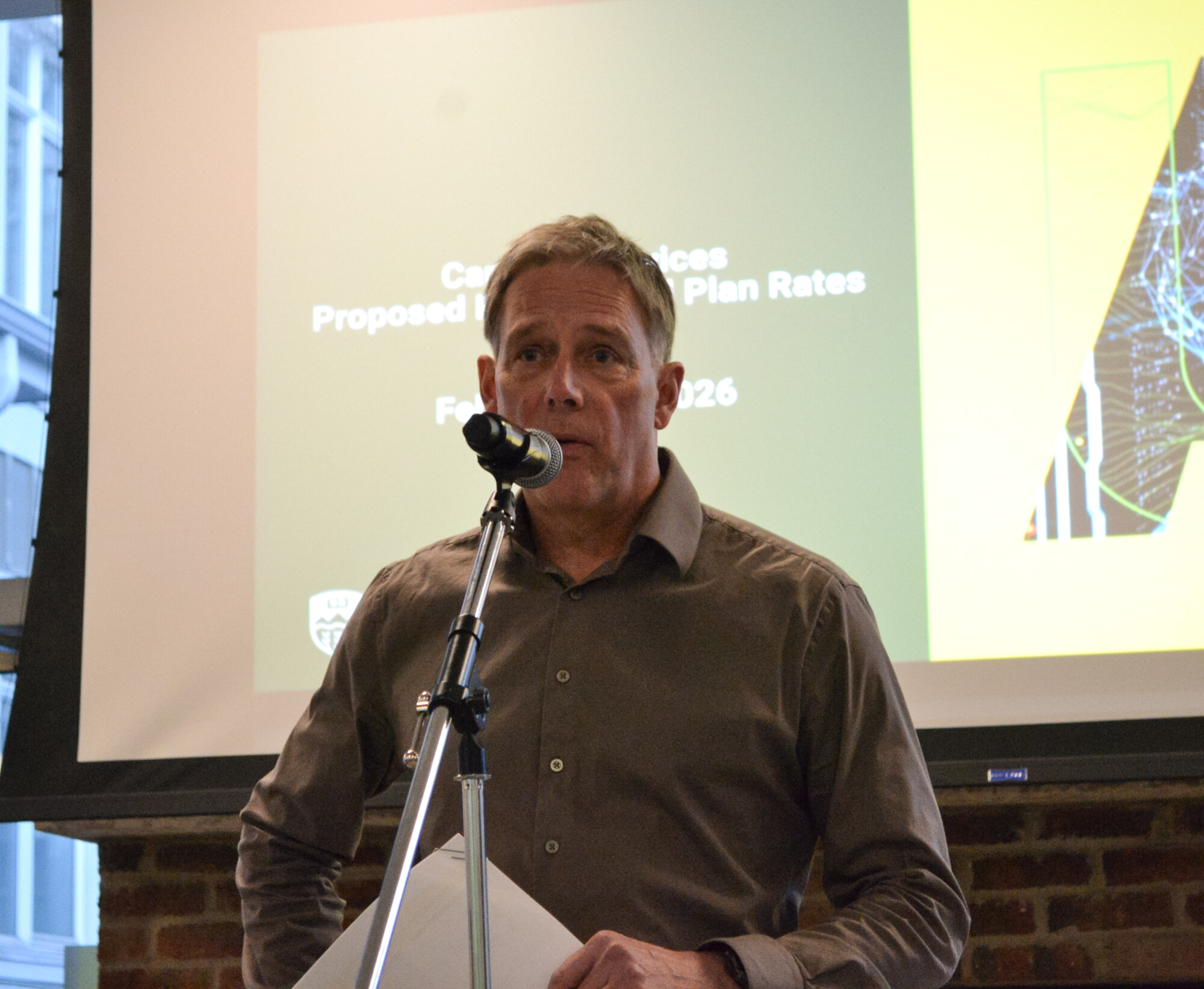
“We have to ensure that we can recover the costs associated with running the residences … through the revenues that, frankly, you pay,” Rode said.
The U of A’s draft 2026–27 consolidated budget features a four per cent increase to residence rates and a five per cent increase to meal plan rates.
Rode explained that residences and dining services operate as ancillary enterprises. This means they must be financially self-sustaining and receive no direct funding from the university’s core operating budget. Therefore, they operate solely on rent and meal plan revenue.
This means that when operating expenses rise, the cost is shifted to the students.
Rode said the major cost pressures include utilities, food and supply costs, maintenance, staffing, and service contracts affected by inflation.
Garcia also talked about rising costs specific to the meal plan and dining services.
The main issue was the rising costs of ingredients. The cost of meat, dairy, baked goods, coffee, and confectionaries have all increased dramatically, according to Garcia.
She also noted that the largest operating expense was labour, which has increased in the last year.
Students voice maintenance concerns
After the presentations, students in residence had a chance to voice their concerns.
A student living in Lister asked if the increase in residence prices would allow for more manpower in fixing things like leaks around Lister, as they have been an issue since the previous year.
Huising responded to the question, saying that fixing the leaks, specifically in the Lister tunnels, would be astronomically expensive, and that they simply don’t have the money.
Another student from International House inquired about plans to install HVAC systems, as the heat was unbearably hot at times and caused them to lose sleep. Additionally, she asked if there were plans for after-hours residence services.
Rode responded to the question, saying “most of these structures were built at a different time, before things were getting so hot.”
He said that he didn’t see a possibility in the near future of retrofitting the buildings with HVAC systems, as that would go beyond their budget. Rode also mentioned that the U of A was looking at plans to increase hours for residence services.
Nolan Greenwood, president of the Lister Hall Students’ Association (LHSA), asked about the comparison between room costs at the U of A and the University of Calgary.
“How can [the U of C] keep in a more competitive rental market, in an equivalent residence, $4,000 cheaper?” Greenwood asked.
Rode responded, stating that the U of C probably wouldn’t divulge its rent profile, and that they might have different cost pressures.
“I don’t have a crystal ball,” Rode said.
Student raise concerns about the quality of residence
Many students brought up the quality of food in residence, as well as the health risk of some foods being left out all day, which was something previously mentioned in a survey by residence services.
“If you watch over the progression of a day, [bread rolls] sit out for well past what is meant to be for food. You’ll see the same rolls from 11:00 a.m. when they’re put out until the dining hall closes,” a student said.
They also mentioned that they had previously brought up the issue to dining staff, and nothing had changed.
Rode said he was surprised to hear that food is sitting for more than two hours, and that the dining staff has very strict guidelines for food safety.
The Gateway asked Rode how he would justify rent increases to students, given that there are more options for students, while also wanting to increase occupancy in residences.
Rode said he didn’t think it was appropriate to mix the town hall forum with media requests, and to follow up over email.
A representative of the U of A stated, “the university’s proposed rate increases are the minimum necessary to cover the increasing costs of providing amenities and services to our students living in residence.”
They also said that “occupancy in our residences is influenced by a range of external factors, including the broader housing market conditions in Edmonton, the total volume of housing available to students both on and off-campus, overall enrolment trends, and shifts in student demographics and preferences.”