VPOF candidates meet at ISU forum, highlight experience gap
First election forum of 2026 sees candidates answer questions regarding Indigenous students advocacy.

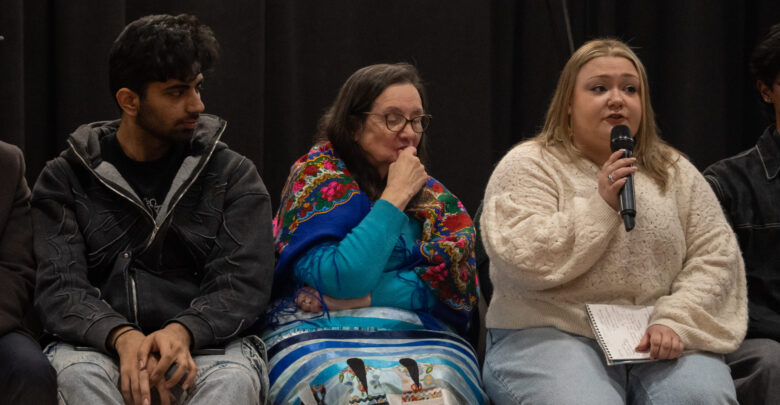 Leah Hennig
 The Indigenous Students’ Union (ISU) forum on February 24 was the first look at this year’s vice-president (operations and finance) (VPOF). We saw the candidates snap out of Instagram and poster campaign mode, and dive into the messy reality of the forums.
Armaan Singh’s pitch is based on one thing: money. In his opening statement, he framed the University of Alberta Students’ Union (SU) as a place where students blindly pay sizeable fees without understanding what for, and plans to make financial reporting more readable for non-finance students. He leaned on financial transparency, food insecurity, and diversifying revenue sources away from strictly students. His message is clear and understandable, and he communicates it well.
This low-level, dollar-figure approach likely stems from Singh’s time working at Dewey’s, a popular campus eatery. Working there, he has gained practical insight into the inner workings of SU businesses. The businesses which make up a sizeable portion of the SU’s revenue.
His platform ran into some trouble when faced with the gap between identifying the problem and identifying the fix. He argued that administrators leave money on the table and mismanage it. Money that could otherwise be spent on higher-priority needs. His key example was the sustainability fund, in which “the SU allocates $90,000 … but only $20,000 of that has been utilized.” He argues that the surplus can fund urgent student needs. That sounds great, but unused does not always mean free to use elsewhere. Funds are often budgeted for specific silos and cannot be moved around at will. Singh’s campaign treats project budgeting like LEGO, moving extra pieces from one place to another. However, in a multi-million dollar organization, it is rarely that simple.
Logan West came in with a different advantage. She is familiar with the institution and the SU’s current environment as the current vice-president (student life) (VPSL). Her opening statement leaned into a long list of relationships, committees, and feedback channels. She talked about sitting with the ISU executive team as the SU representative. And, made it clear that she has been able to turn criticism into action in the past. A key example was her work on the residential school memorial and an Indigenous students’ Elders grant. When compared to Singh’s numbers argument, she showed that she understands the mechanics of how this organization moves.
The clearest example of this contrast arose when questioned about space and accessibility for Indigenous students. Specifically, the ISU lounge and washrooms located in the North Power Plant.
Singh’s answer focused on advocacy. He identified a need for renovations to address some of the issues with the North Power Plant, where the ISU lounge is located. It’s a space that Singh himself has felt at home in.
West’s answer was less emotional and more structural. She framed the problem inside a broader issue: with the university’s aggressive targets for enrolment growth, suggesting that “maintenance required to maintain all the buildings doesn’t increase with it.” Then, she made a point that Singh largely overlooked: student groups need a seat at the table during talks of renovations. Currently, they are consulted after the fact or updated by email. West suggests that they should be in the meetings as stakeholders. This small detail shows her experience with the organization and her knowledge of the shortcomings.
However factual the argument for renovating the power plant may be, we are missing a piece of context. The SU does not own the North Power Plant, where the ISU lounge is located. Neither group has jurisdiction to begin renovations; they only hold the power of advocating to the university.
This forum wasn’t just a first look; it gave us insight into how the SU executive team isn’t just a blank slate. It is a moving object. They have momentum and long-term plans. West is positioning herself as the candidate who can contribute to this continuity and execute this strategic plan to keep the wheels in motion. Singh, on a different but equally important note, is positioning himself as the candidate who will save frustrated students from paying unknown fees and re-allocate mismanaged funds to alternative needs.
Singh came across as a hungry, ambitious candidate ready to challenge assumptions and focus on tangible issues like food and fees. His campaign has better fit the “finance” side of the title.
West came across as a candidate who understands the constraints that overshadow the organization and understands where leverage exists. Her campaign has a better fit for the “operations” side of the title.