 Leah Hennig
The ISA forum went just as expected.
The moderator, Abdullah Al Anik, started with an opening address where he noted that: “We are looking for specifics, not slogans.”
What followed in the vice president (operations and finance) (VPOF) race showed contrasting leniency on this request.
Will each candidate move above and beyond their pre-packaged script? One candidate kept the slogans going, while the other responded more directly.
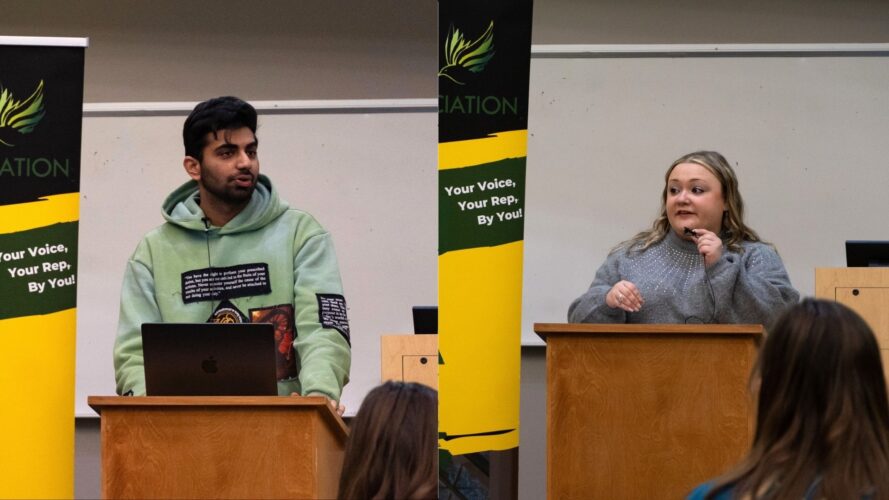
The opening statements were the first sign of this discrepancy. Armaan Singh spent his first trip to the stand repeating the exact same script he had been reading at his previous three opening statements. He told students that, if elected, he plans to give students access to transparency regarding where the $700 of University of Alberta Students’ Union (SU) fees are going. He described $500 of these fees as “optional” and then described the four pillars of his campaign.
Logan West stayed consistent as well, but added a more different emphasis to fit the ISA crowd. She leaned on communicating her credibility, specifically her work on public safety during her time as vice-president (student life) (VPSL), and framed her future plans on implementing and executing the 2026–30 strategic plan. She also mentioned tightening student group processes and making sure the SU produces a worthwhile return on investment on student dollars.
When asked about visa-related financial shocks, however, the candidates gave similar answers. Each candidate made it clear that this lies outside the power of the VPOF. Singh explicitly said he will not “make promises which [he] can’t fulfill,” and West agreed, focusing more on what the SU can do. They both listed relationships, referrals, and maximizing the spending efficiency. This answer felt right at home for the careful West, but it shows an important shift in Singh’s recognition of the position’s boundaries.
With international students being disproportionately affected by issues regarding housing, the topic inevitably came about. Singh pitched affordability through advocacy, and reviving a website that lists rent-controlled housing for student-trusted rentals. West rejected this idea on practicality grounds, suggesting that mainstream housing websites already exist. She argued that a better plan of action would be increasing accessibility to SafeWalk, student employment, and grants for food-centred cultural events. Neither answer fully satisfied the question, which was whether the SU should push for a cap on residence increases tied to inflation. These answers speak of support and advocacy, but do not suggest many concrete mechanisms or plans of action.
In the candidate-to-candidate question period, Singh criticized West for not responding to a critical email for weeks in her previous role as VPSL. He framed her explanation as not a valid excuse. West disclosed that her grandfather ending up in the hospital, dying, sidelined her from her role temporarily and pointed out delays from other parties as well. Singh doubled down in his closing statement, saying that personal hardships do not excuse ignored responsibilities. The moderator, Anik, stepped in with a direct warning, telling candidates not to speak of others’ personal situations like that. Singh crossed a line there. Even if he wanted to make an argument about accountability, the delivery came off as unnecessarily personal and rude.
The pattern across forums is becoming clear. Singh’s weakness appears to be repetition. He frequently returns to the same numbers and pillars, and when pressed on specifics, he speaks broadly about “misallocation.” West’s biggest weakness is also repetition, just in a different form. She regularly points to experience, and relationships, but often stops before saying much about her direct plans. The ISA forum did not fix these issues; instead, it reinforced them.
If the moderator’s “specifics, not slogans” warning lands, the next forums will matter more on adjustment. Singh needs to prove he can do more than speak to his platform and criticize opponents. West must learn that maximizing feasibility means vagueness, and the SU veteran badge can only get you so far in the SU election.
Whoever exits their lane of comfort first will likely pull ahead in this race.