 Leah Hennig
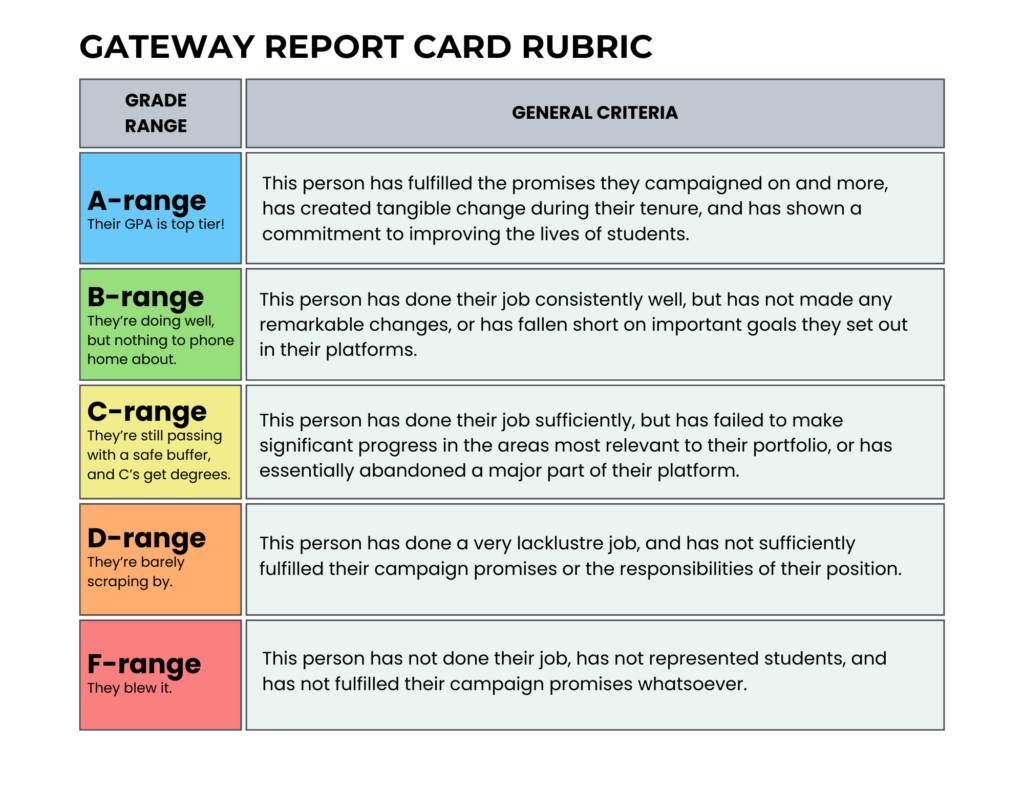
Each year, The Gateway publishes an evaluation of the Students’ Union Executive and the Board of Governors representative. It’s impossible to discuss every aspect of their tenures, so these reports are largely based on the major components of the platform each executive campaigned on, and the most significant responsibilities of their respective positions.
And if you’re short for time, check out our TL;DR for a bite-sized breakdown.
Nathan Thiessen: A
For the University of Alberta Students’ Union (UASU), the vice-president (operations and finance) (VPOF) holds one of the most consequential — and least forgiving — portfolios. The role governs a multimillion-dollar organization, oversees student-facing services, and shapes the long-term sustainability of the UASU itself. It requires balancing immediate student needs with future planning, often under tight financial and institutional constraints. This year, Nathan Thiessen didn’t just meet those demands — he excelled.
Restoring long-term vision where none existed
Thiessen’s defining achievement was delivering a comprehensive UASU strategic plan after years of organizational drift. When he joined the executive, the UASU had gone without a strategic plan for two consecutive years, leaving departments without direction and accountability. Thiessen not only helped deliver a new plan, but did so months ahead of schedule.
More importantly, the plan was not treated as symbolic. Thiessen framed it as a living document, with short-term accountability mechanisms and long-term goals tied directly to operations, finances, sustainability, and student services. In a portfolio where disarray had become normalized, he restored coherence — and did so decisively.
Thiessen consistently emphasized “here and now” impacts alongside long-term planning — and backed that philosophy with action. Students saw tangible improvements across campus: a revamped Dewey’s menu focused on affordability, new microwaves in CAB and Student Representative Associations (SRA) offices, brick chargers and recharge rooms in the Students’ Union Building (SUB), and meaningful upgrades to student study and social spaces like the Room At The Top (RATT) Cafe.
These changes weren’t cosmetic. They addressed affordability, accessibility, and daily student experience — areas where operations and finance decisions most directly affect students’ lives.
Thiessen approached governance with seriousness and foresight. He committed each UASU department and social enterprise to multi-year operational plans aligned with the strategic vision. This ensured decisions weren’t reactive, but sustainable — financially, environmentally, and socially.
His sustainability work extended beyond branding. He increased engagement with the Green Fund, expanded awareness among student groups, and embedded sustainability principles directly into planning and budgeting processes. Rather than treating sustainability as optional, he treated it as operationally essential.
Affordability as an operational priority
While affordability is often treated as an advocacy issue, Thiessen internalized it as an operational responsibility. He reworked UASU businesses to reduce cost barriers, resisted restrictive vendor agreements, expanded affordable food options, and supported access to child care — an issue disproportionately affecting mature students and student parents.
His work on childcare extended beyond rhetoric. Thiessen advanced campus-level advocacy, signed a formal letter on behalf of students who parent, and integrated child care access into the strategic plan as a long-term institutional priority. That level of follow-through is rare in the portfolio.
One of Thiessen’s most impressive feats was navigating institutional friction without sacrificing results. SUB elevator outages — largely under university responsibility — posed major accessibility issues.
SUB faces other issues relating to burst pipes impacting the accessibility of SUB’s entrances and the closure of the second-floor bathrooms. He turned to public advocacy as the process of addressing these issues dragged on. Thiessen also encouraged students to voice their concerns and put pressure on the U of A directly.
Thiessen pushed persistently, escalated when necessary, all while maintaining a functional working relationship with the university. That balance — applying pressure without burning bridges — defined much of his term.
Engagement that actually reached students
With the increased presence of the UASU on social media, students gained clearer insight into where their money goes and what services exist for them. He also strengthened relationships with SRAs, expanded Perks functionality, and supported SRA elections.
Rather than governing from a distance, Thiessen remained grounded — listening to student feedback, walking around campus, and responding to practical needs as they emerged.
Thiessen delivered on his platform — and then went further. He restored long-term vision, stabilized operations, improved affordability, strengthened governance, and delivered tangible benefits students felt every day. His leadership combined competence, ambition, and follow-through at a level that hasn’t been seen in the VPOF role in recent years.
TL;DR: Thiessen rebuilt the UASU’s long-term vision, delivered immediate student-facing improvements, embedded sustainability into operations, and governed with clarity and competence. A standout term — and an easy A.