 Leah Hennig
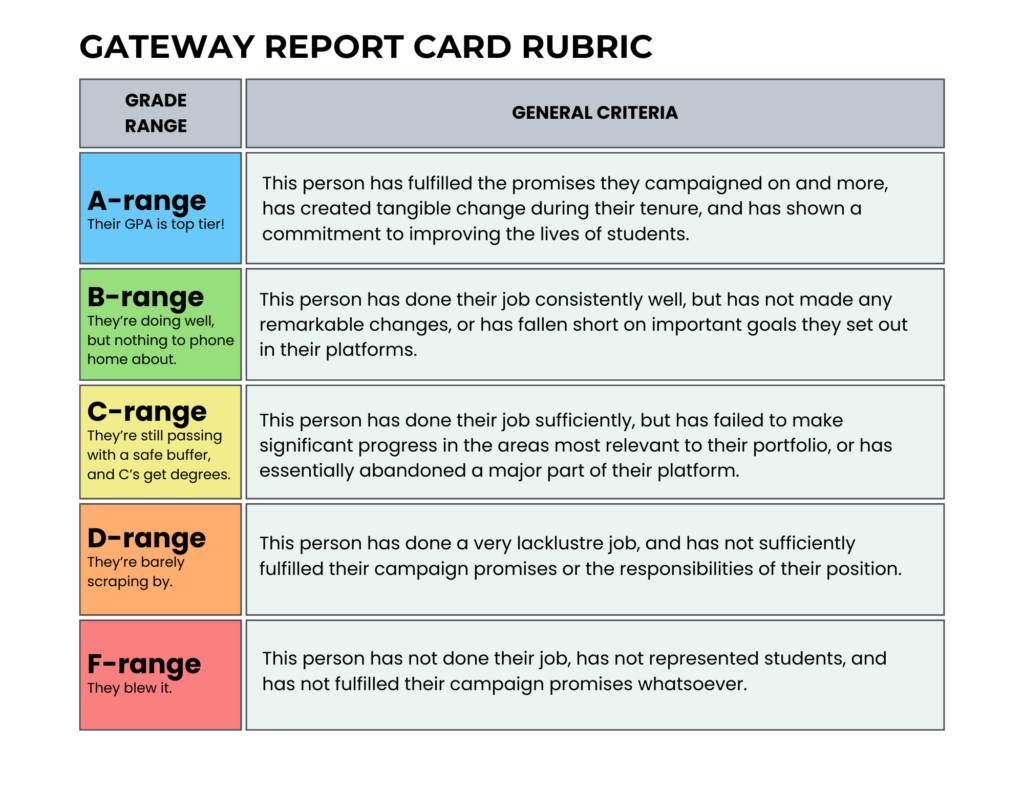
Each year, The Gateway publishes an evaluation of the Students’ Union Executive and the Board of Governors representative. It’s impossible to discuss every aspect of their tenures, so these reports are largely based on the major components of the platform each executive campaigned on, and the most significant responsibilities of their respective positions. The grading rubric can be found at the bottom of the article.
And if you’re short for time, check out our TL;DR for a bite-sized breakdown towards the end of the article.
Abdul Abbasi: A
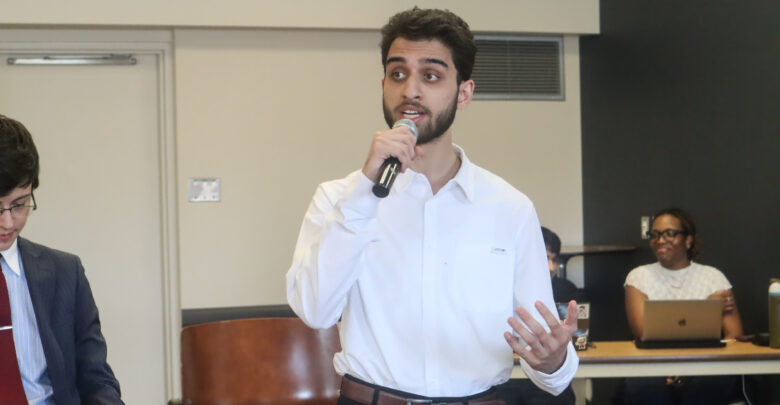
For the University of Alberta Students’ Union (UASU), the vice-president (external) (VPX) is responsible for representing students across municipal, provincial, and federal governments — often at the same time. It’s a role where success is rarely immediate and almost never guaranteed. Outcomes depend on credibility, persistence, and the ability to adapt advocacy strategies as political conditions change. This year, Abdul Abbasi demonstrated all three.
Delivering real wins across every level of government
Abbasi’s term stands out for one reason above all: scale. He secured meaningful funding wins at the federal, provincial, and municipal levels — an uncommon feat for any VPX. At the federal level, Abbasi played a key role in advancing major investments in work-integrated learning, ensuring tens of thousands of students could access paid placements. He also worked alongside the Canadian Alliance of Student Associations (CASA) to advocate against reductions to federal student grants, pushing to protect non-repayable aid at a time when affordability pressures remain acute.
At the provincial level, he helped revive youth employment incentives that directly addressed a growing student employment crisis. He also engaged with the province’s post-secondary funding review process, including advocacy connected to the Mintz panel, to push for a more stable and predictable operating grant framework. Heading into the provincial budget cycle, Abbasi has signalled a continued focus on stabilizing operating grants, protecting student financial aid, and ensuring the panel’s recommendations do not translate into further cost pressures for students. Municipally, he contributed to a substantial student housing investment tied to long-term affordability requirements.
These were not abstract policy discussions. They were material interventions that affected tuition pressure, employment access, and housing stability — three of the most urgent issues facing students.
Strategic advocacy that targets systems, not symptoms
Rather than chasing one-off concessions, Abbasi consistently focused on structural reform. His work around provincial operating grant funding emphasized long-term sustainability, including engagement with expert panels and co-ordinated advocacy across student associations. Federally, he pushed reforms to student financial aid that addressed how aid is assessed and delivered, especially for part-time and low-income students.
Importantly, Abbasi entered his term during a time of political uncertainty. Abbasi demonstrated a willingness to reassess strategy when political conditions shifted. That flexibility reflects political maturity.
Abbasi repeatedly tied his advocacy priorities back to direct student input. He cited early conversations with students about employment shortages, housing costs, transit safety, and food insecurity — and translated those concerns into targeted initiatives. His support for student housing and transit surveys aimed to give municipalities data they could no longer ignore. His work with transit authorities emphasized safety, accessibility, and the recognition that different student communities experience public space differently.
Across North Campus, Augustana, and Campus Saint-Jean, Abbasi maintained regular contact with student leaders and tailored advocacy accordingly. That attention to campus-specific realities strengthened the legitimacy of his external work.
Coalition-building over performative politics
Abbasi’s advocacy style prioritized coalition-building over confrontation for its own sake. He invested heavily in relationships — with other student unions, government officials, and national advocacy bodies — so that when pressure was applied, it carried weight. His leadership within national student organizations amplified U of A students’ influence far beyond campus boundaries.
This didn’t mean avoiding public advocacy altogether. Abbasi engaged with media, supported large-scale student mobilization efforts, and helped run one of the most extensive get-out-the-vote campaigns the UASU has seen. But he treated public pressure as a tool — not a substitute for strategy.
Abbasi fulfilled the promises he campaigned on and exceeded the typical expectations of the VPX role. He delivered tangible funding wins, pursued long-term policy reform, and grounded his advocacy in sustained student engagement. In a portfolio where results are often elusive, Abbasi consistently produced outcomes. That combination of scale, strategy, and follow-through places his term firmly in the A-range.
TL;DR: Abbasi secured major funding wins at all levels of government, pursued structural reform, and grounded his advocacy in student needs. Strategic, effective, and outcome-driven — an A-range term.