 Leah Hennig
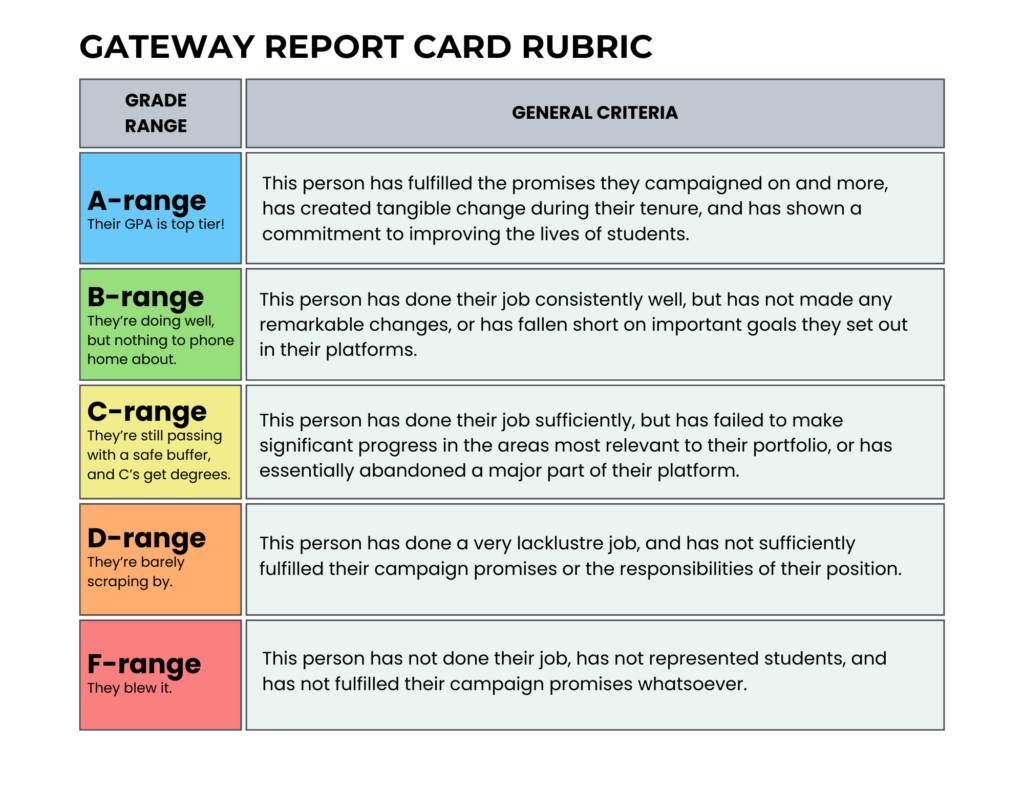
Each year, The Gateway publishes an evaluation of the Students’ Union Executive and the Board of Governors representative. It’s impossible to discuss every aspect of their tenures, so these reports are largely based on the major components of the platform each executive campaigned on, and the most significant responsibilities of their respective positions. The grading rubric can be found at the bottom of the article.
And if you’re short for time, check out our TL;DR for a bite-sized breakdown towards the end of the article.
Pedro Almeida: C
For the University of Alberta Students’ Union (UASU), the president not only serves as a figurehead, but often acts as the connective tissue between the executive team, Students’ Council, and the university administration. The president sits on the General Faculties Council (GFC) and the Board of Governors (BoG), while also setting the tone for how effectively the executive works together. It’s a demanding role, and this year’s president, Pedro Almeida, met some of those demands and fell short on others. Almeida’s approach to the president’s unique portfolio was steady, functional, and tangible outcomes — earning him a C.
Strong executive co-ordination, limited personal visibility
One of Almeida’s strongest areas has been collaboration. His executive team produced a series of small but meaningful changes that directly affected students’ day-to-day experience. He supported improvements to Dewey’s and the Room At The Top (RATT) and the addition of microwaves in Central Academic Building (CAB).
Almeida also highlighted working towards clarifying exam deferral regulations so students can apply before writing an exam. This is an issue that has long caused stress and confusion. This kind of procedural cleanup may not generate headlines, but it reflects a presidency focused on reducing friction rather than chasing symbolic wins.
While none of these initiatives alone redefine the role of president, together they demonstrate follow-through and attention to operational details that students actually notice.
His presidency emphasized cross-portfolio work, including joint advocacy on youth employment, a unified budget submission, the transition from Council of Alberta University Students (CAUS) to Alberta Students Executive Council (ASEC), and progress tied to the UASU’s strategic plan. Rather than centring himself, Almeida positioned the president’s office as a co-ordinator and facilitator.
This approach helped maintain executive cohesion during a year shaped by government budget constraints and institutional uncertainty. However, it also meant Almeida’s personal projects were sometimes less visible. While collaboration is a strength, the presidency still demands moments of clear ownership — something that felt muted.
There are a few initiatives he took more of a leading role in. Get Out the Vote, a transit coalition, and transferring the authority of student groups to the UASU. And of course, the continuation of the work in his term as vice-president (academic) on ONEcard access.
Almeida succeeded in kicking off a pilot program that expanded ONEcard access by a couple of hours. While it’s a good start, it isn’t guaranteed to lead to long-term changes. To make a sustained impact, it will need to grow and expand.
Transparency was a recurring theme in Almeida’s platform. Issues such as delayed executive minutes and a complete lack of minutes for contentious task force consultations raised concerns about accountability. Students expect transparency not only after concerns are raised, but as a default.
On this front, Almeida showed awareness, but didn’t fully close the gap between intention and execution. Much of his focus was around increasing communication with students through social media. While smart to leverage the platforms available to the UASU, this isn’t the end-all, be-all of transparency.
Rocky relationships with student groups
Despite generally maintaining a constructive working relationship with the Indigenous Students’ Union (ISU) — including direct consultation on the strategic plan, ceremony awareness efforts, and initiatives that stemmed from ISU input like the Indigenous Elder Grant — Almeida’s relationship with Indigenous representation was complicated by controversy.
Several student groups, including the ISU, showed up to a Students’ Council meeting — a rare occurrence — to speak against a proposal to reduce the amount of forums during the general election. Furthermore, students raised serious concerns about how the consultation was handled. Consultation felt disrespectful, opaque, and frustrating for many.
The other executives, with the exception of Abdul Abbasi, faced accusations of either disrespect, unkind comments (to put it gently), or failure to fulfil their duties.
Almeida was accused of calling the ISA dysfunctional, and he conceded that he had. That’s not exactly a comment that builds healthy and productive relationships. Outside of just this one meeting, students have raised concerns to The Gateway about his engagement being performative.
Caution over confrontation
Almeida’s advocacy style leaned toward institutional engagement rather than public confrontation. He prioritized maintaining working relationships with the university. That trade-off defines much of Almeida’s presidency: cautious and slow to produce results.
Affordability and tuition remained one of the defining issues of the year, and Almeida’s approach reflected his broader preference for institutional advocacy over public confrontation. He consistently voted against exceptional tuition increases (ETIs) and supported joint executive submissions raising concerns about rising costs, signaling clear opposition within governance spaces. However, that opposition was far less visible to students. At public meetings and broader campus discussions, Almeida rarely adopted a strongly adversarial tone toward the university, instead emphasizing negotiation and maintaining working relationships.
Behind the scenes, it likely preserved access and credibility with decision-makers during a financially constrained year. But discussions around tuition and support for child care are also political moments, where students look for vocal representation as much as procedural advocacy.
Particularly when it came to Almeida’s presence on GFC and BoG, he wasn’t exactly a strong voice. He spent more time praising the U of A than pushing for students’ concerns at these meetings. At some moments, Almeida seemed to be more of a push-over than a strong student advocate. When it came to equity, diversity, and inclusion, Almeida was ready to fold if it meant the government would be happy — and maybe, perhaps, the government would express their satisfaction with more funding.
Almeida delivered some tangible improvements and supported his executives. While his presidency didn’t fundamentally reshape the UASU or its relationship with the university, it provided stability during a difficult year. That stability sometimes came at the cost of maintaining a status quo that leaves students struggling and frustrated. All things considered, Almeida lands himself a C.
TL;DR: Pedro Almeida delivered, but more often supported, small wins for students and kept the executive team working cohesively. However transparency, meaningful relationships with student groups, and public leadership sometimes lagged — earning a C.